Service-Learning Essentials is the resource you need to help you develop high-quality service-learning experiences for college students. Written by one of the field's leading experts and sponsored by Campus Compact, the book is the definitive work on this high-impact educational practice. Service-learning has been identified by the Association of American Colleges and Universities as having been widely tested and shown to be beneficial to college students from a wide variety of backgrounds.
Organized in an accessible question-and-answer format, the book responds clearly and completely to the most common questions and concerns about service-learning. Each chapter addresses issues related to individual practice as well as to the collective work of starting and developing a service-learning center or program, with examples drawn from a variety of disciplines, situations, and institutional types. The questions range from basic to advanced and the answers cover both the fundamentals and complexities of service-learning. Topics include:
Determining what service-learning opportunities institutions should offer
How to engage students in critical reflection in academic courses and in cocurricular experiences
Best practices for developing and sustaining mutually beneficial campus-community partnerships
Integrating service-learning into the curriculum in all disciplines and at all levels, as well as various areas of student life outside the classroom
Assessing service-learning programs and outcomes
The dilemmas of service-learning in the context of power and privilege
The future of service-learning in online and rapidly globalizing environments
Service-learning has virtually limitless potential to enable colleges and universities to meet their goals for student learning while making unique contributions to addressing unmet local, national, and global needs. However, in order to realize these benefits, service-learning must be thoughtfully designed and carefully implemented. This easy-to-use volume contains everything faculty, leaders, and staff members need to know about service-learning to enhance communities, improve higher education institutions, and educate the next generation of citizens, scholars, and leaders.
This chapter defines service-learning and highlights the differences between service-learning and other related experiences. It includes service-learning's fundamental principles, theoretical foundations, and an overview of its history, benefits, and current scope and practices. This basic information is designed to be useful for those new to service-learning as well as for those with substantial service-learning experience. Colleagues who are immersed in the myriad details of service-learning often tell me that they find it refreshing and inspiring to periodically review its underlying concepts, theoretical underpinnings, and guiding principles. I wholeheartedly agree with them.
1.1 What is service-learning?
How Is Service-Learning Different from Volunteerism and Community Service?
How Does It Differ from Other Forms of Experiential Learning Such as Internships?
Is This Service-Learning? How Will I Know If “I'm Really Doing It”?
Is Civic Engagement the New Service-Learning?
Although there are multiple definitions of service-learning in use today, I define service-learning as a form of experiential education in which students engage in activities that address human and community needs, together with structured opportunities for reflection designed to achieve desired learning outcomes (Jacoby, 1996c). The hyphen in service-learning symbolizes reflection and depicts the symbiotic relationship between service and learning. Some definitions clearly state that service-learning must be part of the formal academic curriculum (Clayton, Bringle, & Hatcher, 2013). The definition that I prefer, however, offers a broader umbrella that intentionally includes experiences facilitated by student affairs professionals, campus ministers, community partners, and student leaders, as long as those experiences incorporate the fundamental elements of service-learning, reflection, and reciprocity.
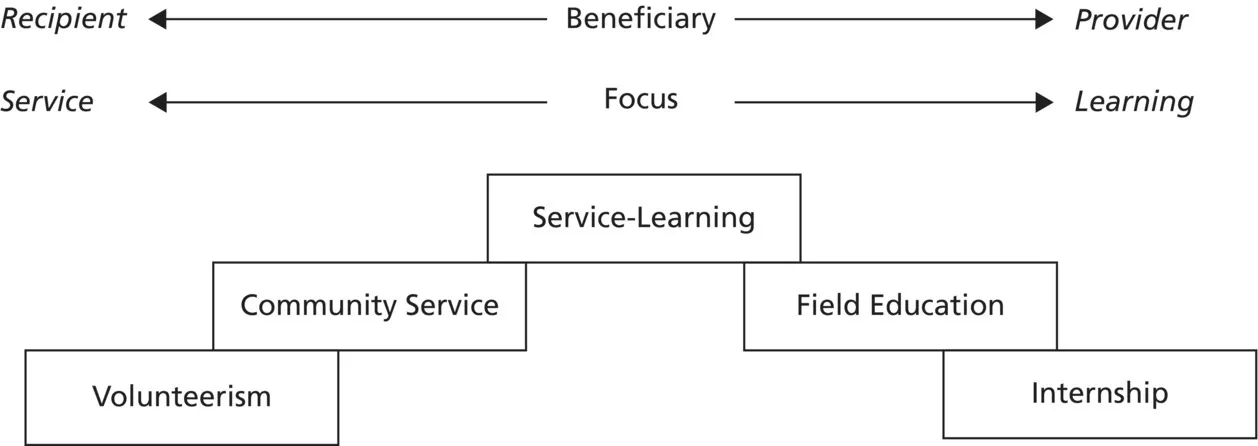
I find it helpful to use Andrew Furco's (1996) often-cited model to highlight the uniqueness of service-learning and how it is distinct from other forms of community-based work and experiential learning. Furco characterizes each program type by its intended benefit and its degree of focus on learning and service.
Figure 1.1. Distinctions Among Service Programs
Source: Furco, 1996, p. 3. Used by permission.
Volunteerism and community service, on the left side of the model, focus on and are intended to benefit the individual, organization, or community served. Volunteerism, on the bottom rung of the model, is a form of charity. It is about providing service, with no intentional link to reflection or learning. While volunteer activities can be ongoing, they often occur on a one-time or sporadic basis. Many service-learning advocates view volunteerism as a one-way, rather paternalistic kind of “feel good” concept that infers the perpetuation of the status quo and dependency.
Moving up a rung, community service programs engage students in activities designed to meet human and community needs. Such programs may be more structured and more sustained than volunteering, thus providing greater benefits to the recipients of the service. Community service does not necessarily include reflection and may lack academic credibility. In addition, the term often refers to a court-imposed sanction.
On the right side of the model, the primary intended beneficiary of internships and fieldwork is the provider, or student, and the main focus is on learning. Internships are experiences in which students engage to learn more about their area of study and to gain practical experience in a potential career field. They may or may not be connected to academic courses or involve reflection. Field work, or field education, is generally connected to the curriculum, often in one of the professions, such as teaching, social services, health, or law. While field work provides benefits to the recipients of the students' service, the focus of field work is on enhancing students' learning in their field of study. Reflection may be part of the experience. Both internships and field work may address human and community needs, but they do not necessarily do so.
Located in the center of the model, service-learning intentionally seeks to strike a balance between student learning and community outcomes. One of the foundational principles of service-learning is “Service, combined with learning, adds value to each and transforms both” (Porter-Honnet & Poulsen, 1990, p. 40). Service-learning is based on the assumption that learning does not necessarily occur as a result of experience itself, but rather as a result of reflection designed to achieve specific learning outcomes. In this sense, service-learning expands on the concepts of community service and volunteerism (Furco, 1996).
In service-learning, opportunities for learning and reflection are integrated into the structure of the program or course. Service-learning is explicitly designed to promote learning about the historical, sociological, cultural, economic, and political contexts that underlie the needs or issues the students address. Different programs or courses emphasize different types and combinations of learning goals: intellectual, social, civic, ethical, moral, spiritual, intercultural, career, or personal. Additional learning outcomes can include, but are certainly not limited to, deepening understanding of academic content, applying theory to practice, increasing awareness of the strengths and limitations of using a discipline's knowledge base to address social issues, understanding human difference and commonality, exploring options for future individual and collective action to solve community problems, and developing a wide range of practical skills.
The other key element of service-learning is reciprocity. Reciprocity means that we, as service-learning educators, relate to the community in the spirit of partnership, viewing the institution and the community in terms of both assets and needs. Participants in reciprocal service-learning relationships seek to avoid what Thea Hillman refers to as the “provider-recipient split” that is all too clear in volunteerism and community service (1999, p.123). Robert Sigmon, one of the early leaders of service-learning, emphasized that “each participant is server and served, care giver and care acquirer, contributor and contributed to. Learning and teaching in a service-learning arrangement is also a task for each of the partners in the relationship … each of the parties views the other as contributor and beneficiary” (1996, p. 4). Reciprocity implies that the community is not a learning laboratory and that service-learning should be designed with the community to meet needs identified by the community. Service-learning activities can take place at or away from the community site and may or may not engage students in interacting with community organization leaders or clients.
The terms and concepts of service-learning and civic engagement are often confounded. Civic engagement is the broader term and can be defined as acting upon a heightened sense of responsibility to one's communities through both political and non-political means (Jacoby, 2009a). It is often described as active citizenship or democratic participation. Civic engagement thus comprises a wider range of activities than has traditionally been associated with service-learning, such as enacting ways to alter public policy, ranging from petitioning to protest and engaging at various levels in the political process. I have often been asked whether the terms service-learning and civic engagement are interchangeable and whether civic engagement is the new term for service-learning. Some of the confusion regarding terminology arises because both service-learning and civic engagement share the desired outcomes of addressing the root causes of the issues that underlie the need for service as well as motivating students to engage in future civic and political action. Further, Peter Levine, the director of the Center for Research and Information on Civic Learning and Engagement, muses that civic engagement's lack of definition may to some extent account for its current popularity: “It is a Rorschach blot within which anyone can find her own priorities” (2007, p. 1).
Another confounding definitional issue is that the term service-learning is used to name it as a program, a pedagogy, and a philosophy. As a program, service-learning is an initiative or set of initiatives that provides opportunities for students to accomplish tasks that meet human and community needs in combination with reflection structured to achieve desired learning outcomes. In curricular programs, service-learning can enable students to achieve discipline-based outcomes or general learning goals, such as critical thinking, information literacy, and collaborative problem solving. Cocurricular programs may have different goals, such as leadership, spirituality, or intercultural competency.
As a pedagogy, service-learning is education that is grounded in experience as a basis for learning and on the centrality of critical reflection intentionally designed to enable learning to occur. As discussed in 4.1, faculty members select service experiences, as they would select texts or other learning activities, that they believe will be most effective in enabling students to learn and apply course content. Reflection in service-learning stimulates learners to integrate experience and observations with existing knowledge, to examine theory in practice, and to analyze and question their a priori assumptions and beliefs.
Service-learning is also a philosophy of “human growth and purpose, a social vision, an approach to community, and a way of knowing” (Kendall, 1990, p. 23). It is a philosophy of reciprocity, which is based on moving from charity to justice, from service to the elimination of need. Service-learning as philosophy is “an expression of values—service to others, community development and empowerment, reciprocal learning—which determines the purpose, nature, and process of social and educational exchange between learners (students) and the people they serve” (Stanton, 1990, p. 67).
Sources of additional information
Campus Compact. (2003). Definitions and principles. Introduction to Service-Learning Toolkit: Readings and Resources for Faculty (2nd ed.). Providence, RI: Campus Compact.
Ikeda, E.K., Sandy, M.G., & Donahue, D.M. (2010). Navigating the sea of definitions. In B. Jacoby & P. Mutascio (Eds.), Looking In Reaching Out: A Reflective Guide for Community Service-Learning Professionals. Boston, MA: Campus Compact.
Kendall, J.C. (Ed.). (1990). Combining Service and Learning: A Resource Book for Community and Public Service (Vol. 1). Raleigh, NC: National Society for Internships and Experiential Education (now National Society for Experiential Education).
1.2 What are the theoretical foundations of service-learning?
Most service-learning scholars believe that the theoretical roots of service-learning are found in the work of John Dewey, particularly Democracy and Education (1916), How We Think (1933), and Experience and Education (1938). Often viewed as the father of experiential education, Dewey sought to understand how experiences can be educative. He observed: “The belief that all genuine education comes about through experience does not mean that all experiences are genuinely or equally educative. Experience and education cannot be directly equated to each other. For some experiences are mis-educative” (1938, p. 25). Learning for Dewey was situational, and he proposed that learning from experience occurs through reflective thinking. Based on Dewey's proposition, reflection has become one of the core el...
Table of contents
Cover
Series page
Title page
Copyright page
Figures and Exhibits
Dedication
Foreword
Preface
Acknowledgments
About the Author
About Campus Compact
Chapter 1: Introduction to Service-Learning
Chapter 2: Understanding and Facilitating Critical Reflection
Chapter 3: Developing and Sustaining Campus-Community Partnerships for Service-Learning
Chapter 4: Integrating Service-Learning into the Curriculum
Chapter 5: Designing and Implementing Cocurricular Service-Learning
Chapter 6: Assessment of Service-Learning
Chapter 7: Administration of Service-Learning
Chapter 8: Facing the Complexities and Dilemmas of Service-Learning
Chapter 9: Securing the Future of Service-Learning in Higher Education
References
Index
End User License Agreement
Trusted by 375,005 students
Access to over 1.5 million titles for a fair monthly price.
Study more efficiently using our study tools.
Frequently asked questions
Yes, you can cancel anytime from the Subscription tab in your account settings on the Perlego website. Your subscription will stay active until the end of your current billing period. Learn how to cancel your subscription
No, books cannot be downloaded as external files, such as PDFs, for use outside of Perlego. However, you can download books within the Perlego app for offline reading on mobile or tablet. Learn how to download books offline
Perlego offers two plans: Essential and Complete
Essential is ideal for learners and professionals who enjoy exploring a wide range of subjects. Access the Essential Library with 800,000+ trusted titles and best-sellers across business, personal growth, and the humanities. Includes unlimited reading time and Standard Read Aloud voice.
Complete: Perfect for advanced learners and researchers needing full, unrestricted access. Unlock 1.5M+ books across hundreds of subjects, including academic and specialized titles. The Complete Plan also includes advanced features like Premium Read Aloud and Research Assistant.
Both plans are available with monthly, semester, or annual billing cycles.
We are an online textbook subscription service, where you can get access to an entire online library for less than the price of a single book per month. With over 1.5 million books across 990+ topics, we’ve got you covered! Learn about our mission
Look out for the read-aloud symbol on your next book to see if you can listen to it. The read-aloud tool reads text aloud for you, highlighting the text as it is being read. You can pause it, speed it up and slow it down. Learn more about Read Aloud
Yes! You can use the Perlego app on both iOS and Android devices to read anytime, anywhere — even offline. Perfect for commutes or when you’re on the go. Please note we cannot support devices running on iOS 13 and Android 7 or earlier. Learn more about using the app
Yes, you can access Service-Learning Essentials by Barbara Jacoby in PDF and/or ePUB format, as well as other popular books in Education & Higher Education. We have over 1.5 million books available in our catalogue for you to explore.