Evolutionary Computation in Gene Regulatory Network Research
eBook - ePub

Evolutionary Computation in Gene Regulatory Network Research

  1. English
  2. ePUB (mobile friendly)
  3. Available on iOS & Android
eBook - ePub

Evolutionary Computation in Gene Regulatory Network Research

About this book

Introducing a handbook for gene regulatory network research using evolutionary computation, with applications for computer scientists, computational and system biologists

This book is a step-by-step guideline for research in gene regulatory networks (GRN) using evolutionary computation (EC). The book is organized into four parts that deliver materials in a way equally attractive for a reader with training in computation or biology. Each of these sections, authored by well-known researchers and experienced practitioners, provides the relevant materials for the interested readers. The first part of this book contains an introductory background to the field. The second part presents the EC approaches for analysis and reconstruction of GRN from gene expression data. The third part of this book covers the contemporary advancements in the automatic construction of gene regulatory and reaction networks and gives direction and guidelines for future research. Finally, the last part of this book focuses on applications of GRNs with EC in other fields, such as design, engineering and robotics.

• Provides a reference for current and future research in gene regulatory networks (GRN) using evolutionary computation (EC)

• Covers sub-domains of GRN research using EC, such as expression profile analysis, reverse engineering, GRN evolution, applications

• Contains useful contents for courses in gene regulatory networks, systems biology, computational biology, and synthetic biology

• Delivers state-of-the-art research in genetic algorithms, genetic programming, and swarm intelligence

Evolutionary Computation in Gene Regulatory Network Research is a reference for researchers and professionals in computer science, systems biology, and bioinformatics, as well as upper undergraduate, graduate, and postgraduate students.

Hitoshi Iba is a Professor in the Department of Information and Communication Engineering, Graduate School of Information Science and Technology, at the University of Tokyo, Toyko, Japan. He is an Associate Editor of the IEEE Transactions on Evolutionary Computation and the journal of Genetic Programming and Evolvable Machines. Nasimul Noman is a lecturer in the School of Electrical Engineering and Computer Science at the University of Newcastle, NSW, Australia. From 2002 to 2012 he was a faculty member at the University of Dhaka, Bangladesh. Noman is an Editor of the BioMed Research International journal. His research interests include computational biology, synthetic biology, and bioinformatics.
Frequently asked questions

Yes, you can cancel anytime from the Subscription tab in your account settings on the Perlego website. Your subscription will stay active until the end of your current billing period. Learn how to cancel your subscription.
No, books cannot be downloaded as external files, such as PDFs, for use outside of Perlego. However, you can download books within the Perlego app for offline reading on mobile or tablet. Learn more here.
Perlego offers two plans: Essential and Complete
  • Essential is ideal for learners and professionals who enjoy exploring a wide range of subjects. Access the Essential Library with 800,000+ trusted titles and best-sellers across business, personal growth, and the humanities. Includes unlimited reading time and Standard Read Aloud voice.
  • Complete: Perfect for advanced learners and researchers needing full, unrestricted access. Unlock 1.4M+ books across hundreds of subjects, including academic and specialized titles. The Complete Plan also includes advanced features like Premium Read Aloud and Research Assistant.
Both plans are available with monthly, semester, or annual billing cycles.
We are an online textbook subscription service, where you can get access to an entire online library for less than the price of a single book per month. With over 1 million books across 1000+ topics, we’ve got you covered! Learn more here.
Look out for the read-aloud symbol on your next book to see if you can listen to it. The read-aloud tool reads text aloud for you, highlighting the text as it is being read. You can pause it, speed it up and slow it down. Learn more here.
Yes! You can use the Perlego app on both iOS or Android devices to read anytime, anywhere — even offline. Perfect for commutes or when you’re on the go.
Please note we cannot support devices running on iOS 13 and Android 7 or earlier. Learn more about using the app.
Yes, you can access Evolutionary Computation in Gene Regulatory Network Research by Hitoshi Iba,Nasimul Noman, Yi Pan,Albert Y. Zomaya in PDF and/or ePUB format, as well as other popular books in Computer Science & Bioinformatics. We have over one million books available in our catalogue for you to explore.

Information

Publisher
Wiley
Year
2016
Print ISBN
9781118911518
eBook ISBN
9781119079781

II
EAs FOR GENE EXPRESSION DATA ANALYSIS AND GRN RECONSTRUCTION

CHAPTER 4
BICLUSTERING ANALYSIS OF GENE EXPRESSION DATA USING EVOLUTIONARY ALGORITHMS

Alan Wee-Chung Liew
School of Information and Communication Technology,
Griffith University, Queensland, Australia

4.1 INTRODUCTION

The major goal of systems biology is to reveal how genes and their products interact to regulate cellular process. To achieve this goal, it is necessary to reconstruct gene regulatory networks, which help us to understand the working mechanisms of the cell. To infer the gene regulatory networks, one often looks at how groups of genes are co-expressed under certain conditions and how they regulate each other. This requires the use of high-throughput technologies such as whole genome expression profiling.
DNA microarray technologies allow us to have an insight into cellular process by simultaneously measuring expression levels of thousands of genes under various conditions. In a typical gene expression matrix, the rows describe genes and the columns describe conditions of the experiments. In DNA microarray experiments, discovering groups of genes that share similar transcriptional characteristics is instrumental in functional annotation, tissue classification, motif identification, and gene regulation [1, 2, 3]. Cluster analysis can help elucidate the regulation (or co-regulation) of individual genes, and therefore has been an important tool in gene regulation network study and network reconstruction [3]. However, in many situations, an interesting cellular process is active only under a subset of conditions, or a single gene may participate in multiple pathways that may or may not be co-active under all conditions [4, 5]. In addition, the data to be analyzed often include many heterogeneous conditions from many experiments. In these instances, it is often unrealistic or even undesirable to require that related genes behave similarly across all conditions. Conventional clustering algorithms, such as k-means, hierarchical clustering (HC), and self-organizing maps [6, 7, 8], often cannot produce satisfactory solution.
Image described by surrounding text.
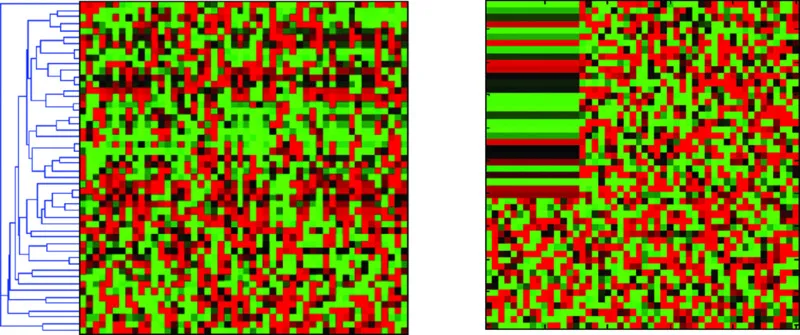
Figure 4.1 An illustrative example where conventional clustering fails but biclustering works. (a) A data matrix, which appears random visually even after hierarchical clustering. (b) A hidden pattern embedded in the data would be uncovered if we permute the rows or columns appropriately [15].
Figure 4.1 illustrates the importance of only grouping the right subset of conditions in clustering. In Figure 4.1a, we see a data matrix clustered using the HC algorithm, where no coherent pattern can be observed by the naked eyes. However, Figure 4.1b indicated that an interesting pattern actually exists within the data if we rearrange the data appropriately. The hidden pattern in Figure 4.1b is called a bicluster, and it shows clearly that only a subset of conditions is relevant in defining this bicluster.
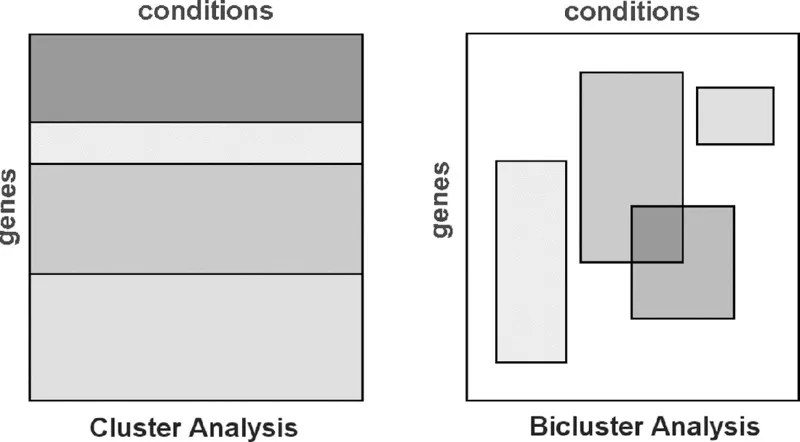
By relaxing the constraint that related genes must behave similarly across the entire set of conditions, “localized” groupings can be uncovered readily. Biclustering allows us to consider only a subset of conditions when looking for similarity between genes. The goal of biclustering is to find submatrices in the dataset, that is, subsets of conditions and subsets of genes, where the subset of conditions exhibits significant homogeneity according to some specific criteria within the subset of genes. Figure 4.2 shows graphically the fundamental difference between clustering and biclustering. Unlike clusters in row-wise or column-wise clustering, biclusters can overlap. In principle, the subsets of conditions for various biclusters can be different. Two biclusters can share some common genes and conditions, and some genes may not belong to any bicluster at all. Since bicluster analysis better reflects the regulatory relationships underlying a cellular process, it has been actively studied for the inference of gene regulatory networks [9].
Two blocks on left, right for Cluster, Bicluster analysis has genes on left side, conditions on top. Left divided into four horizontal portions. Right has four subsets, one intersect.
Figure 4.2 Conceptual difference between (a) cluster analysis and (b) bicluster analysis, where biclusters correspond to arbitrary subsets of rows and columns.
Biclustering is a very challenging problem computationally. It is an NP hard problem [10]. A bicluster can also have complex coherent patterns. F...

Table of contents

  1. Cover
  2. Series
  3. Title page
  4. Copyright
  5. PREFACE
  6. ACKNOWLEDGMENTS
  7. CONTRIBUTORS
  8. I PRELIMINARIES
  9. II EAs FOR GENE EXPRESSION DATA ANALYSIS AND GRN RECONSTRUCTION
  10. III EAs FOR EVOLVING GRNs AND REACTION NETWORKS
  11. IV APPLICATION OF GRN WITH EAs
  12. INDEX
  13. SERIES
  14. EULA