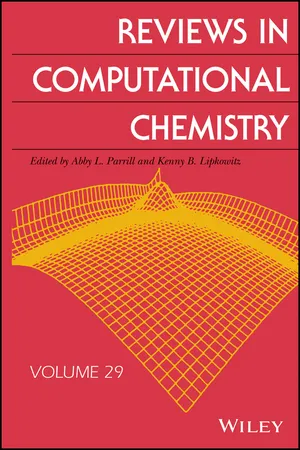
The Reviews in Computational Chemistry series brings together leading authorities in the field to teach the newcomer and update the expert on topics centered on molecular modeling, such as computer-assisted molecular design (CAMD), quantum chemistry, molecular mechanics and dynamics, and quantitative structure-activity relationships (QSAR). This volume, like those prior to it, features chapters by experts in various fields of computational chemistry. Topics in Volume 29 include:
Noncovalent Interactions in Density-Functional Theory
Long-Range Inter-Particle Interactions: Insights from Molecular Quantum Electrodynamics (QED) Theory
Efficient Transition-State Modeling using Molecular Mechanics Force Fields for the Everyday Chemist
Machine Learning in Materials Science: Recent Progress and Emerging Applications
Discovering New Materials via a priori Crystal Structure Prediction
Introduction to Maximally Localized Wannier Functions
Methods for a Rapid and Automated Description of Proteins: Protein Structure, Protein Similarity, and Protein Folding
1 NONCOVALENT INTERACTIONS IN DENSITY FUNCTIONAL THEORY
Gino A. DiLabio1,2 and Alberto Otero-de-la-Roza2
1 Department of Chemistry, University of British Columbia, Okanagan Campus, Kelowna, British Columbia, Canada
2 National Institute for Nanotechnology, National Research Council of Canada, Edmonton, Alberta, Canada
INTRODUCTION
Density functional theory1–10 (DFT) is arguably the most successful approach to the calculation of the electronic structure of matter. The success of the theory is largely based on the fact that many DFT approximations can predict properties such as thermochemistry, kinetic parameters, spectroscopic constants, and others with accuracy rivaling that obtained by high-level ab initio wavefunction theory methods in terms of agreement with experimental quantities. The computational cost of DFT scales formally as N3, where N is the number of electrons in the system, as compared to the N5–N7 scaling (or even higher) of correlated wavefunction methods, indicating that DFT can be applied to much larger systems than wavefunction methods and to the same systems at a much lower computational cost. Furthermore, DFT can be applied to molecular systems using atom-centered basis sets and to molecular and solid-state systems through periodic plane wave approaches, thus allowing for the prediction of the properties of molecular and condensed matter systems on the same theoretical footing.
Despite their broad success in predicting many chemical and physical properties, conventional11 density functional approximations have well-known shortcomings.12–14 In recent years, a great deal of attention has been paid to the inability of conventional DFT methods to predict dispersion interactions accurately. This particular failing of DFT was first illustrated in the 1990s.15–21 An early work by Kristyán and Pulay16 demonstrated that the local density approximation of DFT significantly overbinds the noble gas dimers He2, Ne2, and Ar2, while “improved” DFT methods based on generalized gradient approximations significantly underbind or predict their interactions to be completely repulsive. This work serves as one of the early descriptions of the “dispersion problem” of DFT that underpinned two decades of effort to understand and correct DFT in this capacity.
The absence of explicit dispersion physics in common approximations to DFT naturally focused the attention of researchers on this problem. Current understanding among some members of the DFT community is that, of the van der Waals forces in general, only dispersion is poorly treated. The prevailing opinion is that DFT can treat electrostatics and other effects accurately.5,22 Considering the percent errors in the binding energies of noncovalently interacting dimers predicted by various DFT methods, as shown in Figure 1, this view may seem justified. The figure indicates that DFT methods tend to offer poor predictions of binding energies in predominantly dispersion-bound systems but work well for hydrogen-bonded systems. But is this true?
Figure 1 Mean absolute percent errors in the predicted binding energies of noncovalently interacting dimers using various DFT methods for different types on interactions.
The data and plot style in our Figure 1 was adapted from Figure 2 in Ref. 23.
Applying the very popular B3LYP method to a set of 23 predominantly dispersion-bound dimers yields a mean error of 5.1 kcal/mol, which supports the notion that approximate DFT methods underbinds in the case of dispersion. However, for a set of 23 dimers in which hydrogen bonding is the dominant interaction, B3LYP underbinds by an average of 1.7 kcal/mol, an error that is large enough to contradict the notion that hydrogen bonding is well treated by DFT methods. Some of the 1.7 kcal/mol error in binding may come from the absence of dispersion in B3LYP, but this, as we shall see, is likely not the only deficiency.
The shortcomings of B3LYP are not unique, a...
Table of contents
Cover
Title Page
Table of Contents
CONTRIBUTORS
PREFACE
CONTRIBUTORS TO PREVIOUS VOLUMES
1 NONCOVALENT INTERACTIONS IN DENSITY FUNCTIONAL THEORY
2 LONG-RANGE INTERPARTICLE INTERACTIONS
3 EFFICIENT TRANSITION STATE MODELING USING MOLECULAR MECHANICS FORCE FIELDS FOR THE EVERYDAY CHEMIST
4 MACHINE LEARNING IN MATERIALS SCIENCE
5 DISCOVERING NEW MATERIALS VIA A PRIORI CRYSTAL STRUCTURE PREDICTION
6 INTRODUCTION TO MAXIMALLY LOCALIZED WANNIER FUNCTIONS
7 METHODS FOR A RAPID AND AUTOMATED DESCRIPTION OF PROTEINS
INDEX
End User License Agreement
Trusted by 375,005 students
Access to over 1.5 million titles for a fair monthly price.
Study more efficiently using our study tools.
Frequently asked questions
Yes, you can cancel anytime from the Subscription tab in your account settings on the Perlego website. Your subscription will stay active until the end of your current billing period. Learn how to cancel your subscription
No, books cannot be downloaded as external files, such as PDFs, for use outside of Perlego. However, you can download books within the Perlego app for offline reading on mobile or tablet. Learn how to download books offline
Perlego offers two plans: Essential and Complete
Essential is ideal for learners and professionals who enjoy exploring a wide range of subjects. Access the Essential Library with 800,000+ trusted titles and best-sellers across business, personal growth, and the humanities. Includes unlimited reading time and Standard Read Aloud voice.
Complete: Perfect for advanced learners and researchers needing full, unrestricted access. Unlock 1.5M+ books across hundreds of subjects, including academic and specialized titles. The Complete Plan also includes advanced features like Premium Read Aloud and Research Assistant.
Both plans are available with monthly, semester, or annual billing cycles.
We are an online textbook subscription service, where you can get access to an entire online library for less than the price of a single book per month. With over 1.5 million books across 990+ topics, we’ve got you covered! Learn about our mission
Look out for the read-aloud symbol on your next book to see if you can listen to it. The read-aloud tool reads text aloud for you, highlighting the text as it is being read. You can pause it, speed it up and slow it down. Learn more about Read Aloud
Yes! You can use the Perlego app on both iOS and Android devices to read anytime, anywhere — even offline. Perfect for commutes or when you’re on the go. Please note we cannot support devices running on iOS 13 and Android 7 or earlier. Learn more about using the app
Yes, you can access Reviews in Computational Chemistry, Volume 29 by Abby L. Parrill, Kenny B. Lipkowitz, Abby L. Parrill,Kenny B. Lipkowitz in PDF and/or ePUB format, as well as other popular books in Physical Sciences & Physical & Theoretical Chemistry. We have over 1.5 million books available in our catalogue for you to explore.