An interdisciplinary framework for managing sustainable agrifood supply chains
Supply Chain Management for Sustainable Food Networks provides an up-to-date and interdisciplinary framework for designing and operating sustainable supply chains for agri-food products. Focus is given to decision-making procedures and methodologies enabling policy-makers, managers and practitioners to design and manage effectively sustainable agrifood supply chain networks. Authored by high profile researchers with global expertise in designing and operating sustainable supply chains in the agri-food industry, this book:
Features the entire hierarchical decision-making process for managing sustainable agrifood supply chains.
Covers knowledge-based farming, management of agricultural wastes, sustainability, green supply chain network design, safety, security and traceability, IT in agrifood supply chains, carbon footprint management, quality management, risk management and policy- making.
Explores green supply chain management, sustainable knowledge-based farming, corporate social responsibility, environmental management and emerging trends in agri-food retail supply chain operations.
Examines sustainable practices that are unique for agriculture as well as practices that already have been implemented in other industrial sectors such as green logistics and Corporate Social Responsibility (CSR).
Supply Chain Management for Sustainable Food Networks provides a useful resource for researchers, practitioners, policy-makers, regulators and C-level executives that deal with strategic decision-making. Post-graduate students in the field of agriculture sciences, engineering, operations management, logistics and supply chain management will also benefit from this book.
Eleftherios Iakovou,1 Dionysis Bochtis,2 Dimitrios Vlachos,1 and Dimitrios Aidonis3
1Laboratory of Quantitative Analysis, Logistics and Supply Chain Management, Department of Mechanical Engineering, Aristotle University of Thessaloniki, Thessaloniki, Greece
The agrifood sector is one of the most regulated and protected sectors worldwide, with major implications for sustainability such as the fulfillment of human needs, the support of employment and economic prosperity, the environmental impact, the tackling of poverty, and the creation of new markets (Humphrey and Memedovic, 2006). Indicatively, the European Commission (EC) is promoting significant reforms to its Common Agricultural Policy (CAP) in order to respond to the plethora of internationally emerging agrifood supply challenges (EC, 2010; Scheherazade, 2014). Growing environmental, social as well as ethical concerns, and increased awareness of the impact of food production and consumption on the natural environment have led to increased pressures by consumer organizations, policy-makers, and environmental advocacy groups on agrifood companies to manage social and environmental issues across their supply chains (SCs) from “farm-to-the-fork” and along products’ life cycles (Courville, 2003; Weatherell and Allinson, 2003; Ilbery and Maye, 2005; Maloni and Brown, 2006; Vachon and Klassen, 2006; Welford and Frost, 2006; Matos and Hall, 2007; Grimm, Hofstetter, and Sarkis, 2014).
In this context, designing appropriate effective global strategies for handling agrifood products to fulfill consumers’ demand, while responding to ever-increasing changes of lifestyle and dietary preferences, has become quite a complex and challenging task. Specifically, adverse weather conditions, volatile global food demand, alternative uses of agricultural production and fluctuating commodities’ prices have led to a volatile supply of agricultural products that is expected to exceed its capacity limit in the forthcoming years. To that effect, developed countries have been increasing their agricultural production in agrifood supply chain (AFSC) operations in order to respond to the projected rise of 70% on global food demand by 2050 (FAO, 2006, 2009; Nelson et al., 2010). At the same time, the value of family farms and the development of local food SCs is clearly recognized for both the developing and developed countries (FAO, 2014).
One of the most critical bottlenecks in agrifood production and distribution is the complexity and cost-efficiency of the relevant SC operations. Modern, global agrifood networks require multi-tier supply chain management (SCM) approaches due to the increased flows of goods, processes, and information both upstream and downstream the value chain. These increased requirements are related to the modern, emerging model of agrifood retailers (i.e., grocery retailers, fast-food and catering services’ providers, etc.), the need for vertical and horizontal integration along the AFSCs, the plethora of differentiated product offerings, the market segmentation, the dominance of multinational enterprises in the food processing and retailing sectors, the need for limiting food waste and overexploitation of natural resources, as well as the branding of firms (van Roekel et al., 2002; Chen, Chen, and Shi, 2003; Mena et al., 2014).
Furthermore, SCM has been recognized as a key concept for the agrifood industry competitiveness. The rapid industrialization of agricultural production, the oligopoly in the food distribution sector, the advancement of Information and Communication Technologies (ICT) in logistics, customer concerns, and a divergence of governmental food safety regulations, the establishment of specialized food quality requirements, the emergence of modern food retailer forms, the increasing importance of vertical integration and horizontal alliances, as well as the emergence of a large number of multinational corporations, are just a few of the real-world challenges that have led to the adoption of SCM in the agrifood sector (Chen, 2006). To this end, SCM embraces the challenge to develop and deploy efficient value chains tailored to the specifications of the modern, uncertain environment, subject to the constraints of local and cross-regional conditions, with respect to logistics means and infrastructure, access to land and water resources, allocation of harvesting areas and the various processing and storing facilities, innovative and sustainable good-practice methods, regulatory and techno-economic environments, and rapid changes of food market characteristics.
In order to develop competitive and sustainable AFSCs, there are a few critical issues that have to be first recognized:
the unique attributes of AFSCs that differentiate them from other SC networks;
the decisions that should be made on the strategic, operational, and tactical levels;
the necessary policies to ensure sustainability of the agrifood chains; and
the appropriate innovative interventions, which are required to foster major advances and competitiveness within the evolving AFSC context.
Therefore, more frequent changes in AFSC designs are necessary and strategic actions should be taken to foster sustainability (Halldorsson, Kotzab, and Skjøtt-Larsen, 2009), and thus to achieve higher efficiency in logistics’ operations performance and resource usage (e.g., Gold, Seuring, and Beske, 2010; Carter and Easton, 2011).
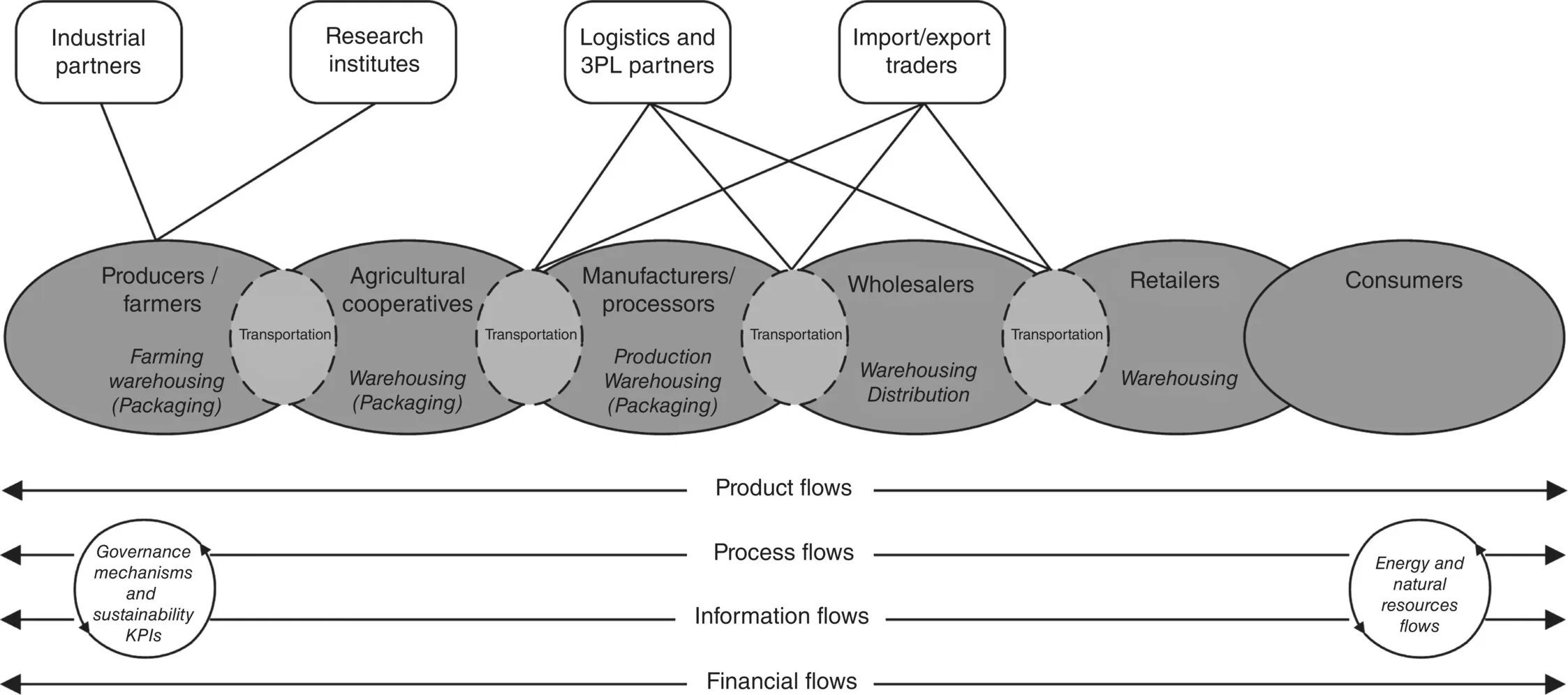
In general, an AFSC is encompassing a set of operations in a “farm-to-the-fork” sequence including farming, processing/production, testing, packaging, warehousing, transportation, distribution, and marketing (Iakovou et al., 2012). These operational echelons have to be harmonized in order to support five flow types, namely:
physical material and product flows;
financial flows;
information flows;
process flows; and
energy and natural resources’ flows.
The aforementioned operations, services, and flows are integrated into a dynamic production–supply–consumption ecosystem of research institutions, industries, producers/farmers, agricultural cooperatives, intermediaries, manufacturers/processors, transporters, traders (exporters/importers), wholesalers, retailers, and consumers (van der Vorst, 2006; Matopoulos et al., 2007; Jaffee, Siegel, and Andrews, 2010). Moreover, the continuous evolution of AFSCs, and the overall complexity of the agrifood environment along with global market trends further highlight the need for integration of individual SCs into a unified AFSC concept. In such a structure, strategic relationships and collaborations among enterprises are dominant, while these organizations are further required to secure their brand identity and autonomy (Van der Vorst, da Silva, and Trienekens, 2007). A conceptual configuration of AFSCs is depicted in Figure 1.1.
Figure 1.1A typical agrifood supply chain.
Adapted from Tsolakis et al., 2014a.
The actors involved in the AFSC system can be generally partitioned into public authorities and private stakeholders. The former category includes mainly national governments and the associated ministries, administrative authorities (regional, district, urban), as well as international organizations (e.g., Food and Agriculture Organization), while the latter encompasses individual farmers/growers, cooperatives, research institutes and innovation centers, chemical industries, agro-industries and processors, food traders, logistics providers, transporters, supermarket chains and food stores, as well as financial institutions (Jaffee, Siegel, and Andrews, 2010). In this context, highly concentrated agro-industrial enterprises and retailers have recently morphed into dominant players in the agrifood fie...
Table of contents
Cover
Title Page
Table of Contents
Notes on contributors
Preface
Acknowledgments
1 Sustainable Agrifood Supply Chain Management
2 Precision Agriculture: Crop Management for Improved Productivity and Reduced Environmental Impact or Improved Sustainability
3 Agricultural Waste Biomass
4 Maintaining Momentum: Drivers of Environmental and Economic Performance, and Impediments to Sustainability
5 A Hierarchical Decision-Making Framework for Quantitative Green Supply Chain Management: A Critical Synthesis of Academic Research Efforts
6 Safety and Traceability
7 Information Technology for Food Supply Chains
8 Carbon Footprint Management for Food Supply Chains: an Integrated Decision Support System
9 Quality Management Schemes and Connections to the Concept of Sustainability in the Food Chain
10 Risk Management for Agri-food Supply Chains
11 Regulatory Policies and Trends
Index
End User License Agreement
Trusted by 375,005 students
Access to over 1.5 million titles for a fair monthly price.
Study more efficiently using our study tools.
Frequently asked questions
Yes, you can cancel anytime from the Subscription tab in your account settings on the Perlego website. Your subscription will stay active until the end of your current billing period. Learn how to cancel your subscription
No, books cannot be downloaded as external files, such as PDFs, for use outside of Perlego. However, you can download books within the Perlego app for offline reading on mobile or tablet. Learn how to download books offline
Perlego offers two plans: Essential and Complete
Essential is ideal for learners and professionals who enjoy exploring a wide range of subjects. Access the Essential Library with 800,000+ trusted titles and best-sellers across business, personal growth, and the humanities. Includes unlimited reading time and Standard Read Aloud voice.
Complete: Perfect for advanced learners and researchers needing full, unrestricted access. Unlock 1.5M+ books across hundreds of subjects, including academic and specialized titles. The Complete Plan also includes advanced features like Premium Read Aloud and Research Assistant.
Both plans are available with monthly, semester, or annual billing cycles.
We are an online textbook subscription service, where you can get access to an entire online library for less than the price of a single book per month. With over 1.5 million books across 990+ topics, we’ve got you covered! Learn about our mission
Look out for the read-aloud symbol on your next book to see if you can listen to it. The read-aloud tool reads text aloud for you, highlighting the text as it is being read. You can pause it, speed it up and slow it down. Learn more about Read Aloud
Yes! You can use the Perlego app on both iOS and Android devices to read anytime, anywhere — even offline. Perfect for commutes or when you’re on the go. Please note we cannot support devices running on iOS 13 and Android 7 or earlier. Learn more about using the app
Yes, you can access Supply Chain Management for Sustainable Food Networks by Eleftherios Iakovou,Dionysis Bochtis,Dimitrios Vlachos,Dimitrios Aidonis in PDF and/or ePUB format, as well as other popular books in Technology & Engineering & Agriculture. We have over 1.5 million books available in our catalogue for you to explore.