Oral Medicine and Pathology at a Glance
  1. English
  2. ePUB (mobile friendly)
  3. Available on iOS & Android
eBook - ePub

About this book

Oral Medicine and Pathology at a Glance, 2nd Edition offers a comprehensive overview of essential aspects of oral medicine and pathology, with an emphasis on oral health care provision in general practice.

  • Updated new edition, covering the most important conditions and commonly encountered oral pathologies and their clinical management
  • Presented in the popular, highly-illustrated At a Glance style with clinical photographs throughout
  • Written by an international author team
  • Includes a companion website with self-assessment MCQs, further reading and downloadable images
Frequently asked questions

Yes, you can cancel anytime from the Subscription tab in your account settings on the Perlego website. Your subscription will stay active until the end of your current billing period. Learn how to cancel your subscription.
At the moment all of our mobile-responsive ePub books are available to download via the app. Most of our PDFs are also available to download and we're working on making the final remaining ones downloadable now. Learn more here.
Perlego offers two plans: Essential and Complete
  • Essential is ideal for learners and professionals who enjoy exploring a wide range of subjects. Access the Essential Library with 800,000+ trusted titles and best-sellers across business, personal growth, and the humanities. Includes unlimited reading time and Standard Read Aloud voice.
  • Complete: Perfect for advanced learners and researchers needing full, unrestricted access. Unlock 1.4M+ books across hundreds of subjects, including academic and specialized titles. The Complete Plan also includes advanced features like Premium Read Aloud and Research Assistant.
Both plans are available with monthly, semester, or annual billing cycles.
We are an online textbook subscription service, where you can get access to an entire online library for less than the price of a single book per month. With over 1 million books across 1000+ topics, we’ve got you covered! Learn more here.
Look out for the read-aloud symbol on your next book to see if you can listen to it. The read-aloud tool reads text aloud for you, highlighting the text as it is being read. You can pause it, speed it up and slow it down. Learn more here.
Yes! You can use the Perlego app on both iOS or Android devices to read anytime, anywhere — even offline. Perfect for commutes or when you’re on the go.
Please note we cannot support devices running on iOS 13 and Android 7 or earlier. Learn more about using the app.
Yes, you can access Oral Medicine and Pathology at a Glance by Pedro Diz Dios,Crispian Scully,Oslei Paes de Almeida,José V. Bagán,Adalberto Mosqueda Taylor in PDF and/or ePUB format, as well as other popular books in Medicine & Oral Health & Surgery. We have over one million books available in our catalogue for you to explore.

Information

Year
2017
Print ISBN
9781119121343
eBook ISBN
9781119121367
Edition
2

1
Examination of extraoral tissues

This book does not include the basics of history taking, only specific relevant points in the text. Bear in mind that the history gives the diagnosis in about 80% of cases.
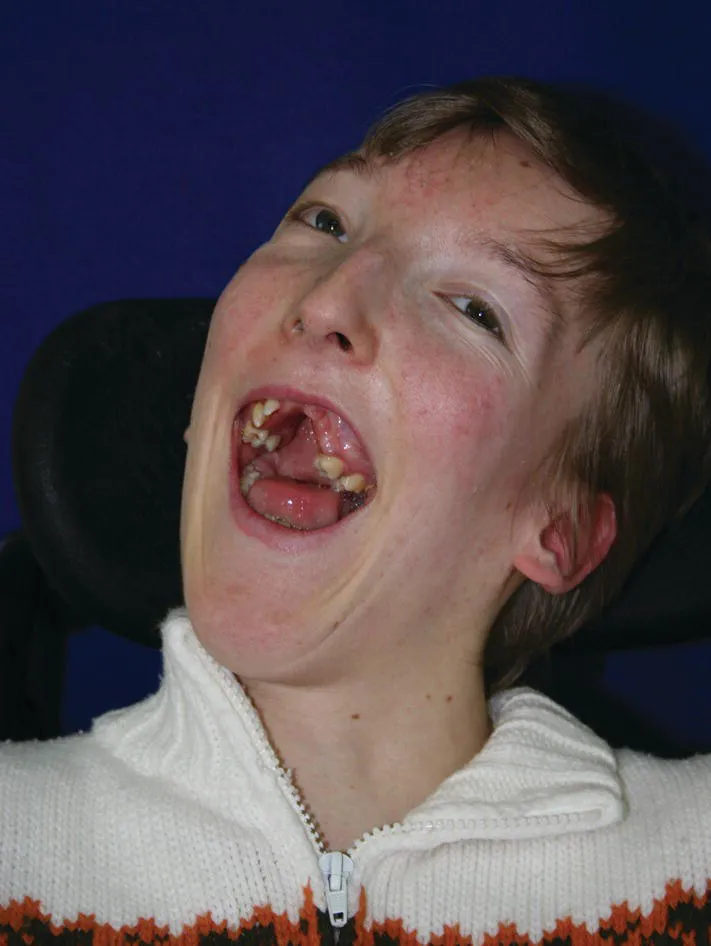
Following the history, during which the clinician will note the patient’s conscious level, any anxiety, appearance, communication, posture, breathing, movements, behavior, sweating, weight loss or wasting (Figure 1.1), physical examination is indicated. This necessitates touching the patient; therefore, informed consent and confidentiality are required, a chaperone available, and religious and cultural aspects should be borne in mind (see Scully and Wilson).
Photo of a child with a cerebral palsy head. His mouth is open, displaying his teeth.
Figure 1.1 Cerebral palsy head.
Relevant medical problems may even be manifest in the fully clothed patient – where changes affect the head and neck, cranial nerves, or limbs. Therefore, while there is no rigid system for examination, the clinician should ensure that these areas are checked.

Head and neck

Pupil size should be noted (e.g. dilated in anxiety or cocaine abuse, constricted in heroin abuse).
Facial color should be noted:
  • pallor (e.g. anemia)
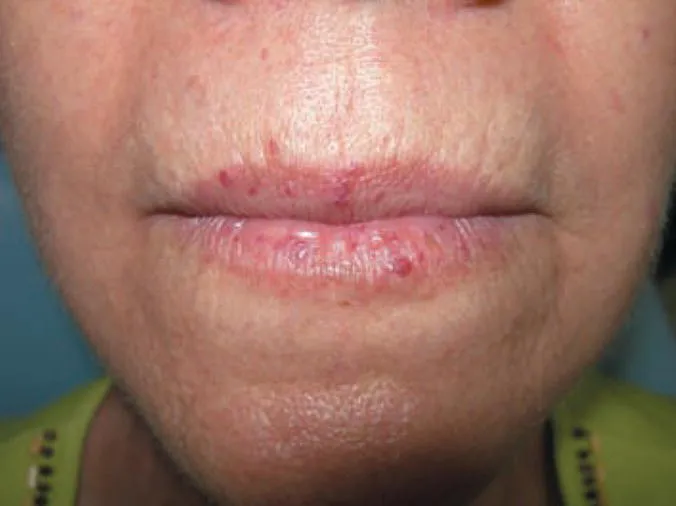
  • rashes (e.g. viral infections, lupus) (Figure 1.2)
  • erythema (e.g. anxiety, alcoholism, polycythemia)
Photo of a patient’s closed lips presenting hereditary hemorrhagic telangiectasia.
Figure 1.2 Hereditary hemorrhagic telangiectasia.
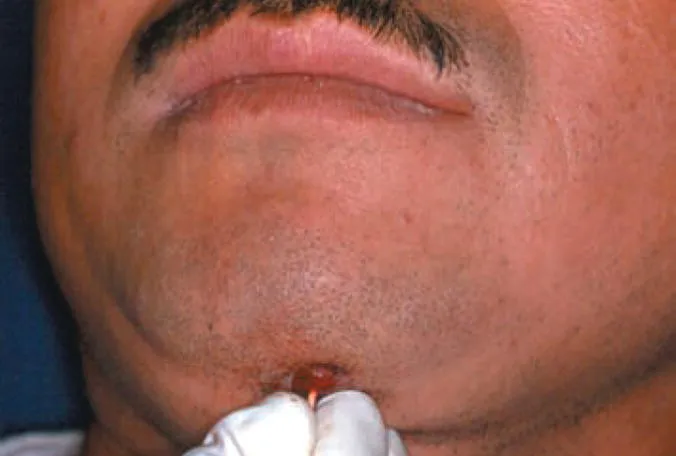
Swellings, sinuses or fistulas should be noted (Figure 1.3).
Photo of a man’s chin with a cutaneous odontogenic fistula.
Figure 1.3 Cutaneous odontogenic fistula.
Facial symmetry is examined for evidence of enlarged masseter muscles (masseteric hypertrophy) suggestive of clenching or bruxism.
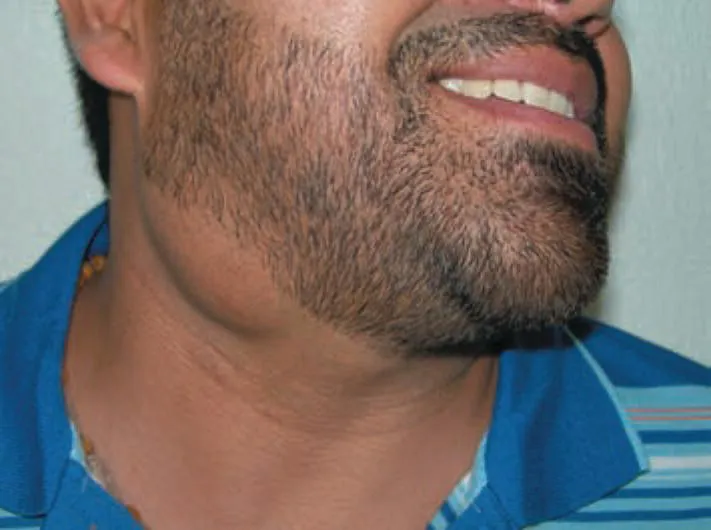
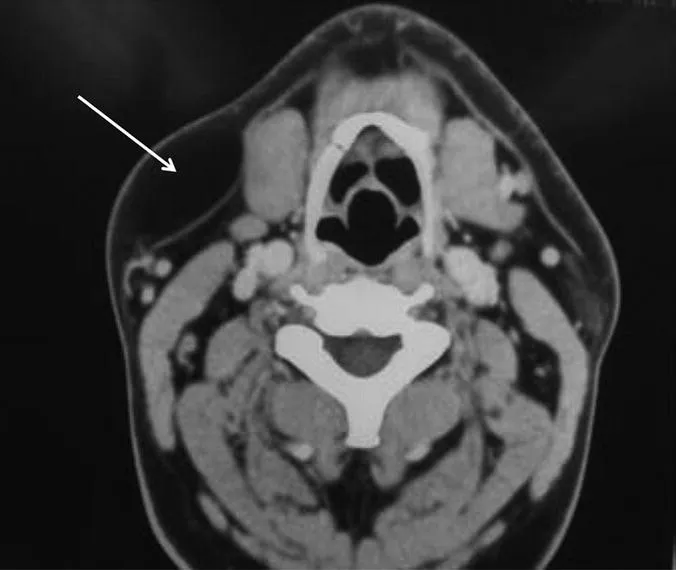
Neck swellings should be elicited, followed by careful palpation of lymph nodes (and salivary and thyroid glands), searching for swelling and/or tenderness, by observing the patient from in front, noting any obvious asymmetry or swelling (Figure 1.4a and b), then standing behind the seated patient to palpate the nodes. Systematically, each region needs to be examined lightly with the pulps of the fingers, trying to roll the nodes against harder underlying structures.
Photo of a bearded man’s neck displaying lipoma, a lump on the neck near the ear.
Figure 1.4a Lipoma.
Image described by caption.
Figure 1.4b Scan of lipoma (arrow on lesion).
Some information can be gained by the texture and nature of the lymphadenopathy; nodes that are tender may be inflammatory (lymphadenitis), while those that are increasing in size and are hard, or fixed to adjacent tissues, may be malignant.

Cranial nerves

The cranial nerves should be examined, in particular facial movement and corneal reflex should be tested and facial sensation determined (Table 1.1). Movement of the mouth as the patient speaks is important, especially when they allow ...

Table of contents

  1. Cover
  2. Title Page
  3. Table of Contents
  4. Preface
  5. About the companion website
  6. 1 Examination of extraoral tissues
  7. 2 Examination of mouth, jaws, temporomandibular region and salivary glands
  8. 3 Investigations: Histopathology
  9. 4 Investigations: Microbiology
  10. 5 Investigations: Imaging
  11. 6 Investigations: Blood tests
  12. 7 Anatomical variants and developmental anomalies
  13. 8 Blisters
  14. 9 Blisters, infections: Herpes simplex virus
  15. 10 Blisters, infections: Varicella zoster virus
  16. 11 Blisters, skin diseases: Pemphigus
  17. 12 Blisters, skin diseases: Pemphigoid
  18. 13 Pigmented lesions
  19. 14 Pigmented lesions: Ethnic pigmentation and tattoos
  20. 15 Pigmented lesions: Melanotic macule
  21. 16 Pigmented lesions: Nevus and others
  22. 17 Pigmented lesions: Malignant melanoma
  23. 18 Red and purple lesions
  24. 19 Red and purple lesions: Desquamative gingivitis, mucositis
  25. 20 Red and purple lesions: Erythematous candidosis
  26. 21 Red and purple lesions: Angiomas
  27. 22 Red and purple lesions: Proliferative vascular lesions, Kaposi sarcoma
  28. 23 Red and purple lesions: Erythroplakia
  29. 24 Red and purple lesions: Erythema migrans (lingual erythema migrans; benign migratory glossitis; geographical tongue; continental tongue)
  30. 25 Swellings: Hereditary conditions, drug-induced swellings
  31. 26 Swellings: Infections, Human Papilloma Virus
  32. 27 Swellings: Granulomatous conditions
  33. 28 Swellings: Reactive lesions
  34. 29 Swellings: Malignant neoplasms, oral squamous cell carcinoma (OSCC)
  35. 30 Swellings: Malignant neoplasms, lymphoma, metastatic neoplasms
  36. 31 Ulcers and erosions: Local causes, drug-induced ulcers
  37. 32 Ulcers and erosions: Aphthae
  38. 33 Ulcers and erosions: Aphthous-like ulcers
  39. 34 Ulcers and erosions: Blood diseases, gastrointestinal disorders
  40. 35 Ulcers and erosions: Infections
  41. 36 Ulcers and erosions: Erythema multiforme, toxic epidermal necrolysis and Stevens-Johnson syndrome
  42. 37 White lesions: Candidosis (candidiasis)
  43. 38 White lesions: Keratosis, leukoplakia
  44. 39 White lesions: Hairy leukoplakia, lichen planus
  45. 40 Salivary conditions: Salivary swelling and salivary excess
  46. 41 Salivary conditions: Dry mouth
  47. 42 Salivary conditions: Sjögren syndrome
  48. 43 Salivary conditions: Sialolithiasis, sialadenitis
  49. 44 Salivary conditions: Neoplasms
  50. 45 Salivary conditions: Mucoceles, sialosis
  51. 46 Neck swelling
  52. 47 Neck swelling: Cervical lymphadenopathy in generalized lymphadenopathy
  53. 48 Neurological conditions: Bell palsy, and trigeminal sensory loss
  54. 49 Neurological conditions and pain: Local, referred and vascular
  55. 50 Neurological conditions and pain: Trigeminal neuralgia
  56. 51 Neurological conditions and pain: Psychogenic (idiopathic facial pain, idiopathic odontalgia, and burning mouth syndrome (oral dysesthesia))
  57. 52 Jaw conditions: Temporomandibular pain-dysfunction
  58. 53 Jaw bone conditions: adiolucencies and radiopacities
  59. 54 Jaw bone conditions: Odontogenic diseases and cysts
  60. 55 Jaw bone conditions: Odontogenic tumors
  61. 56 Jaw conditions: Bone disorders
  62. 57 Jaw bone conditions: Fibro-osseous lesions
  63. 58 Maxillary sinus conditions
  64. 59 Oral malodor
  65. 60 Human immunodeficiency virus (HIV) infection and AIDS
  66. Index
  67. End User License Agreement