Crop protection continues to be an important component of modern farming to maintain food production to feed an expanding human population, but considerable changes have occurred in the regulation of pesticides in Europe in the last decade. The aim has been to reduce their impact on people and the environment. This has resulted in a major reduction in the number of chemicals approved for application on crops. In other parts of the world, a continuing expansion in the growing of genetically modified crops has also changed the pattern of pesticide use.
In this second edition, Graham Matthews, updates how pesticides are registered and applied and the techniques used to mitigate their effects in the environment. Information on operator safety, protection of workers in crops treated with pesticides and spray drift affecting those who live in farming areas is also discussed.
By bringing together the most recent research on pesticides in a single volume, this book provides a vital up to date resource for agricultural scientists, agronomists, plant scientists, plant pathologists, entomologists, environmental scientists, public health personnel, toxicologists and others working in the agrochemical industry and governments. It should assist development of improvements in harmonising regulation of pesticides in countries with limited resources for registration of pesticides.
- English
- ePUB (mobile friendly)
- Available on iOS & Android
eBook - ePub
About this book
Information
1
Pesticides and agricultural development
Agriculture is now confronted with considerable pressure to increase production to feed a higher human population, expected to rise to 9 billion by 2050. In the Green Revolution of the late twentieth century, yields were increased by growing new crop varieties with more fertilizer and protected using pesticides. Growing concerns about the extensive use of pesticides has led to a policy, especially within Europe, of using pesticides only as a last resort in integrated pest management (IPM) programmes. IPM has been adopted initially in protected environments in which biocontrol and other non-chemical techniques have been effective on high-value fresh fruit and vegetable crops. This has to some extent been driven by consumers and supermarkets wanting produce without pesticide residues. In arable crops, the initial use of IPM has been with using economic thresholds to determine when to spray and promoting some biological control by management of field margins.
At present, farmers continue to regard pesticides as an essential tool to ensure that they can maintain production of crops of quality and quantity. Prior to the development of the modern pesticide industry, farmers had to rely very much on crop rotations and mechanical weed control with hoes, hoping for a good dry spell of weather so that the weeds dried and were not merely moved. They also hoped that insect pests and disease control could be ameliorated by choosing a good crop variety, which had some resistance to pest damage. When reconciling pesticide reduction with economic and environmental sustainability in arable farming in France, Lechenet et al. (2014) failed to detect any positive correlation between pesticide use intensity and both productivity (when organic farms were excluded) and profitability. This is not surprising as pesticides protect a crop from yield loss and do not increase the ‘potential’ yields, determined by soil fertility, rainfall and choice of crop variety.
Global estimates of crop losses due to insect pests, diseases caused by various pathogens and competition from weeds, vary depending on the crops involved and local variations in pest severity, but losses from 26 to 40% for major crops, with weeds causing the highest potential loss are reported (Oerke and Dehne, 2004). Some consumers have expressed a desire for ‘organic’ produce, but these usually are marketed at a higher price as farmers get lower yields and poorer quality without adequate crop protection. IPM has made considerable progress, especially within protected crops in which emphasis is given to cultural and biological control of pests, with minimal use of pesticides. Meanwhile the development of genetically modified crops has resulted in 18 million farmers growing biotech crops in 27 countries in 2013 covering 175.2 million hectares (Fig. 1.1). While insecticide use has reduced significantly on crops incorporating the Bt toxin effective against young larval instars of certain important pests, herbicide sprays continue to be needed with herbicide-tolerant crops.
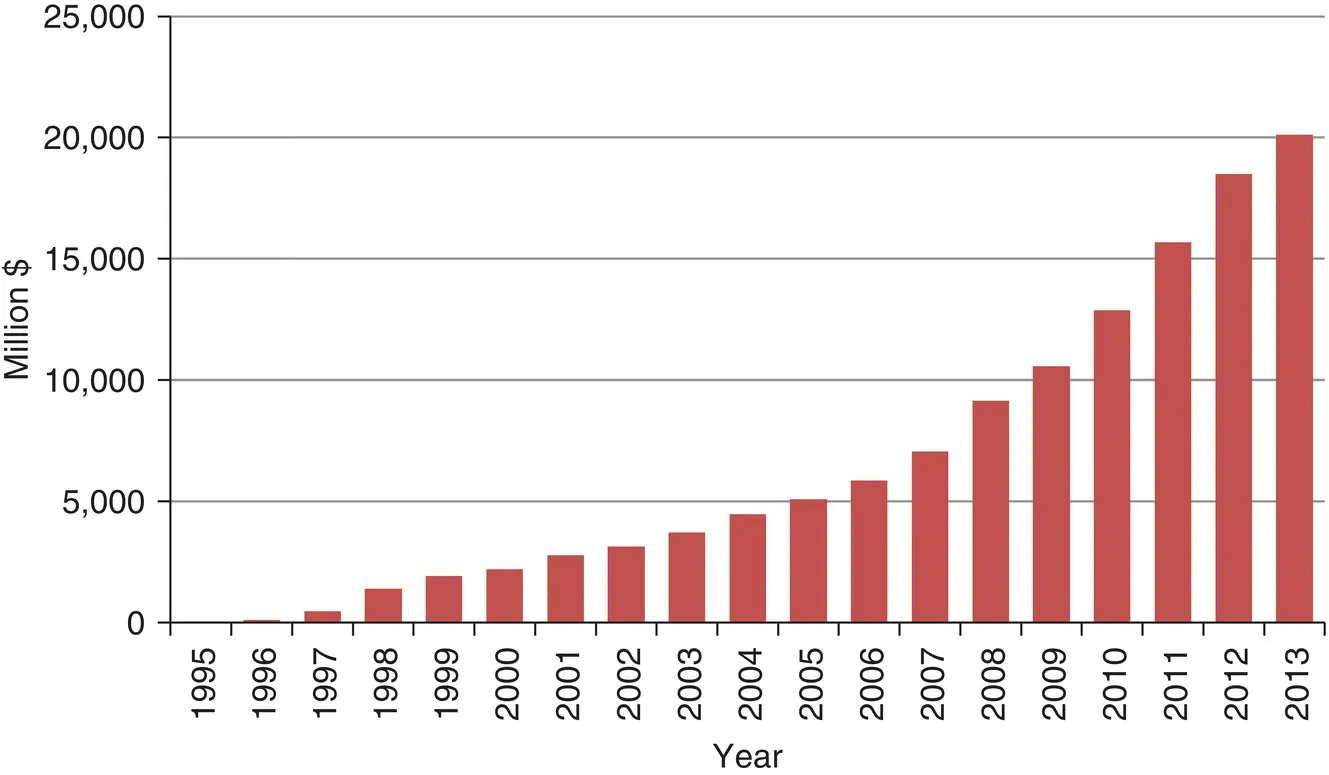
Fig. 1.1 Global market increase for GM seeds (Phillips McDougall, 2014).
Botanical insecticides, such as the pyrethrins, nicotine and rotenone (derris) were available prior to 1940, but they were not widely used, largely because they deteriorated rapidly in sunlight. A few inorganic chemicals, notably copper sulphate, lime sulphur and lead arsenate were also available. However, it was the development of synthetic organic pesticides during and following World War II that revolutionised the control of pests. Chemists had been looking for a cheap chemical with persistence in sunlight and low toxicity to man that would kill insect pests quickly, and in 1938 Muller showed that DDT would indeed fit this specification. Its availability during World War II led to initial use as a 10% dust on humans, for example in Naples, to suppress a typhus outbreak (Crauford-Benson, 1946). Soon afterwards it became available for agricultural use and began to be applied extensively on crops, such as cotton, at rates up to 4 kg ai/ha. Its use has had a major impact on vector control, being responsible, for example in India, for reducing the annual death rate due to malaria from 750,000 to 1,500 in the first eight years it was applied. Recognition of problems associated with the persistence of DDT in the environment were only realised later and highlighted by Rachel Carson in her b...
Table of contents
- Cover
- Title Page
- Table of Contents
- Preface to the first edition
- Preface to second edition
- Acknowledgements
- 1 Pesticides and agricultural development
- 2 Approval of pesticides
- 3 Application of pesticides
- 4 Operator exposure
- 5 Spray drift, bystander, resident and worker exposure
- 6 Environmental aspects of spray drift
- 7 Residues in food
- 8 The future of pesticides
- Appendix 1 Standard terms and abbreviations
- Appendix 2 Checklist of important actions for pesticide users
- Index
- End User License Agreement
Trusted by 375,005 students
Access to over 1.5 million titles for a fair monthly price.
Study more efficiently using our study tools.
Frequently asked questions
Yes, you can cancel anytime from the Subscription tab in your account settings on the Perlego website. Your subscription will stay active until the end of your current billing period. Learn how to cancel your subscription
No, books cannot be downloaded as external files, such as PDFs, for use outside of Perlego. However, you can download books within the Perlego app for offline reading on mobile or tablet. Learn how to download books offline
Perlego offers two plans: Essential and Complete
- Essential is ideal for learners and professionals who enjoy exploring a wide range of subjects. Access the Essential Library with 800,000+ trusted titles and best-sellers across business, personal growth, and the humanities. Includes unlimited reading time and Standard Read Aloud voice.
- Complete: Perfect for advanced learners and researchers needing full, unrestricted access. Unlock 1.5M+ books across hundreds of subjects, including academic and specialized titles. The Complete Plan also includes advanced features like Premium Read Aloud and Research Assistant.
We are an online textbook subscription service, where you can get access to an entire online library for less than the price of a single book per month. With over 1.5 million books across 990+ topics, we’ve got you covered! Learn about our mission
Look out for the read-aloud symbol on your next book to see if you can listen to it. The read-aloud tool reads text aloud for you, highlighting the text as it is being read. You can pause it, speed it up and slow it down. Learn more about Read Aloud
Yes! You can use the Perlego app on both iOS and Android devices to read anytime, anywhere — even offline. Perfect for commutes or when you’re on the go.
Please note we cannot support devices running on iOS 13 and Android 7 or earlier. Learn more about using the app
Please note we cannot support devices running on iOS 13 and Android 7 or earlier. Learn more about using the app
Yes, you can access Pesticides by Graham Matthews,G. A. Matthews in PDF and/or ePUB format, as well as other popular books in Technology & Engineering & Agronomy. We have over 1.5 million books available in our catalogue for you to explore.