The Handbook of Technical Analysis + Test Bank
eBook - ePub

The Handbook of Technical Analysis + Test Bank

The Practitioner's Comprehensive Guide to Technical Analysis

  1. English
  2. ePUB (mobile friendly)
  3. Available on iOS & Android
eBook - ePub

The Handbook of Technical Analysis + Test Bank

The Practitioner's Comprehensive Guide to Technical Analysis

About this book

A self study exam preparatory guide for financial technical analysis certifications

Written by the course director and owner of www.tradermasterclass.com, a leading source of live and online courses in trading, technical analysis, and money management, A Handbook of Technical Analysis: The Practitioner's Comprehensive Guide to Technical Analysis is the first financial technical analysis examination preparatory book in the market. It is appropriate for students taking IFTA CFTe Level I and II (US), STA Diploma (UK), Dip TA (Aus), and MTA CMT Level I, II, and III exams in financial technical analysis, as well as for students in undergraduate, graduate, or MBA courses.

The book is also an excellent resource for serious traders and technical analysts, and includes a chapter dedicated to advanced money management techniques. This chapter helps complete a student's education and also provides indispensable knowledge for FOREX, bond, stock, futures, CFD, and option traders.

  • Learn the definitions, concepts, application, integration, and execution of technical-based trading tools and approaches
  • Integrate innovative techniques for pinpointing and handling market reversals
  • Understand trading mechanisms and advanced money management techniques
  • Examine the weaknesses of popular technical approaches and find more effective solutions

The book allows readers to test their current knowledge and then check their learning with end-of-chapter test questions that span essays, multiple choice, and chart-based annotation exercises. This handbook is an essential resource for students, instructors, and practitioners in the field. Alongside the handbook, the author will also publish two full exam preparatory workbooks and a bonus online Q&A Test bank built around the most popular professional examinations in financial technical analysis.
Frequently asked questions

Yes, you can cancel anytime from the Subscription tab in your account settings on the Perlego website. Your subscription will stay active until the end of your current billing period. Learn how to cancel your subscription.
No, books cannot be downloaded as external files, such as PDFs, for use outside of Perlego. However, you can download books within the Perlego app for offline reading on mobile or tablet. Learn more here.
Perlego offers two plans: Essential and Complete
  • Essential is ideal for learners and professionals who enjoy exploring a wide range of subjects. Access the Essential Library with 800,000+ trusted titles and best-sellers across business, personal growth, and the humanities. Includes unlimited reading time and Standard Read Aloud voice.
  • Complete: Perfect for advanced learners and researchers needing full, unrestricted access. Unlock 1.4M+ books across hundreds of subjects, including academic and specialized titles. The Complete Plan also includes advanced features like Premium Read Aloud and Research Assistant.
Both plans are available with monthly, semester, or annual billing cycles.
We are an online textbook subscription service, where you can get access to an entire online library for less than the price of a single book per month. With over 1 million books across 1000+ topics, we’ve got you covered! Learn more here.
Look out for the read-aloud symbol on your next book to see if you can listen to it. The read-aloud tool reads text aloud for you, highlighting the text as it is being read. You can pause it, speed it up and slow it down. Learn more here.
Yes! You can use the Perlego app on both iOS or Android devices to read anytime, anywhere — even offline. Perfect for commutes or when you’re on the go.
Please note we cannot support devices running on iOS 13 and Android 7 or earlier. Learn more about using the app.
Yes, you can access The Handbook of Technical Analysis + Test Bank by Mark Andrew Lim in PDF and/or ePUB format, as well as other popular books in Business & Finance. We have over one million books available in our catalogue for you to explore.

Information

Publisher
Wiley
Year
2015
Print ISBN
9781118498910
eBook ISBN
9781118498927
Edition
1
Subtopic
Finance

CHAPTER 1
Introduction to the Art and Science of Technical Analysis

LEARNING OBJECTIVES

After studying this chapter, you should be able to:
  • Understand the key concepts underlying technical analysis
  • Identify the different forms of chart analysis
  • Describe the objectives of technical analysis
  • Understand what subjectivity means in technical analysis
  • Recognize the strengths and weaknesses of technical analysis
  • Categorize market participants according to style and time in markets
  • Identify the various styles and approaches in technical analysis
Technical analysis is a fascinating field of study. It is as much science as it is art. Its main strength is that a lot of it is visual, giving practitioners a better feel of the underlying dynamics of the markets. We shall also be looking at the various challenges to technical analysis, their resolution, and how technical analysis affects trading in general. The classification of technical approaches, market participants, and various markets will also be discussed in detail.

1.1 MAIN OBJECTIVE OF TECHNICAL ANALYSIS

It is generally accepted that human beings are born with certain instincts, tempered and molded by evolution via the passing of time. Every human being strives and seeks to fulfill these powerful instinctive forces.
The three main motivational instincts are:
  1. The instinct to survive
  2. The instinct for comfort
  3. The instinct to propagate
The instinct to survive is probably the strongest and most overpowering. Survival almost always precedes the need for comfort or to propagate the species. The instinct to survive includes:
  • The instinct to stay alive
  • The instinct to satisfy hunger
  • The instinct to seek safety, that is, being in a group/herd
  • The instinct to avoid danger (by having natural fears like the fear of fire, loud sounds, heights, etc.)
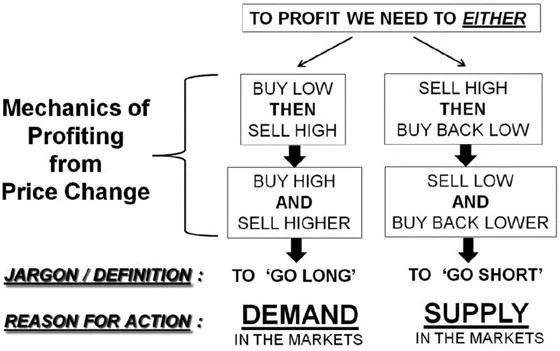
This powerful instinct to survive is the main driving force in life for striving to make a profit. But in order to make a profit to ensure continued survival, there must be a positive change in the actual or perceived value of something that we own. This change in value of some variable may be anything that will allow us to profit from change. One very popular and convenient variable of change is price. We can participate in this price change by satisfying a very simple mechanical rule that will ensure profitability every single time, which is to always buy when prices are low and sell when they are higher, popularly referred to as the buy low, sell high principle. See Figure 1.1.
images
Figure 1.1 The Mechanics of Profiting from a Change.
Unfortunately, in order to satisfy this simple rule of guaranteed profitability, we need to be able to do more of one thing, which is to be able to determine the direction of price ahead of time in order to know exactly when to buy low and subsequently sell higher. Hence, it is not only the mechanical action of buying low and selling high that counts, but also the timing of the action itself that is critical. This introduces an element of chance or probability into an otherwise fairly straightforward mechanical venture. Profitability therefore requires effective and efficient action in two dimensions, that is, price and time. Traders and analysts keep track of this action using a two-dimensional visualization tool, that is, a price-time chart, which tracks price on the vertical axis and time on horizontal axis.
In short, the ability to forecast or predict price or market action in a reasonably accurate fashion represents one of the skills that may be critical for longer-term success as a professional trader or analyst.

1.2 DUAL FUNCTION OF TECHNICAL ANALYSIS

Technical analysis essentially serves two main functions:
  1. For Identification: It identifies and describes past and present price action. It serves as a historical record of what has transpired in the markets. It provides a descriptive representation of market action. This allows the market practitioner to observe how the market has performed in the past, which includes its average volatility over a specified period; its highest and lowest historical price extremes; the common areas of consolidation, average duration, and price excursion of trends; the amount of liquidity and participation in the markets; the average degree and frequency of price gapping; the impact of various monetary economic announcements on price, and so on. This information is especially critical prior to any investment or trading decision.
  2. For Forecasting: Once a particular price or market action is identified, the practitioner may now use this information to interpret what the data actually means before inferring future price action. This inference about potential price action is wholly based on the assumption that price patterns are repetitive to some reasonable degree and therefore may be used as a basis for price predictions.

1.3 FORECASTING PRICE AND MARKET ACTION

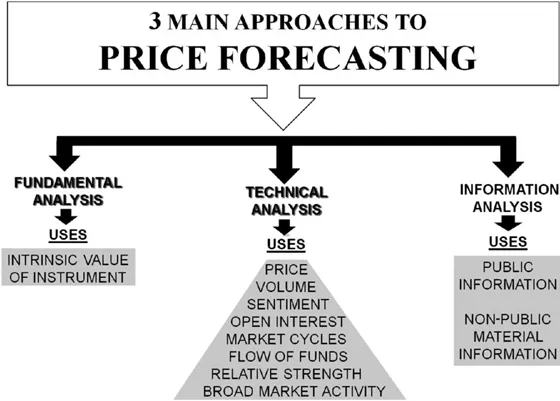
There are three main approaches to predicting potential future price action or behavior, namely via:
  1. Fundamental Analysis
  2. Technical Analysis
  3. Information Analysis
See Figure 1.2.
images
Figure 1.2 Three Approaches to Price Forecasting.

Forecasting Stock Prices Using Fundamental Analysis

One way to gauge the potential price of a stock is by analyzing the company’s performance via its financial statements and accounts in order to determine its intrinsic value or the worth of the security in light of all its holdings, debt, earnings, dividends, income and balance sheet activity, cash flow, and so on. This accounting information is normally represented in ratio form, as in price to earnings (P/E), price to earnings growth (PEG), price to book, price to sales, and debt to equity ratios, to name but a few.
The logic is that a strongly performing company should continue to perform well into the future and garner more demand from investors excited to participate in the expected capital gains derived from the stock’s price and appreciating dividend yields. The price of a stock is expected to rise if there are sufficient buyers, signifying a demand for it. Conversely, the price of a stock is expected to decline if there are sufficient sellers, signifying an oversupply in the stock. Demand is potentially generated if the current stock price is below its estimated intrinsic value, that is, it is currently undervalued or underpriced, whereas ...

Table of contents

  1. Cover
  2. Series
  3. Title page
  4. Copyright
  5. Dedication
  6. Foreword
  7. Preface
  8. Acknowledgments
  9. About the Author
  10. CHAPTER 1 Introduction to the Art and Science of Technical Analysis
  11. CHAPTER 2 Introduction to Dow Theory
  12. CHAPTER 3 Mechanics and Dynamics of Charting
  13. CHAPTER 4 Market Phase Analysis
  14. CHAPTER 5 Trend Analysis
  15. CHAPTER 6 Volume and Open Interest
  16. CHAPTER 7 Bar Chart Analysis
  17. CHAPTER 8 Window Oscillators and Overlay Indicators
  18. CHAPTER 9 Divergence Analysis
  19. CHAPTER 10 Fibonacci Number and Ratio Analysis
  20. CHAPTER 11 Moving Averages
  21. CHAPTER 12 Envelopes and Methods of Price Containment
  22. CHAPTER 13 Chart Pattern Analysis
  23. CHAPTER 14 Japanese Candlestick Analysis
  24. CHAPTER 15 Point-and-Figure Charting
  25. CHAPTER 16 Ichimoku Charting and Analysis
  26. CHAPTER 17 Market Profile
  27. CHAPTER 18 Basic Elliott Wave Analysis
  28. CHAPTER 19 Basics of Gann Analysis
  29. CHAPTER 20 Cycle Analysis
  30. CHAPTER 21 Volatility Analysis
  31. CHAPTER 22 Market Breadth
  32. CHAPTER 23 Sentiment Indicators and Contrary Opinion
  33. CHAPTER 24 Relative Strength Analysis
  34. CHAPTER 25 Investor Psychology
  35. CHAPTER 26 Trader Risk Profiling and Position Analysis
  36. CHAPTER 27 Integrated Technical Analysis
  37. CHAPTER 28 Money Management
  38. CHAPTER 29 Technical Trading Systems
  39. Appendix A Basic Investment Decision Making Based on Chart Analysis
  40. Appendix B Official IFTA CFTe, STA Diploma (UK), and MTA CMT Exam Reading Lists
  41. About the Test Bank and Website
  42. Index
  43. EULA