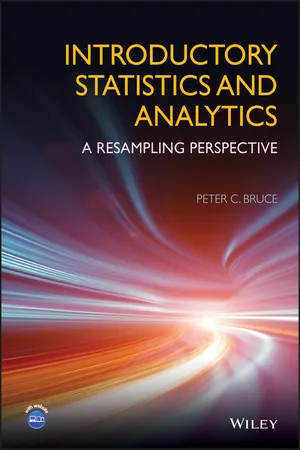
Introductory Statistics and Analytics
eBook - ePub

Introductory Statistics and Analytics

A Resampling Perspective

  1. English
  2. ePUB (mobile friendly)
  3. Available on iOS & Android
eBook - ePub

Introductory Statistics and Analytics

A Resampling Perspective

About this book

Concise, thoroughly class-tested primer that features basic statistical concepts in the concepts in the context of analytics, resampling, and the bootstrap

A uniquely developed presentation of key statistical topics, Introductory Statistics and Analytics: A Resampling Perspective provides an accessible approach to statistical analytics, resampling, and the bootstrap for readers with various levels of exposure to basic probability and statistics. Originally class-tested at one of the first online learning companies in the discipline, www.statistics.com, the book primarily focuses on applications of statistical concepts developed via resampling, with a background discussion of mathematical theory. This feature stresses statistical literacy and understanding, which demonstrates the fundamental basis for statistical inference and demystifies traditional formulas.

The book begins with illustrations that have the essential statistical topics interwoven throughout before moving on to demonstrate the proper design of studies. Meeting all of the Guidelines for Assessment and Instruction in Statistics Education (GAISE) requirements for an introductory statistics course, Introductory Statistics and Analytics: A Resampling Perspective also includes:

  • Over 300 "Try It Yourself" exercises and intermittent practice questions, which challenge readers at multiple levels to investigate and explore key statistical concepts
  • Numerous interactive links designed to provide solutions to exercises and further information on crucial concepts
  • Linkages that connect statistics to the rapidly growing field of data science
  • Multiple discussions of various software systems, such as Microsoft Office ExcelÂŽ, StatCrunch, and R, to develop and analyze data
  • Areas of concern and/or contrasting points-of-view indicated through the use of "Caution" icons

Introductory Statistics and Analytics: A Resampling Perspective is an excellent primary textbook for courses in preliminary statistics as well as a supplement for courses in upper-level statistics and related fields, such as biostatistics and econometrics. The book is also a general reference for readers interested in revisiting the value of statistics.

Frequently asked questions

Yes, you can cancel anytime from the Subscription tab in your account settings on the Perlego website. Your subscription will stay active until the end of your current billing period. Learn how to cancel your subscription.
At the moment all of our mobile-responsive ePub books are available to download via the app. Most of our PDFs are also available to download and we're working on making the final remaining ones downloadable now. Learn more here.
Perlego offers two plans: Essential and Complete
  • Essential is ideal for learners and professionals who enjoy exploring a wide range of subjects. Access the Essential Library with 800,000+ trusted titles and best-sellers across business, personal growth, and the humanities. Includes unlimited reading time and Standard Read Aloud voice.
  • Complete: Perfect for advanced learners and researchers needing full, unrestricted access. Unlock 1.4M+ books across hundreds of subjects, including academic and specialized titles. The Complete Plan also includes advanced features like Premium Read Aloud and Research Assistant.
Both plans are available with monthly, semester, or annual billing cycles.
We are an online textbook subscription service, where you can get access to an entire online library for less than the price of a single book per month. With over 1 million books across 1000+ topics, we’ve got you covered! Learn more here.
Look out for the read-aloud symbol on your next book to see if you can listen to it. The read-aloud tool reads text aloud for you, highlighting the text as it is being read. You can pause it, speed it up and slow it down. Learn more here.
Yes! You can use the Perlego app on both iOS or Android devices to read anytime, anywhere — even offline. Perfect for commutes or when you’re on the go.
Please note we cannot support devices running on iOS 13 and Android 7 or earlier. Learn more about using the app.
Yes, you can access Introductory Statistics and Analytics by Peter C. Bruce in PDF and/or ePUB format, as well as other popular books in Mathematics & Statistics for Business & Economics. We have over one million books available in our catalogue for you to explore.

Information

Chapter 1
Designing and Carrying Out a Statistical Study

In this chapter we study random behavior and how it can fool us, and we learn how to design studies to gain useful and reliable information. After completing this chapter, you should be able to
  • use coin flips to replicate random processes and interpret the results of coin-flipping experiments,
  • define and understand probability,
  • define, intuitively, p-value,
  • list the key statistics used in the initial exploration and analysis of data,
  • describe the different data formats that you will encounter, including relational database and flat file formats,
  • describe the difference between data encountered in traditional statistical research and “big data,”
  • explain the use of treatment and control groups in experiments,
  • explain the role of randomization in assigning subjects in a study,
  • explain the difference between observational studies and experiments.
You may already be familiar with statistics as a method of gathering and reporting data. Sports statistics are a good example of this. For many decades, data have been collected and reported on the performance of both teams and players using standard metrics such as yards via pass completions (quarterbacks in American football), points scored (basketball), and batting average (baseball).
Sports fans, coaches, analysts, and administrators have a rich array of useful statistics at their disposal, more so than most businesses. TV broadcasters can not only tell you when a professional quarterback's last fumble was but they can also queue up television footage almost instantly, even if that footage dates from the player's college days. To appreciate the role that statistical analysis (also called data analytics) plays in the world today, one needs to look no further than the television broadcast of a favorite sport—pay close attention to the statistics that are reported and imagine how they are arrived at.
The whole point in sports, of course, is statistical—to score more points than the other player or the other team. The activities of most businesses and organizations are much more complex, and valid statistical conclusions are more difficult to draw, no matter how much data are available.

Big Data

In most organizations today, raw data are plentiful (often too plentiful), and this is a two-edged sword.
  • Huge amounts of data make prediction possible in circumstances where small amounts of data do not help. One type of recommendation system, for example, needs to process large numbers of transactions to locate transactions with the same items you are looking at—enough so that reliable information about associated items can be deduced.
  • On the other hand, huge data flows can obscure the signal, and useful data are often difficult and expensive to gather. We need to find ways to get the most information and the most accurate information for each dollar spent in gathering and preparing data.

Data Mining and Data Science

The terms big data, data mining, data science, and predictive analytics often go together, and when people think of data mining various things come to mind. Laypersons may think of large corpo...

Table of contents

  1. Cover
  2. Title Page
  3. Copyright
  4. Preface
  5. Acknowledgments
  6. Introduction
  7. Chapter 1: Designing and Carrying Out a Statistical Study
  8. Chapter 2: Statistical Inference
  9. Chapter 3: Displaying and Exploring Data
  10. Chapter 4: Probability
  11. Chapter 5: Relationship Between Two Categorical Variables
  12. Chapter 6: Surveys and Sampling
  13. Chapter 7: Confidence Intervals
  14. Chapter 8: Hypothesis Tests
  15. Chapter 9: Hypothesis Testing—2
  16. Chapter 10: Correlation
  17. Chapter 11: Regression
  18. Chapter 12: Analysis of Variance—ANOVA
  19. Chapter 13: Multiple Regression
  20. Index
  21. End User License Agreement