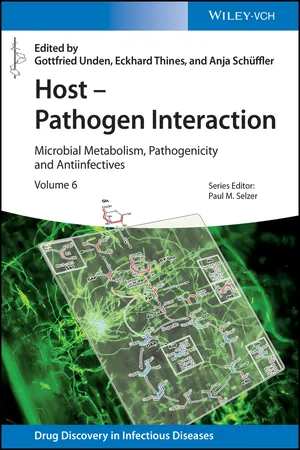
eBook - ePub
Host - Pathogen Interaction
Microbial Metabolism, Pathogenicity and Antiinfectives
- English
- ePUB (mobile friendly)
- Available on iOS & Android
eBook - ePub
Host - Pathogen Interaction
Microbial Metabolism, Pathogenicity and Antiinfectives
About this book
In light of the rapidity increasing incidence rate of bacterial and fungal infections with multi-resistant pathogens, the metabolic changes associated with host-pathogen interactions offer one of the most promising starting points for developing novel antibiotics. . Part one of this comprehensive guide describes the metabolic adaptation of pathogenic microbes in humans, while part two points to routes for the development of novel antibiotics. This is volume six of the book series on drug discovery in infectious diseases by Paul Selzer.
Information
Part One
Adaptation of Microbial Metabolism in Host/Pathogen Interaction
Chapter 1
Metabolic Adaptation of Human Pathogenic Yersiniae
Ann Kathrin Heroven and Petra Dersch*
*Corresponding Author
Abstract
Colonization, subsequent penetration of epithelial layers as well as persistence and proliferation in subepithelial tissues of the host by bacterial pathogens demand the expression of special sets of virulence factors. In addition, the bacteria need to adapt their metabolism to survive and replicate within the specific host niches. Activated metabolic functions and physiological adaptation processes during their life cycle and the different stages of the infection reflect the complex and dynamic nutritional resources of their environments, interbacterial competition for energy sources and onslaught of bactericidal host responses. The enteric pathogenic Yersinia species Y. pseudotuberculosis and Y. enterocolitica and the causative agent of plague, Y. pestis, have adapted to grow in many different environmental reservoirs (e.g., soil, plants, insects) and in warm-blooded animals (e.g., rodents, pigs, humans) with a preference for lymphatic tissues. In the present book chapter, we discuss metabolic adaptations of human pathogenic yersiniae to successfully exploit available nutrients and metabolic functions during infection and illustrate the tight link between carbon metabolism and Yersinia virulence. Furthermore, current knowledge about the complex regulatory networks used to coordinate and fine-tune the control of metabolic and virulence functions are presented. Deciphering the mechanisms of the function and control of bacterial metabolism within host tissues will not only increase our understanding of host–pathogen interactions, it will also facilitate the identification of potential novel drug targets for future prevention and therapeutic strategies.
Introduction
Infections of human pathogenic yersiniae involves a large number of specific pathogenicity factors that mediate efficient resistance against the host defense systems and enable the bacteria to colonize, invade, and multiply successfully within host tissues. The structure, function, and expression of many of these classical virulence factors have been characterized, and their role in pathogenicity has been studied using different animal models. However, to become a successful pathogen, yersiniae must also adapt their metabolic functions to the nutrient/ion composition and the physical conditions (e.g., temperature, pH, oxygen tension) of their surrounding and coordinate their metabolism with their life cycle. These unspecific strategies were long neglected, but recent use of global omic-based profiling techniques, phenotypic microarrays, and the in vivo analysis of metabolic mutants allowed a deeper insight into nutrient sensing, sequestration, and utilization strategies that optimize the metabolism and biological fitness of Yersinia during infection.
Yersinia Life Cycles and Pathogenesis
Of the 17 species of the genus Yersinia only Y. pseudotuberculosis, Y. enterocolitica, and Y. pestis are known to cause diseases in mammals [1, 2]. The two enteric pathogens Y. pseudotuberculosis and Y. enterocolitica are the causative agents of yersiniosis, a gastrointestinal disease with a variety of symptoms such as enteritis, colitis, diarrhea, and mesenteric lymphadenitis, which becomes rarely systemic. Both enteropathogenic species are well adapted to survive long term in external habitats (e.g., ground water, soil, plants, and insects) and are able to persist and replicate in various wild and domestic animals [3, 4]. A recent study analyzing a large number of genomes revealed that they are heterotrophic pathogens that are able to utilize a large variety of C-/N-/energy sources [5]. In contrast, Y. pestis, the causal agent of plague, which has evolved as a separate clone from Y. pseudotuberculosis, shows a reduced metabolic flexibility based on functional gene loss. This may reflect its unique life cycle: (i) replication within the gastrointestinal tract (proventriculus) of infected fleas and (ii) proliferation in the lymphatic system, blood, or tissues of mammals, in particular rodents [6].
All yersiniae are zoonotic pathogens armored with diverse cell envelope–associated virulence structures that either promote host–pathogen interactions or contribute to Yersinia pathogenicity by suppression of the host immune response. In case of the enteric Yersinia species, initial attachment and invasion of the intestinal layer is mediated by the primary invasion factor invasin (InvA), but other adhesive surface-exposed proteins, for example, homologous Inv-type adhesins (InvB/Ifp, InvC), Ail, the autotransporter adhesin YadA and the PsaA (pH6 antigen)/Myf fimbriae appear to support the dissemination process at later stages of the infection [7, 8]. In Y. pestis mainly adhesins Ail and PsaA contribute to host–pathogen interactions, whereas other adhesin/invasin genes, for example, invA and yadA became unfunctional [9, 10]. Moreover, all pathogenic yersiniae evolved mechanisms that mediate resistance against the innate immune response. Several adhesins protect the bacteria against complement killing (e.g., Ail and YadA) or prevent phagocytosis (e.g., PsaA) [7]. Furthermore, they possess a 70-kDa virulence plasmid (pYV/pCD1) that encodes the Ysc (Yersinia secretion)-Yop type III secretion system (T3SS). This needle-like delivery machine (injectisome) enables the bacteria to inject different Yops (Yersinia outer proteins) effector toxins from the bacterial cytoplasm into the cytosol of host cells, in particular professional phagocytes [11]. Yersinia pathogenicity relies on the following crucial functions of translocated Yop effector proteins: (i) antiphagocytic activity by manipulation and destruction of the actin cytoskeleton; (ii) suppression of cytokine production by macrophages, dendritic cells, and neutrophils; and (iii) induction of host cell death [11].
Carbon Metabolism and Links to Yersinia Pathogenesis
External reservoirs, vector and animal environments colonized by Yersinia have likely driven the evolution of metabolic pathways to maximize present nutritional opportunities. Variations in certain metabolic functions might thus be a consequence of the adaptation to a specific host or host niche. A selective advantage can be gained either by acquisition of new metabolic functions, for example, by horizontal gene transfer, or by loss of function mutations that change the metabolic abilities of the pathogen. Furthermore, changes in the control mechanisms implicated in metabolic adaptation and regulatory strategies linking metabolic and virulence traits could manipulate the pathogen's response to varying nutrient availabilities in the environment.
Food Sources, Nutrient Sequestration, and Utilization
Animal tissues contain ...
Table of contents
- Cover
- Titles of the Series “Drug Discovery in Infectious Diseases”
- Title Page
- Copyright
- Table of Contents
- Preface
- Cover Legend
- List of Contributors
- Part One: Adaptation of Microbial Metabolism in Host/Pathogen Interaction
- Part Two: New Inhibitors and Targets of Infectious Diseases
- Index
- End User License Agreement
Trusted by 375,005 students
Access to over 1.5 million titles for a fair monthly price.
Study more efficiently using our study tools.
Frequently asked questions
Yes, you can cancel anytime from the Subscription tab in your account settings on the Perlego website. Your subscription will stay active until the end of your current billing period. Learn how to cancel your subscription
No, books cannot be downloaded as external files, such as PDFs, for use outside of Perlego. However, you can download books within the Perlego app for offline reading on mobile or tablet. Learn how to download books offline
Perlego offers two plans: Essential and Complete
- Essential is ideal for learners and professionals who enjoy exploring a wide range of subjects. Access the Essential Library with 800,000+ trusted titles and best-sellers across business, personal growth, and the humanities. Includes unlimited reading time and Standard Read Aloud voice.
- Complete: Perfect for advanced learners and researchers needing full, unrestricted access. Unlock 1.5M+ books across hundreds of subjects, including academic and specialized titles. The Complete Plan also includes advanced features like Premium Read Aloud and Research Assistant.
We are an online textbook subscription service, where you can get access to an entire online library for less than the price of a single book per month. With over 1.5 million books across 990+ topics, we’ve got you covered! Learn about our mission
Look out for the read-aloud symbol on your next book to see if you can listen to it. The read-aloud tool reads text aloud for you, highlighting the text as it is being read. You can pause it, speed it up and slow it down. Learn more about Read Aloud
Yes! You can use the Perlego app on both iOS and Android devices to read anytime, anywhere — even offline. Perfect for commutes or when you’re on the go.
Please note we cannot support devices running on iOS 13 and Android 7 or earlier. Learn more about using the app
Please note we cannot support devices running on iOS 13 and Android 7 or earlier. Learn more about using the app
Yes, you can access Host - Pathogen Interaction by Gottfried Unden, Eckhard Thines, Anja Schüffler, Gottfried Unden,Eckhard Thines,Anja Schuffler,Anja Schüffler, Paul M. Selzer in PDF and/or ePUB format, as well as other popular books in Biological Sciences & Microbiology. We have over 1.5 million books available in our catalogue for you to explore.