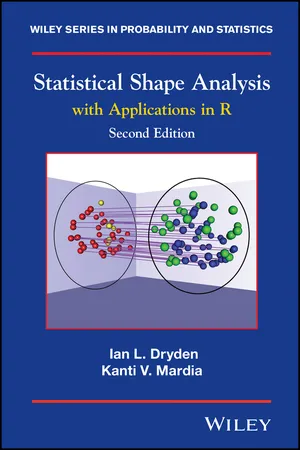
A thoroughly revised and updated edition of this introduction to modern statistical methods for shape analysis
Shape analysis is an important tool in the many disciplines where objects are compared using geometrical features. Examples include comparing brain shape in schizophrenia; investigating protein molecules in bioinformatics; and describing growth of organisms in biology.
This book is a significant update of the highly-regarded Statistical Shape Analysis by the same authors. The new edition lays the foundations of landmark shape analysis, including geometrical concepts and statistical techniques, and extends to include analysis of curves, surfaces, images and other types of object data. Key definitions and concepts are discussed throughout, and the relative merits of different approaches are presented.
The authors have included substantial new material on recent statistical developments and offer numerous examples throughout the text. Concepts are introduced in an accessible manner, while retaining sufficient detail for more specialist statisticians to appreciate the challenges and opportunities of this new field. Computer code has been included for instructional use, along with exercises to enable readers to implement the applications themselves in R and to follow the key ideas by hands-on analysis.
Offers a detailed yet accessible treatment of statistical methods for shape analysis
Includes numerous examples and applications from many disciplines
Provides R code for implementing the examples
Covers a wide variety of recent developments in shape analysis
Shape Analysis, with Applications in R will offer a valuable introduction to this fast-moving research area for statisticians and other applied scientists working in diverse areas, including archaeology, bioinformatics, biology, chemistry, computer science, medicine, morphometics and image analysis.
Objects are everywhere, natural and man-made. Geometrical data from objects are routinely collected all around us, from sophisticated medical scans in hospitals to ubiquitous smart-phone camera images. Decisions about objects are often made using their sizes and shapes in geometrical data, for example disease diagnosis, face recognition and protein identification. Hence, developing methods for the analysis of size and shape is of wide, growing importance. Locating points on objects is often straightforward and we initially consider analysing such data, before extending to curved outlines, smooth surfaces and full volumes.
Size and shape analysis is of great interest in a wide variety of disciplines. Some specific applications follow in Section 1.4 from biology, chemistry, medicine, image analysis, archaeology, bioinformatics, geology, particle science, genetics, geography, law, pharmacy and physiotherapy. As many of the earliest applications of shape analysis were in biology we concentrate initially on biological examples and terminology, but the domain of applications is in fact very broad indeed.
The word ‘shape’ is very commonly used in everyday language, usually referring to the appearance of an object. Following Kendall (1977) the definition of shape that we consider is intuitive.
Definition 1.1 Shapeis all the geometrical information that remains when location, scale and rotational effects are removed from an object.
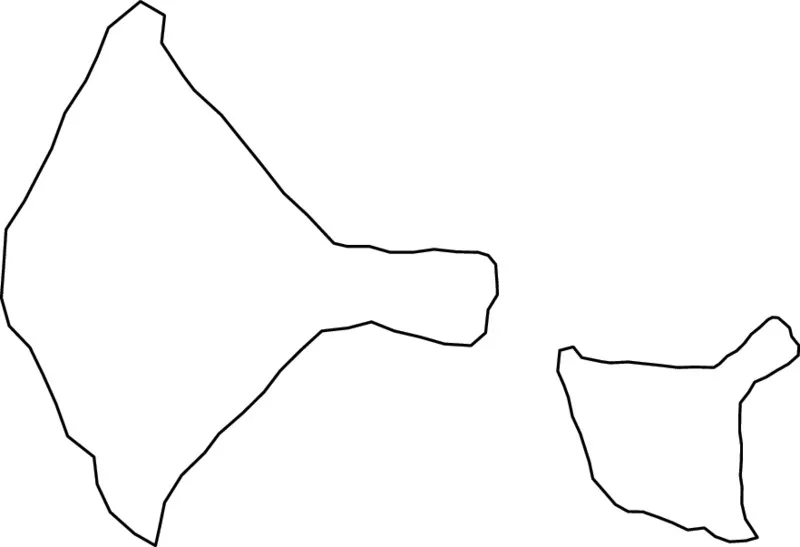
An object’s shape is invariant under the Euclidean similarity transformations of translation, scaling and rotation. For example, the shape of a human skull consists of all the geometrical properties of the skull that are unchanged when it is translated, rescaled or rotated in an arbitrary coordinate system. Two objects have the same shape if they can be translated, rescaled and rotated to each other so that they match exactly, that is if the objects are similar. In Figure 1.1 the two mouse vertebrae outlines have the same shape. In practice we are interested in comparing objects with different shapes and so we require a way of measuring shape, some notion of distance between two shapes and methods for the statistical analysis of shape.
Figure 1.1 Two outlines of the same second thoracic (T2) vertebra of a mouse, which have different locations, rotations and scales but the same shape.
Sometimes we are also interested in retaining scale information (size) as well as the shape of the object, and so the joint analysis of size and shape (or form) is also very important.
Definition 1.2 Size-and-shapeis all the geometrical information that remains when location and rotational effects are removed from an object.
Two objects have the same size-and-shape if they can be translated and rotated to each other so that they match exactly, that is if the objects are rigid-body transformations of each other. ‘Size-and-shape’ is also frequently denoted as form and we use the terms equivalently throughout the text.
A common theme throughout the text is the geometrical transformation of objects. The terms superimposition, superposition, registration, transformation, pose and matching are often used equivalently for operations which involve transforming objects, either with respect to each other or into a specified reference frame.
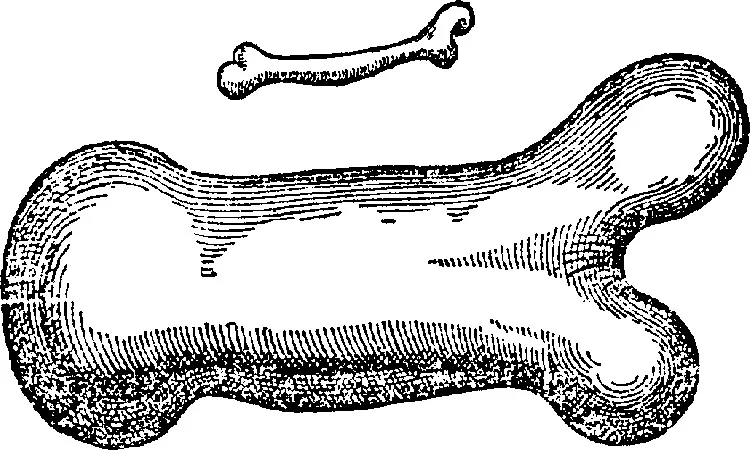
An early writing on shape was by Galileo (1638), who observed that bones in larger animals are not purely scaled up versions of those in smaller animals; there is a shape difference too. A bone has to become proportionally thicker so that it does not break under the increased weight of the heavier animal, see Figure 1.2. The field of geometrical shape analysis was initially developed from a biological point of view by Thompson (1917), who also discussed this application.
Figure 1.2 From Galileo (1638) illustrating the differences in shapes of the bones of small and large animals.
How should a scientist wishing to investigate a shape change proceed? Even describing an object’s shape is difficult. In everyday conversation an object’s shape is usually described by naming a second more familiar shape which it looks like, for example a map of Italy is ‘boot shaped’. This leads to very subjective descriptions that are unsuitable for most applications. A practical way forward is to locate a finite set of points on each object, which summarize the key geometrical information.
1.2 Landmarks
Initially we will describe a shape by locating a finite number of points on each specimen which are called landmarks.
Definition 1.3Alandmarkis a point of correspondence on each object that matches between and within populations.
There are three basic types of landmarks in our applications: scientific, mathematical and pseudo-landmarks. In the literature there have been various ...
Table of contents
Cover
Series
Title page
Copyright
Dedication
Preface
Preface to the first edition
Acknowledgements for the first edition
1 Introduction
2 Size measures and shape coordinates
3 Manifolds, shape and size-and-shape
4 Shape space
5 Size-and-shape space
6 Manifold means
7 Procrustes analysis
8 2D Procrustes analysis using complex arithmetic
9 Tangent space inference
10 Shape and size-and-shape distributions
11 Offset normal shape distributions
12 Deformations for size and shape change
13 Non-parametric inference and regression
14 Unlabelled size-and-shape and shape analysis
15 Euclidean methods
16 Curves, surfaces and volumes
17 Shape in images
18 Object data and manifolds
Exercises
Appendix
References
Index
WILEY SERIES IN PROBABILITY AND STATISTICS
EULA
Trusted by 375,005 students
Access to over 1.5 million titles for a fair monthly price.
Study more efficiently using our study tools.
Frequently asked questions
Yes, you can cancel anytime from the Subscription tab in your account settings on the Perlego website. Your subscription will stay active until the end of your current billing period. Learn how to cancel your subscription
No, books cannot be downloaded as external files, such as PDFs, for use outside of Perlego. However, you can download books within the Perlego app for offline reading on mobile or tablet. Learn how to download books offline
Perlego offers two plans: Essential and Complete
Essential is ideal for learners and professionals who enjoy exploring a wide range of subjects. Access the Essential Library with 800,000+ trusted titles and best-sellers across business, personal growth, and the humanities. Includes unlimited reading time and Standard Read Aloud voice.
Complete: Perfect for advanced learners and researchers needing full, unrestricted access. Unlock 1.5M+ books across hundreds of subjects, including academic and specialized titles. The Complete Plan also includes advanced features like Premium Read Aloud and Research Assistant.
Both plans are available with monthly, semester, or annual billing cycles.
We are an online textbook subscription service, where you can get access to an entire online library for less than the price of a single book per month. With over 1.5 million books across 990+ topics, we’ve got you covered! Learn about our mission
Look out for the read-aloud symbol on your next book to see if you can listen to it. The read-aloud tool reads text aloud for you, highlighting the text as it is being read. You can pause it, speed it up and slow it down. Learn more about Read Aloud
Yes! You can use the Perlego app on both iOS and Android devices to read anytime, anywhere — even offline. Perfect for commutes or when you’re on the go. Please note we cannot support devices running on iOS 13 and Android 7 or earlier. Learn more about using the app
Yes, you can access Statistical Shape Analysis by Ian L. Dryden,Kanti V. Mardia in PDF and/or ePUB format, as well as other popular books in Mathematics & Probability & Statistics. We have over 1.5 million books available in our catalogue for you to explore.