Digital Signal and Image Processing using MATLAB, Volume 2
eBook - ePub

Digital Signal and Image Processing using MATLAB, Volume 2

Advances and Applications: The Deterministic Case

  1. English
  2. ePUB (mobile friendly)
  3. Available on iOS & Android
eBook - ePub

Digital Signal and Image Processing using MATLAB, Volume 2

Advances and Applications: The Deterministic Case

About this book

The most important theoretical aspects of Image and Signal Processing (ISP) for both deterministic and random signals, the theory being supported by exercises and computer simulations relating to real applications.

More than 200 programs and functions are provided in the MATLAB® language, with useful comments and guidance, to enable numerical experiments to be carried out, thus allowing readers to develop a deeper understanding of both the theoretical and practical aspects of this subject. Following on from the first volume, this second installation takes a more practical stance, providing readers with the applications of ISP.

Tools to learn more effectively

Saving Books

Saving Books

Keyword Search

Keyword Search

Annotating Text

Annotating Text

Listen to it instead

Listen to it instead

Chapter 1

Recap on Digital Signal Processing

Signal processing consists of handling data in order to extract information considered relevant, or to modify them so as to give them useful properties: extracting, for example, information on a plane’s speed or distance from a RADAR signal, making an old and decayed sound recording clearer, synthesizing a sentence on an answering machine, transmitting information through a communication channel, etc.
The processing is called digital if it deals with a discrete sequence of values {x1, x2, ...}. There are two types of scenario: either the observation is already a sequence of numbers, as is the case for example for economic data, either the observed phenomenon is “continuous-time”, and the signal’s value x(t) must then be measured at regular intervals.
This second scenario has tremendous practical applications. This is why an entire section of this chapter is devoted to the operation called sampling.
The acquisition chain is described in Figure 1.1.
Figure 1.1Digital signal acquisition
image
The essential part of the acquisition device is usually the analog-to-digital converter, or ADC, which samples the value of the input voltage at regular intervals – every Ts seconds – and provides a coded representation at the output.
To be absolutely correct, this coded value is not exactly equal to the value of x(nTs). However, in the course of this chapter, we will assume that xs(n) = x(nTs). The sequence of these numerical values will be referred to as the digital signal, or more plainly as the signal.
Ts is called the sampling period and Fs = 1/Ts the sampling frequency. The gap between the actual value and the coded value is called quantization noise.
Obviously, the sampling frequency must be high enough “in order not to lose too much information” – a concept we will discuss later on – from the original signal, and there is a connection between this frequency and the sampled signal’s “frequential content”. Anybody who conducts experiments knows this “graph plotting principle”: when the signal’s value changes quickly (presence of “high frequencies”), “many” points have to be plotted (it would actually be preferable to use the phrase “high point density”), whereas when the signal’s value changes slowly (presence of low frequencies), fewer points need to be plotted.
To sum up, the signal sampling must be done in such a way that the numerical sequence {xs(n)} alone is enough to reconstruct the continuous-time signal. The sampling theorem specifies the conditions that need to be met for perfect reconstruction to be possible.

1.1 The sampling theorem

Let x(t) be a continuous signal, with X(F) its Fourier transform, which will also be called the spectrum. The sample sequence measured at the frequency Fs = 1/Ts is denoted by xs(n) = x(nTs).
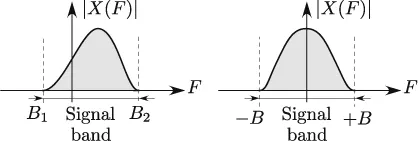
Definition 1.1 When X(F)
image
0 for F
image
(B1, B2) and X(F) = 0 everywhere else, x(t) is said to be (B1, B2) band-limited. If x(t) is real, its Fourier transform has a property called Hermitian symmetry, meaning that X(F) = X*(–F), and the frequency band’s expression is (–B, +B). A common misuse of language consists of referring to the signal as a B-band signal.

Perfect reconstruction

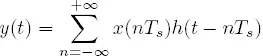
Our goal is to reconstruct x(t), at every time t, using the sampling sequence xs(n) = x(nTs), while imposing a “reconstruction scheme” defined by the expression (1.1):
(1.1)
image
Figure 1.2 – Spectra of band-limited signals
image
where h(t) is called a reconstruction function. Notice that (1.1) is linear with respect to x(nTs). In order to reach this objective, two questions have to be answered:
1. is there a class of signals x(t) large enough for y(t) to be identi...
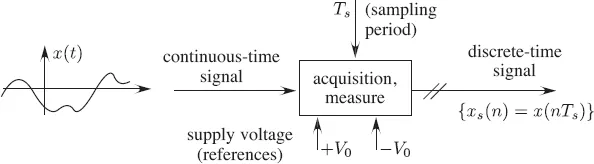
Table of contents

  1. Cover
  2. Contents
  3. Title Page
  4. Copyright
  5. Foreword
  6. Notations and Abbreviations
  7. Chapter 1: Recap on Digital Signal Processing
  8. Chapter 2: Additional Information About Filtering
  9. Chapter 3: Image Processing
  10. Chapter 4: Numerical Calculus and Simulation
  11. Chapter 5: Speech Processing
  12. Chapter 6: Selected Topics
  13. Chapter 7: Hints and Solutions
  14. Chapter 8: Appendix
  15. Bibliography
  16. Index

Frequently asked questions

Yes, you can cancel anytime from the Subscription tab in your account settings on the Perlego website. Your subscription will stay active until the end of your current billing period. Learn how to cancel your subscription
No, books cannot be downloaded as external files, such as PDFs, for use outside of Perlego. However, you can download books within the Perlego app for offline reading on mobile or tablet. Learn how to download books offline
Perlego offers two plans: Essential and Complete
  • Essential is ideal for learners and professionals who enjoy exploring a wide range of subjects. Access the Essential Library with 800,000+ trusted titles and best-sellers across business, personal growth, and the humanities. Includes unlimited reading time and Standard Read Aloud voice.
  • Complete: Perfect for advanced learners and researchers needing full, unrestricted access. Unlock 1.4M+ books across hundreds of subjects, including academic and specialized titles. The Complete Plan also includes advanced features like Premium Read Aloud and Research Assistant.
Both plans are available with monthly, semester, or annual billing cycles.
We are an online textbook subscription service, where you can get access to an entire online library for less than the price of a single book per month. With over 1 million books across 990+ topics, we’ve got you covered! Learn about our mission
Look out for the read-aloud symbol on your next book to see if you can listen to it. The read-aloud tool reads text aloud for you, highlighting the text as it is being read. You can pause it, speed it up and slow it down. Learn more about Read Aloud
Yes! You can use the Perlego app on both iOS and Android devices to read anytime, anywhere — even offline. Perfect for commutes or when you’re on the go.
Please note we cannot support devices running on iOS 13 and Android 7 or earlier. Learn more about using the app
Yes, you can access Digital Signal and Image Processing using MATLAB, Volume 2 by Gérard Blanchet,Maurice Charbit in PDF and/or ePUB format, as well as other popular books in Tecnologia e ingegneria & Ingegneria elettronica e telecomunicazioni. We have over one million books available in our catalogue for you to explore.