- A colorful, comprehensive and interdisciplinary overview of the material conditions of Renaissance plays, England's most important dramatic period
- Contributors are both established and emerging scholars, with many leading international figures in the discipline
- Offers a unique approach by organizing the chapters by cultural context, theatre history, genre studies, theoretical applications, and material studies
- Chapters address newest departures and future directions for Renaissance drama scholarship
- Arthur Kinney is a world-renowned figure in the field
eBook - ePub
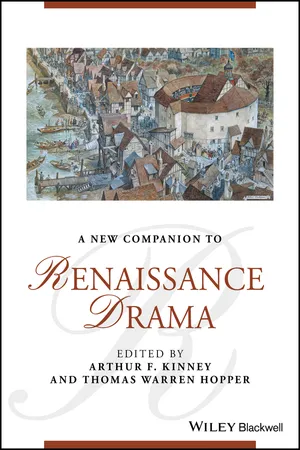
A New Companion to Renaissance Drama
- English
- ePUB (mobile friendly)
- Available on iOS & Android
eBook - ePub
A New Companion to Renaissance Drama
About this book
A New Companion to Renaissance Drama provides an invaluable summary of past and present scholarship surrounding the most popular and influential literary form of its time. Original interpretations from leading scholars set the scene for important paths of future inquiry.
Information
Part I
Context
1
The Politics of Renaissance England
Norman Jones
The English Renaissance took place against a political backdrop dominated by international conflict, dynastic questions, religious tension, and economic confusion. These leitmotifs were modulated by the political styles and personal quirks of Elizabeth I and James I, and their favorites. Elizabeth refused to talk about the succession to the throne, squashed attempts to go beyond the religious settlement of 1559, and, very reluctantly, led England into a world war with Spain, putatively in defense of Protestantism. James, through adroit politics, peacefully settled the succession and took the throne of England, uniting it with Scotland through his person. He made peace with Spain, to the horror of his Protestant subjects, and tried to avoid the pitfalls of ideological warfare, despite Catholic attempts to kill him. He, too, however, was drawn into Continental conflicts in defense of Protestantism. The decisions of both monarchs stressed the economy, but probably encouraged its evolution in ways that launched British capitalism and imperialism.
By 1584 it was clear Elizabeth I would never marry. The political classes, faced with this certainty, began a new political dance around their newly designated Virgin Queen, playing the charade of eternal desirability in the face of advancing age. The Queen was presiding over a Court that was increasingly filled with a younger generation whose understanding of politics, and relation to the Queen, differed from their parents’. Many of the leading political figures of Elizabeth’s early reign died in the 1580s. Most importantly, Robert Dudley, the Earl of Leicester and perhaps the one love of Elizabeth’s life, died in 1588. Increasingly, William Cecil, Lord Burghley, presided over a Privy Council full of younger faces. He was grooming his son Robert to take his place as the leader of Elizabeth’s government, but competition was emerging as Elizabeth was attracted to younger men like Sir Christopher Hatton and Robert Devereux, Earl of Essex.
The generational dynamic in the Court was magnified by religion. By the 1580s the established Church of England was under attack by Catholics, who believed it to be illegitimate, and by people, generally lumped together as Puritans, who wished to see its worship and governing structure reformed. Many of the Puritans thought the Church was too like Catholicism in practice and dress, and some were prompted by their Calvinist theology to urge that England’s bishops be replaced by a presbyterian system.
Catholicism represented an international threat to the Queen’s sovereignty. Since Elizabeth’s excommunication in 1570, Catholics had been forbidden to recognize her authority over religion. Consequently, being a Roman Catholic made one a traitor de facto. Elizabeth never executed a Catholic for heresy, but several hundred people died for asserting that the Pope was the head of the Church.
The reality of this treason was brought home by the organized Catholic mission that began operating in England in the 1570s. Seminary priests were reviving English Catholicism. This was a political act, and the Crown reacted accordingly. Parliament enacted new laws against those who refused to participate in the state Church, and those who withdrew themselves, branded as “recusants,” were fined.
The international Catholic conspiracy against Elizabeth reinforced English Protestant identity and encouraged England to do battle in defense of the faith. The more Puritanical were especially concerned to help beleaguered coreligionists in the Spanish Netherlands, where Calvinist rebels were fighting Spanish Catholic troops. As England entered the 1580s it was teetering on the brink of war with Spain. This attracted some people because it might be very profitable. On September 26, 1580, Sir Francis Drake’s three‐year voyage around the world ended in Plymouth harbor, his ship, the Golden Hind, laden with fabulous riches looted from Spanish America, triggering a national enthusiasm for voyages of trade and plunder. That same year, Richard Hakluyt advised the Muscovy Company to load their ships with English woolens and seek a northeast passage to Cathay. Meanwhile, Richard Hitchcock was urging that a fleet of 400 fishing ships should be sent to the Newfoundland Banks to harvest the “newland fish.” The English nation was beginning its rapid expansion abroad, while its domestic economy acquired a new sophistication (Tawney and Power 1963, 3: 232–57).
Issues of war, peace, religion, and economics were all bound up with the problem of the succession to the throne. As Elizabeth aged, England’s political classes became increasingly concerned about who would be the next sovereign. As the Earl of Essex told King James of Scotland in the late 1580s, “her Majesty could not live above a year or two” (Hammer 1999, 92).
From her accession, Elizabeth I had been reluctant to make her intentions on the succession clear for precisely the reason Essex was courting King James. To declare a successor was to give that person political power. She governed by dividing and confusing, keeping her enemies off balance. Nonetheless, it was widely believed Elizabeth’s cousin, Mary, Queen of Scots, a Catholic, would succeed her.
Since 1568 Mary had been a prisoner in England. She had come into the country as a refugee, escaping the revolt that put her infant son, James VI, on the throne of Scotland and established Protestantism as Scotland’s faith. Once Mary arrived, she became a constant worry for Elizabeth’s counselors, who were well aware that she was heir to the throne of England. From the very beginning of her stay, Mary attracted plotters. In 1572 the Duke of Norfolk was executed for his second attempt to marry her, and many of England’s leaders clamored for her death. Elizabeth remained unpersuaded, honoring her cousin’s royal status.
In the early 1580s, as international tensions heightened, Mary became the center of more plots. Anxious for Spanish help and protection, she offered to place herself, her son, and her kingdom in the hands of Philip II if he could free her. The Spanish ambassador was drawn into a plot which called for the Duke of Guise to bring a force, paid for by Spain, into England. There it would be joined by English Catholics to free Mary. Known as the Throckmorton Plot, it was uncovered in 1584, and English public opinion became hysterically anti‐Spanish. After that, Elizabeth began to think seriously about war with Spain.
Finally, in the summer of 1585, Elizabeth dispatched 4,000 men to aid the Dutch against the Spanish, telling the Dutch ambassadors, “You see, gentlemen, that I have opened the door, that I am embarking once for all with you in a war against the King of Spain.” She sent her favorite, the Earl of Leicester, to lead the English army and to dominate the Dutch government. It was an important departure from Elizabeth’s previous policy, leading the Tudor state into a war that lasted, in one form or another, until 1603.
In the meantime the long‐running saga of Mary, Queen of Scots was coming to an end. In December of 1585 a Catholic exile named Gilbert Gifford was arrested at Dover. Gifford was carrying letters of introduction to Mary, for he was part of a network raising support for her. Sent to London for examination, Gifford changed sides. Thenceforth Mary’s letters, smuggled out in beer barrels, were being read in London. They proved that she was urging a group of conspirators, associated with Anthony Babington, to invade England and murder Elizabeth. With this proof in hand, Elizabeth reluctantly agreed to act against Mary.
Tried before royal commissioners, Mary was found guilty of treason. Elizabeth, unwilling to execute an anointed queen, put off signing the death warrant. Instead, she attempted to convince Mary’s jailers to murder her. To their credit, they refused. Finally, Elizabeth signed the warrant and it was carried out in haste, before she changed her mind again. Mary was executed on February 8, 1587. There was no longer a Catholic heir to the throne of England; the legacy passed to Mary’s son James VI, raised a Protestant in Scotland.
However, Philip II procured a declaration from the Pope naming him the heir of Mary, rather than her son James VI, and began planning an invasion of England as a preliminary to defeating the rebels in the Low Countries. To stop Philip’s Armada, Sir Francis Drake led a raid on the Spanish port of Cádiz in 1587, burning some thirty ships in the harbor.
The Armada finally put to sea on the last day of May, 1588. Half punitive expedition and half crusade, it was supposed to ferry the Duke of Parma’s invasion army across the English Channel. Meanwhile, Cardinal Allen, representing English Catholics from Rome, was calling on them to take up arms against Elizabeth, with God’s blessing.
When the Spanish fleet was finally sighted by Admiral Howard’s scouts, a running battle began. The smaller, faster, better‐armed English ships harried the Spanish, preventing them from linking with Parma’s army and forcing them to run for the North Sea. Somewhere near the Firth of Forth, English pursuit stopped and divine wrath took over. Battered by storms, the Armada retreated toward Spain around Ireland, losing ship after weakened ship.
Meanwhile, Elizabeth was faced with a truly frightening situation. If the Spanish landed their army, it seemed doubtful that England would survive. The Spanish veterans were a much better army than those assembled hastily in England from local militias and lacking the infrastructure for keeping the field very long. They were never tested in battle, but their assembling gave Elizabeth a great opportunity for propaganda. On August 9, as the Spanish were retreating, she visited the army encamped at Tilbury. Appearing in armor and carrying a marshal’s baton, she made a famous speech, declaring “I know I have...
Table of contents
- Cover
- Title Page
- Table of Contents
- List of Illustrations
- Notes on Contributors
- Acknowledgments
- Introduction
- Part I: Context
- Part II: Theater History
- Part III: Genres
- Part IV: Critical Approaches
- Part V: Playwrights, Publishers, and Textual Studies
- Index
- End User License Agreement
Trusted by 375,005 students
Access to over 1.5 million titles for a fair monthly price.
Study more efficiently using our study tools.
Frequently asked questions
Yes, you can cancel anytime from the Subscription tab in your account settings on the Perlego website. Your subscription will stay active until the end of your current billing period. Learn how to cancel your subscription
No, books cannot be downloaded as external files, such as PDFs, for use outside of Perlego. However, you can download books within the Perlego app for offline reading on mobile or tablet. Learn how to download books offline
Perlego offers two plans: Essential and Complete
- Essential is ideal for learners and professionals who enjoy exploring a wide range of subjects. Access the Essential Library with 800,000+ trusted titles and best-sellers across business, personal growth, and the humanities. Includes unlimited reading time and Standard Read Aloud voice.
- Complete: Perfect for advanced learners and researchers needing full, unrestricted access. Unlock 1.5M+ books across hundreds of subjects, including academic and specialized titles. The Complete Plan also includes advanced features like Premium Read Aloud and Research Assistant.
We are an online textbook subscription service, where you can get access to an entire online library for less than the price of a single book per month. With over 1.5 million books across 990+ topics, we’ve got you covered! Learn about our mission
Look out for the read-aloud symbol on your next book to see if you can listen to it. The read-aloud tool reads text aloud for you, highlighting the text as it is being read. You can pause it, speed it up and slow it down. Learn more about Read Aloud
Yes! You can use the Perlego app on both iOS and Android devices to read anytime, anywhere — even offline. Perfect for commutes or when you’re on the go.
Please note we cannot support devices running on iOS 13 and Android 7 or earlier. Learn more about using the app
Please note we cannot support devices running on iOS 13 and Android 7 or earlier. Learn more about using the app
Yes, you can access A New Companion to Renaissance Drama by Arthur F. Kinney, Thomas Warren Hopper, Arthur F. Kinney,Thomas Warren Hopper in PDF and/or ePUB format, as well as other popular books in Literature & Literary Criticism in Drama. We have over 1.5 million books available in our catalogue for you to explore.