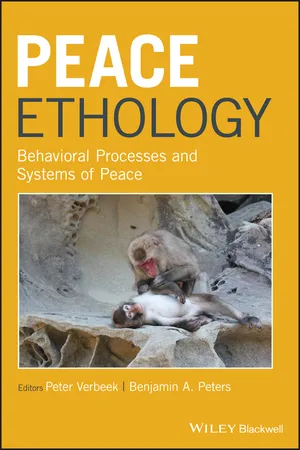
A scholarly collection of timely essays on the behavioral science of peace
With contributions from experts representing a wide variety of scholarly fields (behavioral and social sciences, philosophy, environmental science, anthropology and economics), Peace Ethology offers original essays on the most recent research and findings on the topic of the behavioral science of peace. This much-needed volume includes writings that examine four main areas of study: the proximate causation of peace, the developmental aspects of peace, the function and systems of peace and the evolution of peace.
The popular belief persists that, by nature, humans are not pre-disposed to peace. However, archeological and paleontological evidence reveals that the vast majority of our time as a species has been spent in small hunter-gatherer bands that are basically peaceful and egalitarian in nature. The text also reveals that most of the earth's people are living in more peaceful societies than in centuries past. This hopeful compendium of essays:
Contains writings from noted experts from a variety of academic studies
Offers a social-psychological perspective on the causation of peaceful behavior
Includes information on children's peacekeeping and peacemaking
Presents ideas for overcoming social tension between police and civilians
Provides the most recent thinking on the behavioral science of peace
Written for students and academics of the behavioral and social sciences, Peace Ethology offers scholarly essays on the development, nature, and current state of peace.
At the time that we are writing the introductory chapter to this volume, 100 years after the start of a “war to end all wars” and 70 years after the end of World War II, the world is not at peace. While we are writing this chapter in relative comfort, an untold number of our fellow human beings of all ages are suffering the effects of direct or structural violence. Even here, in one of the most peaceful countries in the world, people suffer these effects when there is bullying, domestic violence, assault, rape, and homicide, and these ill effects extend to those who are victims of discrimination, labor exploitation, and poverty, to name only a few examples. And yet, we believe that this is a promising time for peace. We see new opportunities for peace in behavioral science, in the global policy arena, and in everyday life. And we propose that these basic and applied opportunities for peace are intertwined.
This book develops and advances the behavioral science of peace. It offers new concepts for integrating knowledge systems concerning peace across disciplines, and it provides examples of recent research on behavioral processes and systems of peace that illustrate the integrative framework that we propose. The book grew out of a weeklong interdisciplinary workshop at the Lorentz Center of Leiden University in the Netherlands entitled “Obstacles and Catalysts of Peaceful Behavior” (OCPB). Fifty‐three scientists from three continents and a range of disciplines, including anthropology, ethology, evolutionary biology, neuroscience, political science, and psychology, attended the workshop in March 2013. Of the 23 authors in this book, 13 attended the workshop. While previous interdisciplinary gatherings at the Lorentz Center addressed behavioral aspects of peace (“Aggression and Peacemaking in an Evolutionary Context” in 2010 – see Fry 2013; and “Context, Causes and Consequences of Conflict” – see Kruk & Kruk de Bruin 2010), OCPB stood out due to its exclusive focus on peaceful behavior. One of the participants captured the synergistic mixture of topics addressed during the workshop and the promise this holds for the study of peace as follows: “It was very interesting to see how apparently disconnected realities, such as molecular biology, canine ethology, cooperation in primates, oxytocin, and Japan’s Article 9, came together and made sense in developing an alternative insight on peaceful behavior.” The aim of this book is to channel this synergy further by presenting a peace ethology approach to the behavioral processes and systems of peace.
Operationalizing Peace Concepts
A traditional perspective on peace links it to the absence of direct violence, in particular organized mass killing in war (Galtung 1996, 2012). Other forms of direct violence implied in this negative notion of peace include the examples mentioned in this chapter such as physical bullying, assault, and homicide, and extend to torture and the intentional destruction of homes and communities of targeted victims (cf. Opotow 2012). The more recent positive notion of peace is based on the absence of structural violence (Galtung 1996, 2012). Structural violence in this context refers to harm caused to people through, for example, social injustice, discrimination, prejudice, social or moral exclusion, and poverty linked to these conditions, and their intended or unintended cultural justifications (cf. Galtung 2012). Christie (2012) interprets these two complementary perspectives on peace as “direct peace” and “structural peace,” with the former achieved through peacemaking and the latter through peacebuilding (Table 1.1).
Table 1.1 Three dimensions of peace: direct, structural, and sociative peace.
Source: Adapted from Christie (2012).
Direct
Structural
Sociative
Violence
Direct violence1
Structural violence1
None/aggression3
Peace
Direct peace2
Structural peace2
Sociative peace3
Negative1
Positive1
(Peacemaking)2
(Peacebuilding)2
(Peacekeeping)4
1 Galtung (1996, 2012).
2 Christie (2012).
3 Gregor (1996), cited in Verbeek (2008).
4 Verbeek (2013).
Note: Peace terms adopted in this chapter are in boldface font.
Conceptualizing peace as the absence of violence tends to concentrate intellectual and practical energy on the study of obstacles to peace at the relative expense of the study of catalysts to peace. Moreover, implicit in this approach is the notion of peace as a state, specifically a state that occurs with the absence of direct and structural violence. In this volume, we present a dynamic approach to peace. We investigate and discuss peace as process, more specifically a complex of behavioral processes and the behavioral systems that may ensue as a function of these processes. Our treatment of peace as process reflects a contemporary perspective of peace, both in practice and in science, as evidenced, for example, in Nobel Peace Prize Laureate Óscar Arias Sánchez’ suggestion, “Peace is a never‐ending process, the work of many decisions by many people in many countries. It is an attitude, a way of life, a way of solving problems and resolving conflicts” (Sánchez 1995 cited in Verbeek 2008). This is mirrored by psychologists Morton Deutsch and Peter Coleman, who propose, “Peace is never achieved, but rather is a process that is fostered by a variety of cognitive, affective, behavioral, structural, institutional, spiritual, and cultural components” (Deutsch & Coleman 2012). Going by these two quotes alone, we can identity multiple levels and domains at which the processes of peace can be measured, including “decision‐making, attitudes, life‐styles, and conflict resolution” (from Sánchez 1995), and “cognitive and emotional functioning, behavior, (social) structures, institutional functioning, spirituality, and culture” (from Deutsch & Coleman 2012).
The process‐based concept of peace that we propose here transcends peace as a response to direct or structural violence (direct peace and structural peace) to include peace concerned with the pr...
Table of contents
Cover
Foreword
1 The Nature of Peace
Part One: Proximate Causation
Part Two: Development
Part Three: Function
Part Four: Evolution
Index
End User License Agreement
Trusted by 375,005 students
Access to over 1.5 million titles for a fair monthly price.
Study more efficiently using our study tools.
Frequently asked questions
Yes, you can cancel anytime from the Subscription tab in your account settings on the Perlego website. Your subscription will stay active until the end of your current billing period. Learn how to cancel your subscription
No, books cannot be downloaded as external files, such as PDFs, for use outside of Perlego. However, you can download books within the Perlego app for offline reading on mobile or tablet. Learn how to download books offline
Perlego offers two plans: Essential and Complete
Essential is ideal for learners and professionals who enjoy exploring a wide range of subjects. Access the Essential Library with 800,000+ trusted titles and best-sellers across business, personal growth, and the humanities. Includes unlimited reading time and Standard Read Aloud voice.
Complete: Perfect for advanced learners and researchers needing full, unrestricted access. Unlock 1.5M+ books across hundreds of subjects, including academic and specialized titles. The Complete Plan also includes advanced features like Premium Read Aloud and Research Assistant.
Both plans are available with monthly, semester, or annual billing cycles.
We are an online textbook subscription service, where you can get access to an entire online library for less than the price of a single book per month. With over 1.5 million books across 990+ topics, we’ve got you covered! Learn about our mission
Look out for the read-aloud symbol on your next book to see if you can listen to it. The read-aloud tool reads text aloud for you, highlighting the text as it is being read. You can pause it, speed it up and slow it down. Learn more about Read Aloud
Yes! You can use the Perlego app on both iOS and Android devices to read anytime, anywhere — even offline. Perfect for commutes or when you’re on the go. Please note we cannot support devices running on iOS 13 and Android 7 or earlier. Learn more about using the app
Yes, you can access Peace Ethology by Peter Verbeek, Benjamin A. Peters, Peter Verbeek,Benjamin A. Peters in PDF and/or ePUB format, as well as other popular books in Scienze biologiche & Ecologia. We have over 1.5 million books available in our catalogue for you to explore.