Multi-Asset Investing
eBook - ePub

Multi-Asset Investing

A Practitioner's Framework

  1. English
  2. ePUB (mobile friendly)
  3. Available on iOS & Android
eBook - ePub

Multi-Asset Investing

A Practitioner's Framework

About this book

Despite the accepted fact that a substantial part of the risk and return of any portfolio comes from asset allocation, we find today that the majority of investment professionals worldwide are focused on security selection. Multi-Asset Investing: A Practitioner's Framework questions this basic structure of the investment process and investment industry.

  • Who says we have to separate alpha and beta?
  • Are the traditional definitions for risk and risk premium relevant in a multi-asset class world?
  • Do portfolios cater for the 'real risks' in their investment processes?
  • Does the whole Emerging Markets demarcation make sense for investing?
  • Why do active Asian managers perform much poorer compared to developed market managers?
  • Can you distinguish how much of a strategy's performance comes from skill rather than luck?
  • Does having a performance fee for your manager create alignment or misalignment?
  • Why is the asset management transitioning from multi-asset strategies to multi-asset solutions?

These and many other questions are asked, and suggestions provided as potential solutions. Having worked together for fifteen years, the authors' present implementable solutions which have helped them successfully manage large asset pools.

The Academic Perspective

"Multi-Asset Investing asks fundamental questions about the asset allocation investment processes in use today, and can have a substantial impact on the future structure of the finance industry. It clarifies and distils the techniques that investment professionals need to master to add value to client portfolios."

—Paul Smith, President & CEO, CFA Institute

"Pranay Gupta, Sven Skallsjo, and Bing Li describe the essential concepts and applications of multi-asset investing. Their treatment is far ranging and exceptionally lucid, and always with a nod to practical application. Buy this book and keep it close at hand."

—Mark Kritzman, MIT Sloane School of Management

"Innovative solutions to some of the most difficult investment problems we are faced with today. Multi-asset Investing tackles investment issues which don't have straight forward solutions, but nevertheless are faced by every investment professional. This book sets the standard for investment processes of all asset managers."

—SP Kothari, MIT Sloane School of Management

The Asset Owner Perspective

"Multi-asset means different things to different people. This is the first text that details a comprehensive framework for managing any kind of multi-asset investment problem. Further, its explanation of the commercial aspects of managing a multi-asset investment business for an asset manager, private bank or asset owner make it an indispensable tool"

—Sadayuki Horie, Dy. Chairman - Investment Advisory Comm., Government Pension Investment Fund, Japan

"Multi-Asset Investing shows the substantial scope there is to innovate the asset allocation process. With its novel approaches to allocation, portfolio construction and risk management it demonstrates the substantial value that can be added to any portfolio. The solutions proposed by Multi-Asset Investing are creative, thought provoking, and may well be the way all portfolios need to be managed in the future."

—Mario Therrien, Senior Vice President, Caisse de Depot et Placement du Quebec, Canada

The Asset Manager's Perspective

"Never has astute asset allocation and diversification been more crucial than today. Asset Managers which are able to innovate their investment processes and products in this area, are more likely to be the winners. Multi-Asset Investing provides both simple and sophisticated, tested and implementable techniques for successfully managing multi-asset portfolios."

—Vincent Camerlynck, former CEO BNP Paribas Investment Partners, Asia Pacific

The Investment Strategist Perspective

"For plan sponsors, portfolio managers, analysts and risk managers, Multi-Asset Investing is an unparalleled guide for portfolio management. Its approach to blending the quantitative and fundamental, top-down and bottom up and the risk and return frameworks makes it a valuable tool for any kind of investment professional. It clarifies a complex subject into a series of practical ideas to help add value to any portfolio."

—Ajay S. Kapur, Chief Strategist, BOA Merrill Lynch Asia

Frequently asked questions

Yes, you can cancel anytime from the Subscription tab in your account settings on the Perlego website. Your subscription will stay active until the end of your current billing period. Learn how to cancel your subscription.
No, books cannot be downloaded as external files, such as PDFs, for use outside of Perlego. However, you can download books within the Perlego app for offline reading on mobile or tablet. Learn more here.
Perlego offers two plans: Essential and Complete
  • Essential is ideal for learners and professionals who enjoy exploring a wide range of subjects. Access the Essential Library with 800,000+ trusted titles and best-sellers across business, personal growth, and the humanities. Includes unlimited reading time and Standard Read Aloud voice.
  • Complete: Perfect for advanced learners and researchers needing full, unrestricted access. Unlock 1.4M+ books across hundreds of subjects, including academic and specialized titles. The Complete Plan also includes advanced features like Premium Read Aloud and Research Assistant.
Both plans are available with monthly, semester, or annual billing cycles.
We are an online textbook subscription service, where you can get access to an entire online library for less than the price of a single book per month. With over 1 million books across 1000+ topics, we’ve got you covered! Learn more here.
Look out for the read-aloud symbol on your next book to see if you can listen to it. The read-aloud tool reads text aloud for you, highlighting the text as it is being read. You can pause it, speed it up and slow it down. Learn more here.
Yes! You can use the Perlego app on both iOS or Android devices to read anytime, anywhere — even offline. Perfect for commutes or when you’re on the go.
Please note we cannot support devices running on iOS 13 and Android 7 or earlier. Learn more about using the app.
Yes, you can access Multi-Asset Investing by Pranay Gupta,Sven R. Skallsjo,Bing Li in PDF and/or ePUB format, as well as other popular books in Business & Finance. We have over one million books available in our catalogue for you to explore.

Information

Publisher
Wiley
Year
2016
Print ISBN
9781119241522
eBook ISBN
9781119241577
Edition
1
Subtopic
Finance

CHAPTER 1
An Introduction to the Multi-Asset Investment Problem

The last decade of financial market research and asset management has focused a great deal on the generation of alpha, the separation of return into alpha and beta, and in debating active versus passive management. Indeed, the majority of the investment industry across the world today is structured to support these facets of managing assets. The majority of market research carried out in investment banks is at the individual security level to advocate potential investments expected to generate excess return over the market benchmark. The majority of active asset managers in any asset class in any geographic region of the world claim to have skill in finding the “right” stocks and bonds, which would allow them to beat market benchmarks, and thus charge active management fees. Even asset owners, be it sovereign wealth funds, corporate and government pension plans or endowments have the majority of their effort and resources focused on selecting the right strategies and hiring and firing external managers.
This structure of the financial industry, however, seems to be at odds with a basic tenet that all of us have learnt over and over again – that asset allocation is responsible for 90% of the risk and return of a portfolio. While the actual number of 90% has been disputed by many, it is still widely accepted that asset allocation as a function accounts for a large part if not the majority of a portfolio’s total return. Why then do we have the bulk of the global financial services industry structured to focus on the 10% related to research and investment strategies based on security selection? Meanwhile, the main meat of the investment problem, portfolio allocation, remains pitifully under-researched, under-innovated and remains the single biggest cause for asset owners, institutional or individual, failing to reach their portfolio objectives.
A realization of this fact has led to an interest in global multi-asset investing. Initially starting with a focus on asset allocation, the field of multi-asset investing has become diverse, and is called by different names and positioned differently in different organizations. Apart from multi-asset, this research area has been called asset allocation, risk allocation, factor allocation, risk budgeting, strategic asset allocation, tactical asset allocation, macro investing, investment solutions and policy portfolio creation, to name a few, and is used at almost all levels of the investment spectrum from asset owner strategic portfolio creation to creation of fund of funds.
In this text we examine the many facets of multi-asset investing and propose a generalized framework that puts the nomenclature of various market activities in this field into perspective. We argue that all assets today operate within a global multi-asset context, and the “real” active management skill required for the successful management of asset owner portfolios is one of allocation. What is represented today as active or passive management relative to a market benchmark is a problem of considerably smaller significance. However, the multi-asset absolute return problem is far more difficult than a relative return investment problem, and requires better tools and methodologies than are available in the investment world today. This book hopes to propose some practical suggestions in this continuing evolution.

h2
1.1 WHAT IS MULTI-ASSET INVESTING?

We define multi-asset investing as any investment activity where more than one asset class is involved in the composition of an investment product, service or solution. This includes everything from the client requirement and product design, to the various components of the investment process and portfolio analysis required to manage such a product.
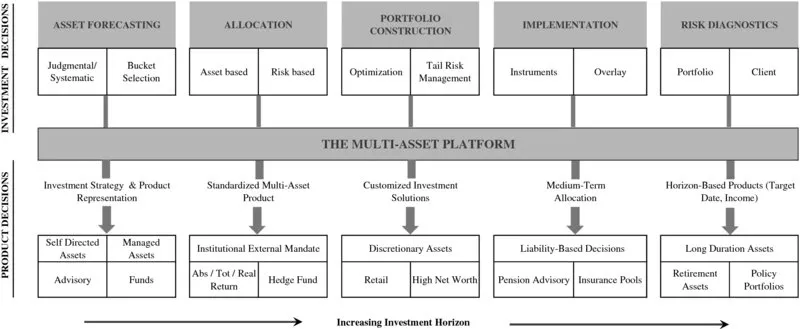
Figure 1.1 depicts a framework showing the broad architecture of all multi-asset activities covering this broad field. In the investment decisions category this covers asset forecasting, allocation, portfolio construction, implementation and risk diagnostics. A greater variety is emerging in the asset forecasting processes, both judgmental and systematic, along with greater introspection of the choice of buckets being used for allocation purposes. This variety of forecasts can then be formulated on the basis of return, risk or a combination of the two, at multiple investment horizons. Portfolio construction of a multi-asset portfolio is evolving to incorporate “real risk” constraints, along with greater focus on the management of tail risk. Implementation of the multi-asset portfolio is becoming more flexible, not only with active managers as is traditionally done, but with the newly available derivative instruments. This has brought back the active–passive debate, with the popularity of smart beta as a product category. Finally, the portfolio analysis or diagnostics framework needed to analyze issues and design improvements in the investment process is becoming a basic necessity. At the product decision level, there is greater effort to customize the investment product being offered. This has led to the creation of multiple multi-asset strategies, each of which is relevant to a category of asset owners, where their specific requirements and constraints are incorporated into the investment solution.
Block diagram: asset forecasting under investment decisions, et cetera points to multi-asset platform yielding increasing investment horizon under product decisions.
Figure 1.1 The variety of investment and product and decisions required in a multi-asset investment platform
In this book, we challenge some of the long accepted beliefs in the management of global multi-asset strategies, and propose some heuristic solutions to problems that are faced by practitioners. We propose tested non-standard solutions to some of the actual practical problems faced in global multi-asset investing. In many cases, it is difficult to prove with an academic level of rigor that the proposed solution is theoretically optimal; however, what we can say is that we have used each and every one of these tools successfully in the management of large asset pools. The techniques described here may not be the final end product of the investment process evolution, but seem to be a more robust solution than what is used in many investment processes today. Finally, we aim to provide a structure that can serve as the basis for the direction of future research initiatives in the many areas that encompass multi-asset investing.

h2
1.2 THE CONVENTIONAL STRUCTURE

The original concept of investing across multiple asset classes in a portfolio was based on the premise that it provided diversification and that investing in equities would earn a risk premium. These two concepts of diversification and risk premium spawned the creation of multi-asset investing for asset owner portfolios. However, the two basic tenets of the traditional framework stand challenged today as cross-asset correlation is much higher and risk premium lower and more volatile. The basic requirements of an asset owner of a target return and managed drawdown risk are therefore more challenging to meet. This has led to greater focus on all aspects of the multi-asset investment process which can be improved. An evolution in the creation, management and deployment of multi-asset products is therefore underway in order to accommodate the more complex global financial markets, where hybrid instruments and derivatives are more readily available.

h2
1.3 TRANSITIONING FROM ACTIVE MANAGEMENT TO EXPOSURE ALLOCATION

The concept of asset classes based on instruments used in corporate capital structure has been at the foundation of multi-asset investing. Having segmented the financial universe into these asset classes, the majority of investment resources in both asset owners and asset managers are focused on beating the respective asset class market benchmarks to create alpha. But is separation of alpha and beta necessary for a better investment outcome or simply for deciding what is an appropriate fee structure? We propose a structure which generalizes the concepts of alpha and beta, and argue that there is no clear distinction between alpha and beta. The demarcation is actually between commoditized and non-commoditized beta exposures, which changes as the market evolves. We believe that the implications of this framework for active investment and risk management processes, is that the investment management industry will transition to a structure where greater resources and effort are spent on allocation, compared to alpha generation.
Another ramification of the instrument-based asset class structure is that this categorization has also been used as the basis for asset allocation decisions. However, while allocation is improved by using uncorrelated silos, we know that there is a conceptual overlap between credit and equity as parts of a single corporate capital structure. Disentangling interest rate risk present in sovereign bonds, credit risk present in corporate bonds and equity risk present in equity securities, would allow the creation of a stacked structure for estimation of risk and risk premiums. We believe this may be a more appropriate structure for allocation decisions.

h2
1.4 CREATING AN IMPROVED ALLOCATION STRUCTURE

Most plan sponsors formulate a single long-term asset allocation for their assets, and then spend a great deal of effort to select a number of active managers within each silo of asset class or style. While this diversifies alpha and manager risk, it ignores the fact that the single most important decision responsible for the risk and performance of the assets, the allocation decision, which remains as an undiversified single decision, is in many cases outsourced or done with minimal internal resources, and is the primary cause of many plans having funding gaps.
We argue that the traditional plan sponsor asset allocation process needs to be redesigned to become multi-strategy in design, and be implemented by asset owners using a range of approaches. Different views and methodologies will therefore reduce the plan’s exposure to a single point of failure, and provide diversification where it’s needed most. We discuss two such approaches – a fundamental process and a systematic process. Our fundamental allocation process is based on the concept of business cycles, and proposes that asset prices are impacted by six main cycles – the global business cycle, the local business cycle, the monetary cycle, the credit and capex cycles and the market cycle. Along with risk limiting factors, we have found that this assimilation of cycle information is useful in taking allocation decisions.
A second approach to allocation is grounded in quantitative techniques to create a strategic allocation stance against major asset classes. Using a risk budgeting framework, and adapting it to regimes caused by macroeconomic changes allows us to actively alter the allocation between the main asset classes. With the implementation of a drawdown management approach, we find that this modified active risk budgeting process yields better results across various evaluation parameters, when compared to a standard risk allocation process, or a 60/40 portfolio. We further confirm the stability of this approach by testing its viability in different historic time periods, and different bull and bear market regimes for equities and bonds.
Finally, we discuss a new approach to make the allocation forecasting process more efficient. An army of investment analysts at investment banks regularly analyze individual securities ...

Table of contents

  1. Cover
  2. Series
  3. Title page
  4. Copyright
  5. Dedication
  6. Preface
  7. About the Authors
  8. Chapter 1 An Introduction to the Multi-Asset Investment Problem
  9. Chapter 2 The Traditional Allocation Structure
  10. Chapter 3 Transitioning from Active Management to Exposure Allocation
  11. Chapter 4 Redefining Risk Premium for Multi-Asset Allocation Decisions
  12. Chapter 5 A Multi-Strategy Allocation Structure
  13. Chapter 6 A Fundamental Exposure Allocation Approach – Business Cycles
  14. Chapter 7 A Systematic Exposure Allocation Process – Active Risk Budgeting
  15. Chapter 8 Estimation of Asset Allocation
  16. Chapter 9 Optimization for Multi-Asset Portfolios
  17. Chapter 10 Managing Tail Risk in Multi-Asset Portfolios
  18. Chapter 11 Multi-Asset Investing in Emerging Markets
  19. Chapter 12 The Importance of Asset Allocation in Asian Equities
  20. CHAPTER 13 Implementing a Multi-Asset Strategy – Active or Passive
  21. Chapter 14 An Exposure-Based Risk Diagnostics Framework
  22. Chapter 15 Impact of Manager Compensation on Allocation Decisions
  23. Chapter 16 From Multi-Asset Strategies to Multi-Asset Solutions
  24. Chapter 17 Multi-Asset Investing for Private Wealth Assets
  25. Chapter 18 Structuring a Multi-Asset Investing Business
  26. Chapter 19 Competing for Better Institutional Investment Outcomes
Willis Towers Watson Investment Services
  27. Bibliography and References
  28. Index
  29. EULA