A unique guide to the most important technical aspects of photovoltaic power generation with comprehensive analysis and author industry-experience
Unique from other books in the area in that it explains profound theories in simple language, introduces widely used production equipment and processes for industry professionals, and explains the complete PV industry chain from material to power generation
Has originated from the author's practical industry experience, enabling the use of up-to-date information during this time of new development in the Chinese PV industry
Content includes approximately 255 illustrations and 46 tables to help clarify complex theories.
1.1.1 Solar Energy Is the Most Promising Renewable Energy Source in the World
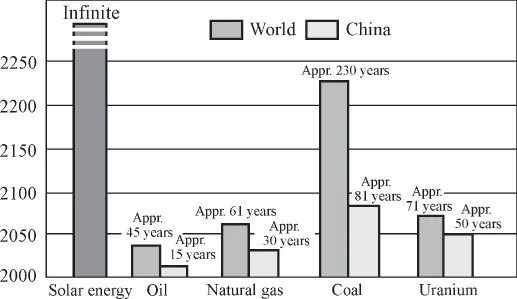
The amount of solar radiation striking the earth per second is equivalent to the energy obtained by burning 500 tons of coal. The thermonuclear reactions inside the sun can last 6 × 10¹⁰ years and generate ‘inexhaustible’ energy. Many energy sources on the earth including wind energy, hydro energy, ocean thermal energy, tidal energy and biomass energy derive their energy from the sun. The currently most widely used fossil fuels such as oil, natural gas and coal are also the forms of the stored energy originally obtained from the sun. As shown in Figure 1.1, based on the existing proved reserves and the current consumption rate of the conventional fossil energy, the world's primary energy source from fossil fuels will be exhausted soon, and China in particular will face a severe shortage of fossil energy sources. In addition, the excessive use of fossil fuels has led to environmental problems and climate change, which has attracted growing attention from governments all around the world. With the outbreak of the energy crisis and the impending depletion of fossil energy resources on the earth, people are increasingly aware of the urgent need to develop solar energy and other renewable energy sources. Both the signing of the Kyoto Protocol in 1997 and the holding of the 2009 UN Climate Change Conference in Copenhagen indicate most governments in the world have regarded the renewable energy use as their national energy strategy. Particularly solar energy is of the greatest strategic significance as it is the ideal renewable and sustainable energy source.
Figure 1.1 Timescale for depletion of conventional fossil energy resources in China and across the world (based on the proved reserves and current consumption rate).
According to statistics, in 2006, the world population already exceeded 6.5 billion and the world energy demand converted into the installed capacity was 14.5 terrawatt (TW); by 2050, the world population will reach 90 to 10 billion and the world energy demand converted into the installed capacity will approximate 60 TW. By that time the world will have almost used up the primary energy resources and have to rely on renewable energy sources. It's reported that the world has a potential hydropower capacity of 4.6 TW only 0.9 TW of which can be actually exploited; the world has 2 TW of actually exploitable wind energy and 3 TW of biomass energy. It means that with a potential capacity of 120,000 TW and the actual available capacity of 600 TW, solar energy will remain the only energy source that can meet the future world energy demand. In this sense, photovoltaic (PV) power will be a key part of the future world energy consumption structure.
The U.S. Department of Energy also released a similar report in 2005. Although the long-term world energy consumption forecasting varies from country to country, the prediction of the future world energy consumption trend remains identical (see Table 1.1 for detailed information).
Table 1.1 Future world dnergy demand and renewable resources
Actual World Energy Consumption in 2004
13 TW
Estimated World Energy Consumption in 2050
30 TW
Estimated World Energy Consumption in 2100
46 TW
Undeveloped Hydropower
<0.5 TW
Ocean energy (tides, waves, currents)
<2 TW
Terrain Energy
12 TW
Available Wind Energy
2∼4 TW
Total World Solar Energy
120,000 TW
The Joint Research Centre made a similar forecast according to which PV power will become the most important part in the world energy consumption. By 2030, renewable energy will account for more than 30% of the total world energy consumption while over 10% of the world power supply will come from PV power. By 2040, renewable energy will account for more than 50% of the total world energy consumption while over 20% of the world power supply will come from PV power. By the end of this century, renewable energy will account for more than 80% of the total world energy consumption while over 60% of the world power supply will come from PV power. Judging from the development in the past 20 years, PV power development will be further accelerated.
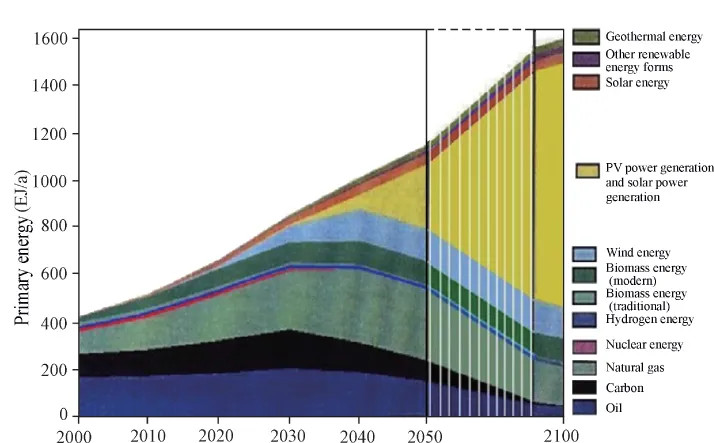
With the gradual depletion of the fossil energy resources, human beings must accelerate developing renewable energy resources to achieve sustainable energy resource development. It's predicted that by 2050 PV power and solar thermal power will account for a higher proportion than fossil energy resources and other renewable energy resources in the world energy consumption structure. Figure 1.2 indicates the forecast of the development trend of world energy consumption structure in the twenty-first century.
Figure 1.2 Forecast of world energy consumption structure in the twenty-first century.
PV power generation technologies were first applied in space. At present it has been widely used on the earth. Governments all around the world have given support in policy to the development of PV power generation technologies and the application of these technologies in architecture. Grid-connected PV power generation and PV power stations will become the inevitable trend of PV power development. A lot of countries are competing with each other to develop various PV materials and high-efficiency PV power generation technologies to expand the application fields of solar energy.
The rapid development of the solar cell industry is quite unique in the modern industry and unmatched by even the semiconducto...
Table of contents
Cover
Title Page
Copyright
Table of Contents
About the Author
Preface
Chapter 1: Basic Physics of Solar Cells
Chapter 2: Materials of Solar Cells
Chapter 3: Preparation Methods of Crystalline Silicon Solar Cells
Chapter 4: Preparation Methods of Thin Film Silicon Solar Cells
Chapter 5: High-Efficiency Silicon Solar Cells and Non-Silicon-Based New Solar Cells
Chapter 6: Modules and Arrays of Solar Cells
Chapter 7: PV Systems and Grid-Connected Technologies
Bibliography
Index
End User License Agreement
Trusted by 375,005 students
Access to over 1.5 million titles for a fair monthly price.
Study more efficiently using our study tools.
Frequently asked questions
Yes, you can cancel anytime from the Subscription tab in your account settings on the Perlego website. Your subscription will stay active until the end of your current billing period. Learn how to cancel your subscription
No, books cannot be downloaded as external files, such as PDFs, for use outside of Perlego. However, you can download books within the Perlego app for offline reading on mobile or tablet. Learn how to download books offline
Perlego offers two plans: Essential and Complete
Essential is ideal for learners and professionals who enjoy exploring a wide range of subjects. Access the Essential Library with 800,000+ trusted titles and best-sellers across business, personal growth, and the humanities. Includes unlimited reading time and Standard Read Aloud voice.
Complete: Perfect for advanced learners and researchers needing full, unrestricted access. Unlock 1.5M+ books across hundreds of subjects, including academic and specialized titles. The Complete Plan also includes advanced features like Premium Read Aloud and Research Assistant.
Both plans are available with monthly, semester, or annual billing cycles.
We are an online textbook subscription service, where you can get access to an entire online library for less than the price of a single book per month. With over 1.5 million books across 990+ topics, we’ve got you covered! Learn about our mission
Look out for the read-aloud symbol on your next book to see if you can listen to it. The read-aloud tool reads text aloud for you, highlighting the text as it is being read. You can pause it, speed it up and slow it down. Learn more about Read Aloud
Yes! You can use the Perlego app on both iOS and Android devices to read anytime, anywhere — even offline. Perfect for commutes or when you’re on the go. Please note we cannot support devices running on iOS 13 and Android 7 or earlier. Learn more about using the app
Yes, you can access Technology, Manufacturing and Grid Connection of Photovoltaic Solar Cells by Guangyu Wang in PDF and/or ePUB format, as well as other popular books in Physical Sciences & Energy. We have over 1.5 million books available in our catalogue for you to explore.