Essential Statistics for the Pharmaceutical Sciences
eBook - ePub

Essential Statistics for the Pharmaceutical Sciences

  1. English
  2. ePUB (mobile friendly)
  3. Available on iOS & Android
eBook - ePub

Essential Statistics for the Pharmaceutical Sciences

About this book

Essential Statistics for the Pharmaceutical Sciences is targeted at all those involved in research in pharmacology, pharmacy or other areas of pharmaceutical science; everybody from undergraduate project students to experienced researchers should find the material they need.

This book will guide all those who are not specialist statisticians in using sound statistical principles throughout the whole journey of a research project - designing the work, selecting appropriate statistical methodology and correctly interpreting the results.  It deliberately avoids detailed calculation methodology.  Its key features are friendliness and clarity.   All methods are illustrated with realistic examples from within pharmaceutical science.

This edition now includes expanded coverage of some of the topics included in the first edition and adds some new topics relevant to pharmaceutical research.

  • a clear, accessible introduction to the key statistical techniques used within the pharmaceutical sciences
  • all examples set in relevant pharmaceutical contexts.
  • key points emphasised in summary boxes and warnings of potential abuses in 'pirate boxes'.
  • supplementary material - full data sets and detailed instructions for carrying out analyses using packages such as SPSS or Minitab – provided at:
    https://www.wiley.com/go/rowe/statspharmascience2e

An invaluable introduction to statistics for any science student and an essential text for all those involved in pharmaceutical research at whatever level.

Tools to learn more effectively

Saving Books

Saving Books

Keyword Search

Keyword Search

Annotating Text

Annotating Text

Listen to it instead

Listen to it instead

Information

Part 1
Presenting data

1
Data types

This chapter will …

  • Set out a system for describing different types of data.
  • Explain why we need to identify the type of data with which we are dealing.

1.1 Does it really matter?

To open a statistics book with a discussion of the way in which data can be categorised into different types probably sounds horribly academic. However, the first step in selecting a data handling technique is generally identifying the type of data with which we are dealing. So, it may be dry, but it does have real consequences.
We will discuss three types of data. These go under a variety of names. The names that this book will use are (with common alternatives in brackets):
  • Interval scale (Continuous measurement data)
  • Ordinal scale (Ordered categorical data)
  • Nominal scale (Categorical data)

1.2 Interval scale data

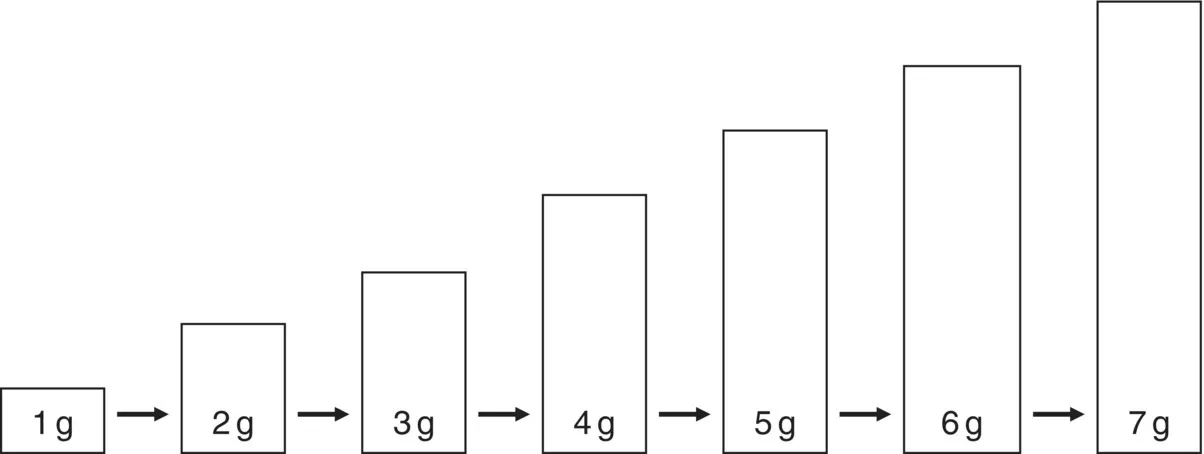
The first two types of data that we will consider are both concerned with the measurement of some characteristic. ‘Interval scale’ (or what is sometimes called ‘Continuous measured’) data includes most of the information that would be generated in a laboratory. These include weights, lengths, timings, concentrations, pressures etc. Imagine we had a series of objects weighing 1, 2, 3 and so on up to 7 g, as in Figure 1.1.
c1-fig-0001
Figure 1.1 Interval scale data – a series of weights (1–7 g)
Now think about the differences in weights as we step from one object to the next. These steps, each of one unit along the scale, have the following characteristics:
  1. The steps are of an exactly defined size. If you told somebody that you had a series of objects like those described above, he or she would know exactly how large the weight differences are as we progressed along the series.
  2. All the steps are of exactly the same size. The weight difference between the 1 and 2 g objects is the same as the step from 2 to 3 g or 6 to 7 and so on.
Because these measurements have constant sized steps (intervals), the measurement scale is described as a ‘Constant interval scale’ and the data as ‘Interval scale’. Although the weights quoted in Figure 1.1 are exact integers, weights of 1.5 or 3.175 g are perfectly possible, so the measurement scale is said to be ‘Continuous’.

1.3 Ordinal scale data

Again measurement is involved, but the characteristic being assessed is often more subjective in nature. It’s all well and good to measure nice neat objective things like blood pressure or temperature, but it’s also a good idea to get the patient’s angle on how they feel about their treatment. The most obvious way to do this is as a score, of (say) –2 to +2 with the following equivalences:
  • –2 = Markedly worse
  • –1 = A bit worse
  • 0 = About the same
  • +1 = A bit better
  • +2 = Markedly better
In this case (Figure 1.2) all we know is that if one patient reports a higher value than another, they are more satisfied with their outcome. However, we have no idea how much more satisfied he/she might be.
c1-fig-0002
Figure 1.2 Ordinal scale data – scores for patient responses to treatment
Since we have no idea how large the steps are between scores, we obviously could not claim that all steps are of equal size. In fact, it is not even necessarily the case that the difference between scores of –2 and 0 is greater than that between +1 and +2. So, neither of the special characteristics of a constant interval scale apply to this data.
The name ‘Ordinal’ reflects the fact that the various outcomes form an ordered sequence going from one extreme to its opposite. Such data is sometimes referred to as ‘Ordered categorical’. In this case the data is usually discontinuous; individual cases being scored as –1 or +2 and so on, with no fractional values.

1.4 Nominal scale data

In this case there is no sense of measuring a characteristic; we use a system of classifications, with no natural ordering. For example, one of the factors that influences the effectiveness of treatment could be the specific manufacturer of a medical device. So, all patients would be classified as users of ‘Smith’, ‘Jones’, or ‘Williams’ equipment. There is no natural sequence to these; they are just three different makes...

Table of contents

  1. Cover
  2. Title page
  3. Table of Contents
  4. Preface
  5. Statistical packages
  6. About the website
  7. Part 1: Presenting data
  8. Part 2: Interval-scale data
  9. Part 3: Nominal-scale data
  10. Part 4: Ordinal-scale data
  11. Part 5: Other topics
  12. Index
  13. End User License Agreement

Frequently asked questions

Yes, you can cancel anytime from the Subscription tab in your account settings on the Perlego website. Your subscription will stay active until the end of your current billing period. Learn how to cancel your subscription
No, books cannot be downloaded as external files, such as PDFs, for use outside of Perlego. However, you can download books within the Perlego app for offline reading on mobile or tablet. Learn how to download books offline
Perlego offers two plans: Essential and Complete
  • Essential is ideal for learners and professionals who enjoy exploring a wide range of subjects. Access the Essential Library with 800,000+ trusted titles and best-sellers across business, personal growth, and the humanities. Includes unlimited reading time and Standard Read Aloud voice.
  • Complete: Perfect for advanced learners and researchers needing full, unrestricted access. Unlock 1.4M+ books across hundreds of subjects, including academic and specialized titles. The Complete Plan also includes advanced features like Premium Read Aloud and Research Assistant.
Both plans are available with monthly, semester, or annual billing cycles.
We are an online textbook subscription service, where you can get access to an entire online library for less than the price of a single book per month. With over 1 million books across 990+ topics, we’ve got you covered! Learn about our mission
Look out for the read-aloud symbol on your next book to see if you can listen to it. The read-aloud tool reads text aloud for you, highlighting the text as it is being read. You can pause it, speed it up and slow it down. Learn more about Read Aloud
Yes! You can use the Perlego app on both iOS and Android devices to read anytime, anywhere — even offline. Perfect for commutes or when you’re on the go.
Please note we cannot support devices running on iOS 13 and Android 7 or earlier. Learn more about using the app
Yes, you can access Essential Statistics for the Pharmaceutical Sciences by Philip Rowe in PDF and/or ePUB format, as well as other popular books in Medicine & Pharmacology. We have over one million books available in our catalogue for you to explore.