eBook - ePub
Environmental Impact of Polymers
- English
- ePUB (mobile friendly)
- Available on iOS & Android
eBook - ePub
Environmental Impact of Polymers
About this book
This text addresses the common negative perception of polymer materials on the environment with a thorough analysis of what really occurs when industry and academia collaborate to find environmental solutions. The book examines the environmental and social effects of polymer materials and explains methods of quantifying environmental performance. With an emphasis on the importance of education, the authors stress the importance of awareness and activity in negating polymers' environmental impact.
Information
1
Some Notes on Two Controversies around Plastic Materials and their Media Coverage
1.1. Introduction
This chapter addresses two controversies associated with plastics, namely the fate of plastic waste in the environment and the effects of substances contained in plastics and suspected of having endocrine-disrupting effects.
Section 1.2 is designed to be a non-exhaustive introduction to the treatment by social science, and more generally by the interdisciplinary science of risk, to the question of the effects of plastics on health and the environment. Section 1.3 provides an empirical analysis of the media coverage of these two controversies, with a corpus chosen as an example (French newspapers and two television documentaries). On this basis, we draw conclusions about the role, actual and potential, of researchers in chemistry in relation to the analyzed controversies.
1.2. Socio-political aspects of the two controversies in the scientific literature
The controversy surrounding the regulation of the risks of endocrine disruptors has crystallized around conflicting arguments regarding the role of low-dose toxicity of chemical substances in general. Scientific confrontation between the classical vision in toxicology of postulating the monotonous character of the relationship between dose and effect, and the emergence of research showing the existence of non-monotonic [VAN 09] relationships, raises questions about the adequacy of the regulatory protocols of risk assessment. Used for many years, these protocols are built upon the basis of the “traditional” vision of risk.
One of the best known controversies of endocrine disruptors concerns bisphenol-A (BPA). For researchers who conducted toxicological research on BPA, the scientific debate touches upon several aspects of risk. Generally for endocrine disrupters, the points in contradiction concern the existence of non-monotonic dose–response relationships, the relevance of proof of the physiological nature which seems to confirm the effects of low doses, and the importance of critical windows of exposure. Vandenberg et al. [VAN 09] analyzed in detail the scientific literature on BPA, including whether:
– the mechanisms of action of the substance are understood for low doses;
– the population is exposed to levels high enough for an effect to occur;
– the oral route of exposure is the only relevant route;
– BPA is conjugated by the digestive system;
– animal studies can be extrapolated to humans;
– the effects observed in animals exposed to BPA are consistent from one study to another;
– BPA induces cancer.
The way we consider each of these arguments may have a decisive influence on how to assess the risk of BPA. Depending upon the specialists they welcomed into their midst, committees of various experts have made different assessments of the relevance of the knowledge for each of these elements. The result is a situation that may seem paradoxical: various expert committees have resulted in completely opposite conclusions from the same starting data: if for some “there is no risk from BPA” for others “there is a general risk from BPA for the entire population” [BER 10].
The literature in social science is relatively poor in studies of the controversy surrounding endocrine disruptors and is even poorer concerning the controversy about the future of plastic waste. A search of the literature of the CNRS in social science with the keywords “plastic”/“plastics” in the title and “controversy” in the body of the article results in a single article dealing with a controversy about a major fire in a plastics recycling factory in Canada. A search with the word “plastic” in the title and “media” + “environment” in the body of the article leads to no responses.
The first systematic analysis of public attitudes to the controversy surrounding BPA was recently published by Brewer and Ley [BRE 11]. The authors studied four categories of public attitudes, namely familiarity with BPA, concerns toward its toxicity, support for bans and behaviors to reduce the personal exposure to plastics containing this substance. The study showed that these attitudes are directly correlated to two factors:
– the use of media (i.e. newspapers and the Internet);
– the level of trust in the key players in the controversy (i.e. scientists, the food safety and environmental agency primarily concerned with controlling the risk of chemical substances and industry).
The use of traditional media has an influence which is directly proportional to the level of familiarity with the subject and to the protective individual behavior. More than newspapers, the use of the Internet has been found to be a major factor influencing concerns, pro-ban attitudes and protective behaviors. TV is not correlated to any of the attitudes studied.
Yet the media is not an essential factor for favorable attitudes toward banning the substance. The less we have confidence in the US Food and Drug Administration (FDA) and industry, the more we are in favor of banning BPA and the more we are concerned with toxicity. Similarly, the higher the confidence in science, the more attitudes are in favor of banning BPA and demonstrating concern for its toxicity.
Somewhat paradoxically, confidence in the FDA does not play an important role in protective behaviors (whereas the role of such an agency is precisely to induce such behavior when a potential hazard exists or, in contrast, to assert their lack of necessity when the risk is not real).
The use of the media (traditional and the Internet) and the trust (or not) in the players having a central role to play represent, therefore, “shortcuts” (heuristics) for the public that help non-specialists to form an opinion during scientific controversies and to take decisions in relation to their individual consumption practices.
Among the English-language writers, Sheldon Krimsky was among the first to study the history of the controversy surrounding endocrine disruptors in the United States in his book Hormonal Chaos [KRI 00]. Another recent sociological and historical analysis of the risk assessment of BPA had a significant impact in the United States. This is the work of Sarah Vogel of Columbia University, “The Politics of Plastics: The Making and Unmaking of Bisphenol A ‘Safety’” [VOG 09]. Her description of the controversy emphasizes the disparity between the standards of risk assessment, still in force after about 20 years in the United States, and the scientific advances on the effects of doses. A second striking element of this analysis is the polarization of the industry studies and the public research on the toxicity of BPA – the first showing no effect, while the vast majority of the second highlights various changes in the prostate of the fetus and in the development of the mammary gland, genetic, immune and metabolic perturbations, and changes at neurological and behavioral levels. This “funding effect” cited by Vogel [VOG 09] is particularly well demonstrated by a study of the literature conducted by Vom Saal and Hughes [SAA 05], which showed that 90% of the 115 studies financed by government sources reported effects of one form or another owing to BPA exposure of the (regulatory) reference dose or below this dose, whereas none of the 11 studies funded by industry showed an effect.
In the field of social sciences in France, a recent research report describes the emergence of “low doses” as a cornerstone of a paradigm change in terms of risks to health and the environment. Analyzing several controversies and on the basis of a series of interviews with epistemologists, toxicologists and biologists, Chateauraynaud et al. [CHA 11] describe the history of the question (sociological and political as well as scientific) of low doses in three waves (the 1960s with the radiological risk and the inability to determine a threshold below which an exposure to radioelements would be safe; the major health crises of the 1990s and the rise of the precautionary principle; and finally the controversy surrounding endocrine disruptors with the questioning of dose–monotonous effect relationships). The study concludes with a “reconfiguration of the relationship between fundamental research, risk assessment and public management of vulnerabilities”.
Its funding from the PNRPE program of the Department of Ecology, research has been done by Jean-Paul Gaudillère (INSERM) and Nathalie Jas (INRA), into a comparison of the trajectories of the controversy surrounding endocrine disruptors in France and in the United States. The project began at the time when endocrine disruptors were not yet becoming a media controversy and were not yet visible in France. The central hypothesis of the project was the difference between France (some controversy) and the United States (strong controversy for several years) and was not so much about the presence or absence of certain research skills but rather concerned the practical expertise and public debate and whether or not it facilitated the convergence between ecology, medicine and agriculture.1
Finally, the communication to the general public of scientific uncertainty about the effects of endocrine disruptors on male fertility has been studied in a recent research project and published in part in Maxim et al. [MAX 12].
The author is not aware of media coverage in France of any analysis of the controversies surrounding plastics.
1.3. Plastics in the French media: a small sample
Two main topics recur in recent media treatment of the environmental and health effects of plastics, especially the environmental effects of plastic waste (particularly to the oceans) and the effects on public health of toxic substances contained within plastics.
For an analysis of the written press, the results presented in section 1.2 are from a search using the LexisNexis database, which is one of the largest collections of French and international print media, with is updated as soon as the newspapers are published and provides almost exhaustive access to national and regional sources in France.
For televisual news, the results are from a non-systematic analysis of two documentaries, namely “Addicted to plastic” and “Plastics: a toxic warning”.
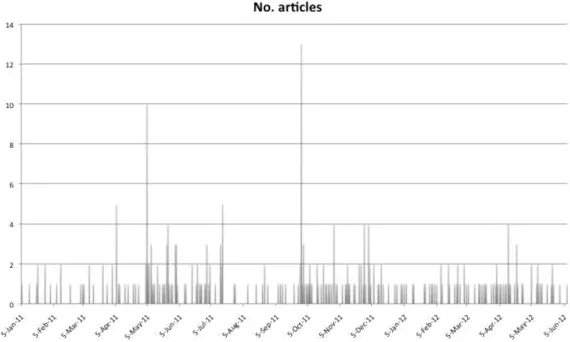
Figure 1.1. Distribution of the “endocrine disruptor” corpus in 2011–2012
1.3.1. The written press: endocrine disruption
The corpus used for analyzing the media coverage of endocrine disruptors has been obtained by using the keywords “disruptor” and “endocrine” for the period from 1st January 2011 to 10th June 2012. A number of articles, 278, were identified in newspapers, magazines and internet media. Mail, legal news and the specialized press were excluded. This controversy appeared with relatively constant frequency throughout the corpus of the year 2011 (Figure 1.1).
The four peaks which can be observed (Figure 1.1) are associated with specific events:
– 5th April 2011 corresponds to the publication of a study showing that distylbene has transgenerational effects on the grandchildren of women treated with it;
– 4th May, when the National Assembly passed a bill banning the use of endocrine disrupters such as phthalates and parabens;
– 15th July, at the occasio...
Table of contents
- Cover
- Contents
- Title Page
- Copyright
- Preface
- Introduction: The Societal Impact of Polymers and Plastic Materials: Solutions and Perspectives
- 1 Some Notes on Two Controversies around Plastic Materials and their Media Coverage
- 2 Plastic Waste and the Environment
- 3 Polymers and Marine Litter
- 4 Between Prejudice and Realities: How Plastics Are Essential for the Future
- 5 Lifecycle Assessment and Green Chemistry: A Look at Innovative Tools for Sustainable Development
- 6 Are Bioplastics “Green” Plastics?
- 7 Environmental Characterization of Materials for Product Design
- 8 Choice of Materials and Environmental Impact: Case of a Water Bottle
- 9 Formulation and Development of Biodegradable and Bio-based Multiphase Materials: Plasticized Starch-based Materials
- 10 Different Strategies for Ecoplastics Development
- 11 Thoughts about Plastic Recycling. Presentation of a Concrete Example: End-of-Life Polypropylene
- 12 Recyclable and Bio-based Materials Open Up New Prospects for Polymers: Scientific and Social Aspects
- 13 Food Packaging: New Directions for the Control of Additive and Residue Migration
- 14 Biodegradability and/or Compostability?
- 15 The Regulation by Law of Nanosciences and Nanotechnologies
- 16 Teaching Sustainable Development
- List of Author
- Index
Trusted by 375,005 students
Access to over 1.5 million titles for a fair monthly price.
Study more efficiently using our study tools.
Frequently asked questions
Yes, you can cancel anytime from the Subscription tab in your account settings on the Perlego website. Your subscription will stay active until the end of your current billing period. Learn how to cancel your subscription
No, books cannot be downloaded as external files, such as PDFs, for use outside of Perlego. However, you can download books within the Perlego app for offline reading on mobile or tablet. Learn how to download books offline
Perlego offers two plans: Essential and Complete
- Essential is ideal for learners and professionals who enjoy exploring a wide range of subjects. Access the Essential Library with 800,000+ trusted titles and best-sellers across business, personal growth, and the humanities. Includes unlimited reading time and Standard Read Aloud voice.
- Complete: Perfect for advanced learners and researchers needing full, unrestricted access. Unlock 1.5M+ books across hundreds of subjects, including academic and specialized titles. The Complete Plan also includes advanced features like Premium Read Aloud and Research Assistant.
We are an online textbook subscription service, where you can get access to an entire online library for less than the price of a single book per month. With over 1.5 million books across 990+ topics, we’ve got you covered! Learn about our mission
Look out for the read-aloud symbol on your next book to see if you can listen to it. The read-aloud tool reads text aloud for you, highlighting the text as it is being read. You can pause it, speed it up and slow it down. Learn more about Read Aloud
Yes! You can use the Perlego app on both iOS and Android devices to read anytime, anywhere — even offline. Perfect for commutes or when you’re on the go.
Please note we cannot support devices running on iOS 13 and Android 7 or earlier. Learn more about using the app
Please note we cannot support devices running on iOS 13 and Android 7 or earlier. Learn more about using the app
Yes, you can access Environmental Impact of Polymers by Thierry Hamaide, Rémi Deterre, Jean-François Feller, Thierry Hamaide,Rémi Deterre,Jean-François Feller in PDF and/or ePUB format, as well as other popular books in Physical Sciences & Organic Chemistry. We have over 1.5 million books available in our catalogue for you to explore.