Dementia Care at a Glance is the perfect companion for health and social care professionals, nurses, students as well as family members and voluntary workers needing information and guidance about dementia care. Taking a person-centred and interpersonal approach, each chapter outlines an aspect of the experience of living with dementia and the steps that the nurse or healthcare professional can take to support them.
This comprehensive book will assist readers to respond effectively, sensitively and with compassion to people living with dementia in acute settings, as well as in care environments and at home. It acknowledges the challenges that arise for people with dementia, family members and professionals and offers practical solutions based on current thinking and best practice.
Presented in the bestselling at a Glance format, with superb illustrations and a concise approach
Covers the common forms and manifestations of dementia, their causes, and how to address them
Addresses a wide range of topics including, interventions, communication, care planning, medication, therapy, leadership as well as ethical and legal issues
Takes a positive holistic approach, including not only physical and mental health issues but social and spiritual implications and a person-centred focus throughout
Suitable for students on a range of healthcare courses
Supported by a companion website with multiple-choice questions and reflective questions
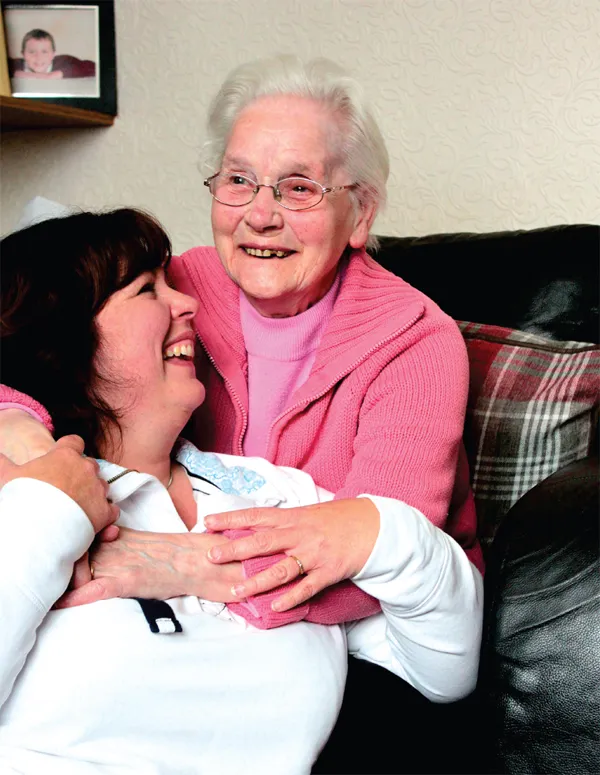
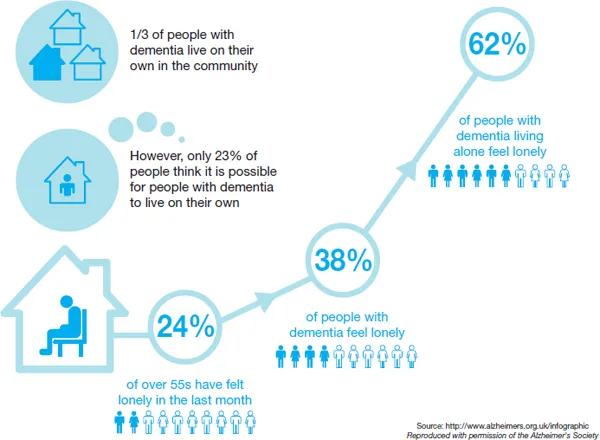
‘Dementia' is an umbrella term, referring to a range of conditions associated with old age in which memory, language skills, cognitive functioning and the ability to carry out everyday activities of daily living are progressively weakened due to processes within the brain that lead to gradual neuronal death. Dementia is not a natural part of ageing, and most older people do not develop dementia. However, for those who are affected, it has an impact on their ability to be independent, to engage with others as equals, to look after everyday basic needs and to maintain usual roles in society. Some of these consequences are related to the stigma still associated with dementia rather than the actual condition itself. Relationships are central to the well-being of people with dementia, yet sometimes friends and relatives do not feel able to interact with and support loved ones, which can lead to feelings of isolation (Figure 1.1).
Demographic factors mean that ever larger numbers of people are expected to be living with dementia in the near future. Therefore, there is a pressing need to let people know what they can do to minimise stigma, to understand the disease processes and their impact, to communicate effectively and to play a part in changing relationships, society and the physical environment so that we welcome and include those living with dementia. At the same time, current and future generations can learn how to minimise the risk of developing dementia by making simple lifestyle adjustments.
Who the book is for
In this context, people with dementia, their family members, health and social care professionals, student nurses and other professionals in training, voluntary workers and concerned members of communities need information about dementia, insight into people's experiences and guidance on appropriate support and interventions. This book is for anyone in these situations who wants to make a positive difference to the experiences of people living with dementia.
Overview of dementia
There are many types of dementia; the most frequently occurring are Alzheimer's disease (60–70% of cases) and vascular dementia. Other forms include Lewy body disease, mixed dementia (Alzheimer's combined with vascular-type pathology), frontotemporal dementia, posterior cortical atrophy, alcohol-related dementia and Creutzfeldt–Jakob disease. While these conditions differ in their causation, specific patterns of development and initial symptomatology, they have much in common. All affect short-term memory, emotions, cognition, language and the ability to sequence activities and so cope with everyday life. We outline the most common types of dementia in the early chapters and subsequently use the term ‘dementia' to cover all forms.
Defining our terms
‘Dementia' is used to refer to the conditions outlined previously. The people who have a form of dementia are called ‘people with dementia' or ‘people living with dementia' throughout the book. This is because dementia does not, and should not, eliminate the person – we feel it is useful to separate the condition so that it is reinforced that despite its effects, these do not overwhelm the history, personality, lifetime experiences and relationships of a person.
‘Stages' of dementia
All forms of dementia are progressive, which means they gradually get worse. We refer to dementia developing in stages, although in reality the stages described do not happen in a neat pattern, as each individual's experience is unique. ‘Early stages' means those who may have recently had concerns about memory confirmed and those who may have come to terms with their diagnosis and are continuing to live independently, despite some problems with short-term memory and word-finding difficulties. People in this situation can usually continue to drive and continue with their social roles, although professional life may be difficult. They may wish to let other people know of their diagnosis, so as to explain any problems that might arise (such as forgetting names, getting lost in unfamiliar environments), and may need a little support but are generally able to articulate their wishes and carry them out. As time goes on, people living with dementia may experience further difficulties, for example, risks related to forgetting to turn gas or taps off, difficulties expressing themselves, problem-solving or following TV programmes. They may need prompting with some activities of daily living and at times may need assistance. Later on, people may struggle to live independently and find it difficult to understand other people and to express their own thoughts and feelings. In later stages, they will need more assistance with simple tasks. Life can become frustrating, particularly when others do not understand and make adjustments. Family carers can find caring very stressful. All forms of dementia are terminal conditions and grow similar in later stages. Eventually the person will need palliative care (care aiming to keep a person comfortable and pain free at end of life).
Causes for optimism
Despite the negative prognosis, there is much that can be done to improve well-being for those living with dementia and to anticipate in treatment breakthroughs in the future. Funding for research is at its highest levels ever and more money is committed. Anti-dementia drugs have some positive effects and new drugs are being trialled. Many countries have national strategies outlining the importance of high-quality care, support and social inclusion throughout the condition. Campaigns to eradicate stigma are already making a difference to peoples' lives and architects are becoming more aware of how dementia-friendly environments can promote independence.
The strengths of people with dementia
People with dementia themselves are increasingly confident about talking about their condition and campaigning for change by blogging, addressing conferences and contributing to government policy development.
Our beliefs and approach
We take the view that people living with dementia are valuable citizens and that it is everybody's business to ensure they are supported so as to have the best quality of life. This means addressing social inclusion, optimum physical health and a range of interventions, treatments and therapies. The experiences of people with dementia result mainly from the quality of relationships, so most of all we hope to promote positive, person-centred interpersonal connections.
The experiences of people with dementia
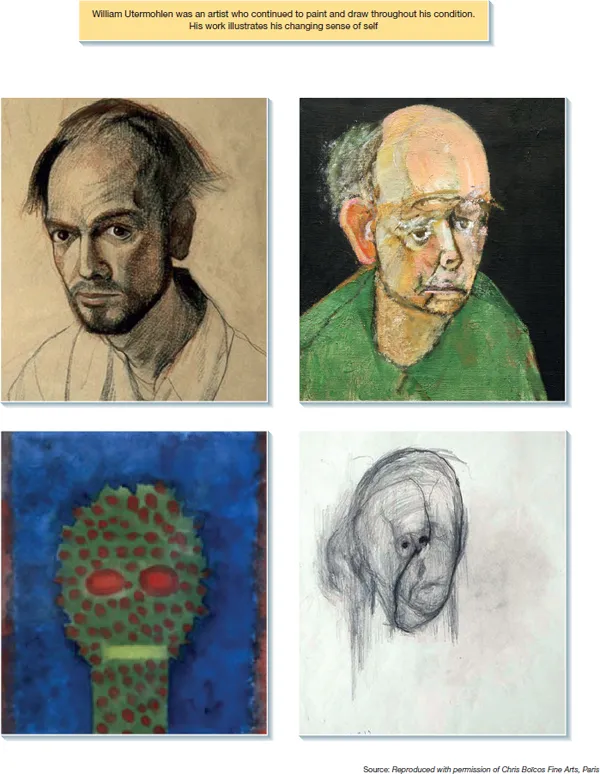
Figure 2.1The artwork of William Utermohlen
Gaining insight into people's experiences
In the early stages of dementia, people are able to describe their experiences, thoughts and feelings. As the dementia progresses, this becomes more difficult because of language and memory problems.
The experience of having dementia is unique and very personal. Even though there is a general pattern in how the syndromes progress, each person's journey will be different because of other factors such as their personality, the type of dementia, the nature of their close relationships and support network, educational level, economic situation and location. In addition, dementia is still often stigmatised and awareness of having a ‘damaged identity' plays a part in an individual's sense of self.
Professionals and family members wishing to gain insight into the world and experience of a person with dementia, therefore, need to listen closely and sensitively to how the person communicates about what it is like to live with the condition. They can also attempt to gain insight through other means and empathise by imagining how they might feel if they had the difficulties associated with dementia.
Listening to people with dementia
The most effective way to find out about someone's experience is to ask them. A question such as ‘what's it like living with your condition?', should enable a person in early or middle stages of dementia to open up about how they feel and what their life involves. It is important to listen patiently and...
Table of contents
Cover
QR code
TitlePage
Copyright
Preface
Acknowledgement
About the companion website
Part 1 Setting the scene
Part 2 Dementia causes and types
Part 3 Well-being and response in early stages
Part 4 Underpinning principles and skills
Part 5 Mental health problems
Part 6 Physical health problems
Part 7 Interventions
Part 8 The physical environment
Part 9 Carers and relationships
Part 10 Responding to dementia-related difficulties
Part 11 Ethical and legal issues
Part 12 The future
References
Further reading
Index
EULA
Trusted by 375,005 students
Access to over 1.5 million titles for a fair monthly price.
Study more efficiently using our study tools.
Frequently asked questions
Yes, you can cancel anytime from the Subscription tab in your account settings on the Perlego website. Your subscription will stay active until the end of your current billing period. Learn how to cancel your subscription
No, books cannot be downloaded as external files, such as PDFs, for use outside of Perlego. However, you can download books within the Perlego app for offline reading on mobile or tablet. Learn how to download books offline
Perlego offers two plans: Essential and Complete
Essential is ideal for learners and professionals who enjoy exploring a wide range of subjects. Access the Essential Library with 800,000+ trusted titles and best-sellers across business, personal growth, and the humanities. Includes unlimited reading time and Standard Read Aloud voice.
Complete: Perfect for advanced learners and researchers needing full, unrestricted access. Unlock 1.5M+ books across hundreds of subjects, including academic and specialized titles. The Complete Plan also includes advanced features like Premium Read Aloud and Research Assistant.
Both plans are available with monthly, semester, or annual billing cycles.
We are an online textbook subscription service, where you can get access to an entire online library for less than the price of a single book per month. With over 1.5 million books across 990+ topics, we’ve got you covered! Learn about our mission
Look out for the read-aloud symbol on your next book to see if you can listen to it. The read-aloud tool reads text aloud for you, highlighting the text as it is being read. You can pause it, speed it up and slow it down. Learn more about Read Aloud
Yes! You can use the Perlego app on both iOS and Android devices to read anytime, anywhere — even offline. Perfect for commutes or when you’re on the go. Please note we cannot support devices running on iOS 13 and Android 7 or earlier. Learn more about using the app
Yes, you can access Dementia Care at a Glance by Catharine Jenkins,Laura Ginesi,Bernie Keenan in PDF and/or ePUB format, as well as other popular books in Medicine & Psychiatric & Mental Health Nursing. We have over 1.5 million books available in our catalogue for you to explore.