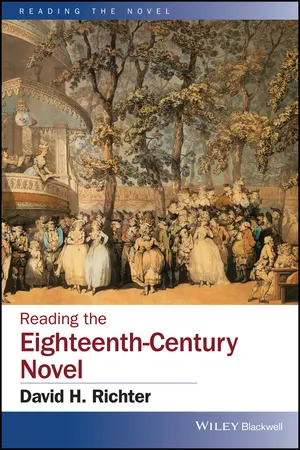
Reading the Eighteenth-Century Novel
eBook - ePub

Reading the Eighteenth-Century Novel

  1. English
  2. ePUB (mobile friendly)
  3. Available on iOS & Android
eBook - ePub

Reading the Eighteenth-Century Novel

About this book

Reading the Eighteenth-Century Novel is a lively exploration of the evolution of the English novel from 1688-1815. A range of major works and authors are discussed along with important developments in the genre, and the impact of novels on society at the time.

The text begins with a discussion of the "rise of the novel" in the long eighteenth century and various theories about the economic, social, and ideological changes that caused it. Subsequent chapters examine ten particular novels, from Oroonoko and Moll Flanders to Tom Jones and Emma, using each one to introduce and discuss different rhetorical theories of narrative. The way in which books developed and changed during this period, breaking new ground, and influencing later developments is also discussed, along with key themes such as the representation of gender, class, and nationality. The final chapter explores how this literary form became a force for social and ideological change by the end of the period. Written by a highly experienced scholar of English literature, this engaging textbook guides readers through the intricacies of a transformational period for the novel.

Trusted by 375,005 students

Access to over 1.5 million titles for a fair monthly price.

Study more efficiently using our study tools.

Information

Year
2017
Print ISBN
9781118621103
9781118621141
Edition
1
eBook ISBN
9781118621110

Chapter 1
The World That Made the Novel

This book is about reading the English novel during the “long eighteenth century,” a stretch of time that, in the generally accepted ways of breaking up British literary history into discrete periods for university courses, begins some time after the Restoration of King Charles II in 1660 and ends around 1830, before the reign of Queen Victoria. At the beginning of this period, the novel can hardly be said to exist, and writing prose fiction is a mildly disreputable literary activity. Around 1720, Daniel Defoe’s fictional autobiographies spark continuations and imitations, and in the 1740s, Samuel Richardson and Henry Fielding’s novels begin what is perceived as “a new kind of writing.” By the end of the period, with Jane Austen and Walter Scott, the novel has not only come into existence, it has developed into a more‐or‐less respectable genre, and in fact publishers have begun to issue series of novels (edited by Walter Scott and by Anna Barbauld, among others) that establish for that time, if not necessarily for ours, a canon of the English novel. With the decline of the English drama and the almost complete eclipse of the epic,1 the novel has become by default the serious literary long form, on its way to becoming by the mid‐nineteenth century, with Dickens, Thackeray, and Eliot, the pre‐eminent genre of literature. This chapter will consider how and why the novel came to be when it did.

The Novel before the Novel

But before we get to that story, we need to make sure that it’s the right story to be telling. Margaret Doody argues on the first page of her provocatively titled The True Story of the Novel that “the Novel as a form of literature in the West has a continuous history of about two thousand years.” She is certainly right that long form prose fiction goes back to the Greek romances of the first through fourth centuries CE: the earliest is probably Chariton’s Chaereas and Callirhoe and the best‐known Longus’s Daphnis and Chloe. These were tales of lovers, usually nobly born, beautiful and chaste, whose flight from parental opposition leads them into incredible dangers surmounted by unbelievable artifices. For example, in Leucippe and Clitophon (second‐century romance by Achilles Tatius) the lovers are shipwrecked, then captured by bandits, who proceed to sacrifice Leucippe and, after disemboweling her, to eat her liver; Clitophon, who has observed this from afar, wants to commit suicide until he is informed by his clever servant that Leucippe is alive, thanks to a wandering actor who impersonated the priest and used a retractable dagger – a theatrical prop he happened to have with him—along with some animal’s blood and entrails, to simulate the sacrifice.
By evening we had filled and crossed the trench, and I went to the coffin prepared to stab myself. “Leucippe,” I cried, “thy death is lamentable not only because violent and in a strange land, but because thou hast been sacrificed to purify the most impure; because thou didst look upon thine own anatomy; because thy body and thy bowels have received an accursed sepulchre, the one here, the other in such wise that their burial has become the nourishment of robbers. And this the gods saw unmoved, and accepted such an offering! But now receive from me thy fitting libation.” About to cut my throat, I saw two men running up, and paused, thinking that they were pirates and would kill me. They were Menelaus and Satyrus! Still I could not rejoice in their safety, and I resisted their attempt to take my sword. “If you deprive me of this sword, wherewith I would end my sorrows in death, the inward sword of my grief will inflict deathless sorrows upon me. Let me die: Leucippe dead, I will not live.” “Leucippe lives !” said Menelaus, and, tapping upon the coffin, he summoned her to testify to his veracity. Leucippe actually rose, disembowelled as she was, and rushed to my embrace.
Doody’s claim that “Romance and the Novel are one” (15) has generally been found unconvincing. Although Doody can point to a group of “tropes” (general plot points and themes, like erotic desire and generational conflict) that one can find in both the Greek romances and the English novel of the eighteenth century, this is a very weak claim, since they can be found without looking very hard pretty much everywhere else in literature. Her stronger claim – that these “tropes” are moments in the worship‐service of the Mother Goddess, which continues in the novel into our own day – has generally been met with ridicule. But the genre of romance was certainly around and being read in the eighteenth century. It was viewed as the competition, though: many of the most important eighteenth‐century novelists insisted on defining their work in opposition to, rather than within, the genre of romance.
The other genre of prose fiction current during this late classical period is the Menippean satire, exemplified by Apuleius’ Golden Ass, and Petronius’ Satyricon (both first‐century CE). These were episodic tales primarily ridiculing the behavior and pretensions of wealthy middle‐class citizens of the Roman empire. Here’s a sample from the Satyricon; the narrator is a guest at an over‐the‐top dinner in the mansion of a parvenu ex‐slave named Trimalchio:
I inquired who that woman could be who was scurrying about hither and yon in such a fashion. “She’s called Fortunata,” he replied. “She’s the wife of Trimalchio, and she measures her money by the peck. And only a little while ago, what was she! May your genius pardon me, but you would not have been willing to take a crust of bread from her hand. Now, without rhyme or reason, she’s in the seventh heaven and is Trimalchio’s factotum, so much so that he would believe her if she told him it was dark when it was broad daylight! As for him, he don’t know how rich he is, but this harlot keeps an eye on everything and where you least expect to find her, you’re sure to run into her. She’s temperate, sober, full of good advice, and has many good qualities, but she has a scolding tongue, a very magpie on a sofa, those she likes, she likes, but those she dislikes, she dislikes! Trimalchio himself has estates as broad as the flight of a kite is long, and piles of money. There’s more silver plate lying in his steward’s office than other men have in their whole fortunes! And as for slaves, damn me if I believe a tenth of them knows the master by sight.
Both romance and fictional satire, prose versions of tragedy and comedy, continue into the high middle ages and the Renaissance in different forms. In the Middle Ages the dominant form was the chivalric romance; in English the longest, most detailed, and most artistic of these is Thomas Malory’s Morte d’Arthur published 1485 by Caxton.
So after the quest of the Sangreal was fulfilled, and all knights that were left alive were come again unto the Table Round, as the book of the Sangreal maketh mention, then was there great joy in the court; and in especial King Arthur and Queen Guenever made great joy of the remnant that were come home, and passing glad was the king and the queen of Sir Launcelot and of Sir Bors, for they had been passing long away in the quest of the Sangreal.
Then, as the book saith, Sir Launcelot began to resort unto Queen Guenever again, and forgat the promise and the perfection that he made in the quest. For, as the book saith, had not Sir Launcelot been in his privy thoughts and in his mind so set inwardly to the queen as he was in seeming outward to God, there had no knight passed him in the quest of the Sangreal; but ever his thoughts were privily on the queen, and so they loved together more hotter than they did to‐forehand, and had such privy draughts together, that many in the court spake of it, and in especial Sir Agravaine, Sir Gawaine’s brother, for he was ever open‐mouthed.
So befell that Sir Launcelot had many resorts of ladies and damosels that daily resorted unto him, that besought him to be their champion, and in all such matters of right Sir Launcelot applied him daily to do for the pleasure of Our Lord, Jesu Christ. And ever as much as he might he withdrew him from the company and fellowship of Queen Guenever, for to eschew the slander and noise; wherefore the queen waxed wroth with Sir Launcelot. And upon a day she called Sir Launcelot unto her chamber, and said thus: Sir Launcelot, I see and feel daily that thy love beginneth to slake, for thou hast no joy to be in my presence, but ever thou art out of this court, and quarrels and matters thou hast nowadays for ladies and gentlewomen more than ever thou wert wont to have aforehand.
Fictional satire also continues, usually in shorter forms, of which the best known are the comic tales in the Decameron by Giovanni Boccaccio and the fabliau, which English‐speaking readers know best in the bawdy stories in rhyming couplets told by the Miller and the Reeve in Chaucer’s Canterbury Tales.
There is a genuine flowering of Elizabethan prose fiction but it, nevertheless, does not produce anything remotely like the eighteenth‐century novel. One strand, that of the long form romance, long form, is the pastoral; these are English texts usually mixing prose and poetry, such as Sidney’s Arcadia (1580; New Arcadia 1586) and Mary Wroth’s Urania (1621). Some of the shorter and less elaborate versions of prose romance served as the sources of Shakespeare’s comedies, like Thomas Lodge’s lyrical Rosalynde (1590), which became As You Like It, and Robert Greene’s acerbic Pandosto: The Triumph of Time (1588), which became The Winter’s Tale. Behind the poetic prose of these romances stands John Lyly’s Euphues (1578), a homiletic conduct book written in a style with elaborately balanced phrases, which has given its name to the genre. This style can be seen in the following soliloquy from Pandosto, in which Franion (on whom Antigonus in The Winter’s Tale is based) meditates whether he should follow his sovereign’s orders to kill the queen:
Ah Franion, treason is loved of many, but the traitor hated of all. Unjust offences may for a time escape without danger, but never without revenge. Thou art servant to a king, and must obey at command. Yet, Franion, against law and conscience it is not good to resist a tyrant with arms nor to please an unjust king with obedience. What shalt t...

Table of contents

  1. Cover
  2. Title Page
  3. Table of Contents
  4. Acknowledgments
  5. Chapter 1: The World That Made the Novel
  6. Chapter 2: Oroonoko (1688)
  7. Chapter 3: Moll Flanders (1722)
  8. Chapter 4: Pamela, or Virtue Rewarded (1740)
  9. Chapter 5: The History of Tom Jones, A Foundling (1749)
  10. Chapter 6: The Life and Opinions of Tristram Shandy, Gent. (1759–1767)
  11. Chapter 7: Evelina: The History of a Young Lady’s Entrance into the World (1778)
  12. Chapter 8: The Mysteries of Udolpho (1794)
  13. Chapter 9: Things As They Are, or The Adventures of Caleb Williams (1794)
  14. Chapter 10: Waverley, or ‘Tis Sixty Years Since (1814)
  15. Chapter 11: Emma (1815)
  16. Chapter 12: The World the Novel Made
  17. Selected Further Reading
  18. Index
  19. End User License Agreement

Frequently asked questions

Yes, you can cancel anytime from the Subscription tab in your account settings on the Perlego website. Your subscription will stay active until the end of your current billing period. Learn how to cancel your subscription
No, books cannot be downloaded as external files, such as PDFs, for use outside of Perlego. However, you can download books within the Perlego app for offline reading on mobile or tablet. Learn how to download books offline
Perlego offers two plans: Essential and Complete
  • Essential is ideal for learners and professionals who enjoy exploring a wide range of subjects. Access the Essential Library with 800,000+ trusted titles and best-sellers across business, personal growth, and the humanities. Includes unlimited reading time and Standard Read Aloud voice.
  • Complete: Perfect for advanced learners and researchers needing full, unrestricted access. Unlock 1.5M+ books across hundreds of subjects, including academic and specialized titles. The Complete Plan also includes advanced features like Premium Read Aloud and Research Assistant.
Both plans are available with monthly, semester, or annual billing cycles.
We are an online textbook subscription service, where you can get access to an entire online library for less than the price of a single book per month. With over 1.5 million books across 990+ topics, we’ve got you covered! Learn about our mission
Look out for the read-aloud symbol on your next book to see if you can listen to it. The read-aloud tool reads text aloud for you, highlighting the text as it is being read. You can pause it, speed it up and slow it down. Learn more about Read Aloud
Yes! You can use the Perlego app on both iOS and Android devices to read anytime, anywhere — even offline. Perfect for commutes or when you’re on the go.
Please note we cannot support devices running on iOS 13 and Android 7 or earlier. Learn more about using the app
Yes, you can access Reading the Eighteenth-Century Novel by David H. Richter in PDF and/or ePUB format, as well as other popular books in Literature & Literary Criticism. We have over 1.5 million books available in our catalogue for you to explore.