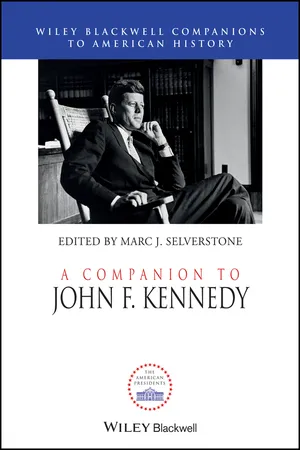
More so than any other twentieth-century president, arguably, John F. Kennedy, despite his abbreviated tenure, has captivated scholars and the general public alike.1 As a rule, books on Kennedy sell well. This is partly due to the Kennedy mystique popularized by Theodore White's idyllic essay in Life magazine immediately following the Kennedy assassination, which reflected Jackie Kennedy's Camelot characterization. If Kennedy had only lived, many Americans continue to believe, the nation's social turmoil that followed would never have occurred. The evolving scholarship focusing on Kennedy's life and presidency has taken a more measured view, as it has transitioned from the Camelot approach of the 1960s and the anti-Kennedy revisionist works beginning in the 1970s to the more balanced studies that followed. This chapter covers the historiography of Kennedy's life and presidency and my own contributions to it.
Much had already been written on Kennedy by the time I was asked, in 1983, to write the Kennedy volume for the American Presidency Series, published by the University Press of Kansas. This literature included two best-selling, gracefully written works from Kennedy insiders: Arthur Schlesinger Jr.'s Thousand Days and Theodore Sorensen's Kennedy, both published in 1965. While Schlesinger, a Kennedy administrative assistant and unofficial court historian, covered the presidency in encyclopedic fashion, Sorensen's intimate account as White House special counsel provided the closest thing we have to a Kennedy memoir. What they had in common was an adulation of the Kennedy presidency, which contributed to the public view of Kennedy's presidential greatness. While other insider books soon followed – which several scholars have labeled the Camelot School of Kennedy historiography – the inevitable backlash of revisionism set in by the 1970s, depicting Kennedy as a Cold Warrior in foreign policy and inept in implementing his domestic agenda. Based primarily on published sources, the two best examples of early Kennedy revisionism were Henry Fairlie's The Kennedy Promise and Bruce Miroff's Pragmatic Illusions.
Not until Herbert Parmet's two-volume biography appeared in the early 1980s did we have a balanced appraisal of Kennedy based on the recently opened Kennedy papers, first located at Waltham, Massachusetts, and then stored at the Kennedy Library in Boston. Thus began what I have chosen to call postrevisionism in Kennedy studies. Parmet's Jack (as Kennedy was most often known) focused on the rise and prepresidential career of Kennedy and was followed by JFK, which covered Kennedy's presidential campaign and presidency. Parmet, a noted political historian at the Graduate School of the City University of New York, characterized Kennedy's presidency as one in which style overrode substance. He viewed him as a “moderate conservative” domestically and a Wilsonian in foreign policy who sought to make the world safe for diversity (Parmet 1983: 354, 132). Even though Kennedy's achievements, according to Parmet, were relatively modest, they remained an important part of his legacy. These included the Peace Corps, the Nuclear Test Ban Treaty, his response to the Soviet threat in Berlin and Cuba, and his belated commitment to civil rights.
My challenge involved adding to what was already known about the Kennedy presidency. Other writers had neglected or too briefly treated several aspects of the Kennedy presidency, including agricultural policy, the space program, Kennedy's relationship with the press, his private life in the White House, and the administration's war against organized crime, which I thought at the time might have had something to do with his assassination. The opening of previously closed documents on the Berlin and Cuban missile crises, as well as on the Bay of Pigs and Vietnam, afforded additional opportunities for new perspectives, as did various oral histories and recently published books. Through the Freedom of Information Act, I managed to open the White House Gate Logs, which identified visitors to Kennedy's office or private residence, confirming the frequent visits of Max Jacobson, the amphetamines doctor, and Judith Campbell Exner and other women accused of having sexual relations with Kennedy (see Giglio 1992).
I also adopted a method of evaluating the Kennedy presidency that others had not used. I systematically looked at the domestic and foreign problems that faced the nation when Kennedy took office in 1961 and then turned to the ones remaining when he was assassinated on November 22, 1963. I concluded that Kennedy left America better than he found it and that he had grown in office during his final year. Even though he failed to accomplish most of his major domestic legislative agenda, he did promote economic growth, kept unemployment and inflation low, laid the foundations for major tax cuts, improved conditions on the agricultural front, implemented the first public housing program since 1949, reduced discrimination against women, and made his belated commitment to civil rights a moral issue that led to the passage of the Civil Rights Act of 1964 under President Johnson. He also updated traditional New Deal commitments such as social security and the minimum wage.
While he had inherited foreign crises in Berlin, the Congo, Laos, and Vietnam, only Vietnam remained virulent at Kennedy's death, thanks to his efforts. Even so, as all scholars agree, his sponsorship of the Bay of Pigs fiasco in April 1961 represented his most significant failure. It not only worsened relationships with Castro's Cuba but also arguably, in concert with subsequent efforts to destabilize Castro through Operation Mongoose, contributed to the Soviet Union's decision to place ground-to-ground missiles in Cuba capable of destroying most American cities. While failing as a crisis avoider, I argued, Kennedy excelled in managing the missile crisis of October 1962. His cool, measured response, when hawkish advisors sought air strikes, led to the missile withdrawal and the subsequent emerging détente with the Soviet Union that included the Nuclear Test Ban Treaty of September 1963. Most scholars have agreed that Kennedy's handling of that crisis represented the high point of his presidency.
I concluded that Kennedy merited an above-average ranking – the only president to serve fewer than four years to have been ranked that highly, according to the scholar-based Murray-Blessing Poll of 1988. In the process, I found more positive aspects to the Kennedy presidency than Parmet. Regardless, most reviewers found the two books balanced and readable.
Interest in Kennedy continued for the remainder of the 1990s, partly due to the opening of additional source material and the growing fascination with or appreciation of Kennedy. The latter especially involved the general public who, in various polls, ranked Kennedy as America's most popular and greatest president. To many observers, Kennedy was arguably the last president that a majority of Americans trusted. His tragic death left in its wake not only an elegant widow and two attractive children but also realizable dreams and promises that soon soured as the social fabric unraveled in the face of the escalation in Vietnam, the social protest movement, and the urban riots of the late 1960s, followed by Watergate and other contentious developments of the 1970s and 1980s. Kennedy consequently remained relevant in the 1990s as many more historians explored his life and death.
Three books on Kennedy's presidency soon followed my 1991 effort, two of which were best sellers with sales of 100,000 or more. President Kennedy: Profile of Power, by Richard Reeves, made the greatest splash and was the most comprehensive. Reeves, a well-known syndicated columnist, eschewed the typical thematic chapter approaches of Parmet, myself, and other scholars on such topics as civil rights, the missile crisis, and Berlin. Instead, he sought to focus on issues the same way the president confronted them: collectively and in competition with one another, stressing the interrelationship of events and problems. Reeves was interested in what Kennedy “knew and when he knew it and what he actually did – sometimes day by day, sometimes hour by hour, sometimes minute by minute” (Reeves 1993: 13). This sort of narrative approach provided a more realistic view of the presidency and the difficult choices facing Kennedy, but dealing with diverse matters collectively made for challenging reading even when chapters were thoughtfully organized.
According to Reeves, the major issues in 1961 were in foreign policy. Kennedy dumped civil rights and other domestic problems onto Attorney General Robert Kennedy and other associates. The following year, Kennedy initially turned more to domestic issues such as the economy, medical care for the elderly, space exploration, and the steel crisis; by that fall, the civil rights movement and the missile crisis dominated the president's day. In 1963, the frenetic pace continued with Kennedy tangling almost daily with such diverse matters as the tax cut bill, the mounting civil rights crisis, nuclear test ban negotiations, and the Vietnam War, which assumed much more importance on the eve of his death. Reeves did not ignore Kennedy's personal life. He portrayed a physically flawed president who nevertheless found time to engage in extramarital activities.
Even though Reeves concentrated even less on domestic affairs than did Kennedy, he convincingly showed that, in Kennedy's mind, “the struggle with communism would be the focus of the history of his times” (1993: 278). As Kennedy once said, “Domestic policy can only defeat us [politically],” but “foreign policy can kill us [literally]” (Schlesinger 2007: 515).
What sort of president was Kennedy? Reeves depicted him as a gifted politician who reacted to events with varying degrees of success. To Reeves, the missile crisis probably represented his greatest achievement, in part because it made him more credible around the world and more popular at home. Even when Kennedy failed, he covered himself with plausible explanations. He was much better in dealing with concrete matters than with broader, long-range issues, according to Reeves. Unlike Camelot School and many postrevisionist historians, myself included, Reeves concluded that there was little evidence of growth in Kennedy's presidency, for he continued to make mistakes in 1963. Reeves's polished style, his effort to uncover new documentary material, and his extensive and skillful interviewing provided a significant contribution to the literature.
Two years earlier, in 1991, Thomas Reeves (no relation) also attracted national attention, with appearances on the Today show and in other public media. An accomplished biographer of Senator Joseph McCarthy and President Chester Arthur, and professor of history at the University of Wisconsin, Parkside, Reeves focused on what he perceived as Kennedy's lack of character, including his womanizing, his arrogance, his deception, his insensitivity toward others, and his relentless pursuit of power, which Reeves argued characterized his political career. To Reeves, character began with integrity, which he defined as compassion, generosity, prudence, loyalty, responsibility, humility, and perseverance. Kennedy lacked these qualities, Reeves argued, because of a father who preached winning at all costs and a mother too detached from domestic life and too frequently absent from home. All of this created a Kennedy that most Americans did not know.
Reeves argued that Kennedy's lack of character negatively affected his presidency. He accused Kennedy of being “pragmatic to the point of amorality,” saying his “sole standard seemed to be political expediency” (Reeves 1991: 415). That made him ...