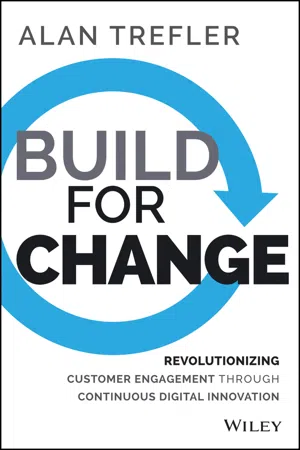
Customers have radically changed the ways they interact with businesses, and today's organizations need to adapt
Is your company prepared for the Gen D future, or is it heading toward life support? A lot of companies across the globe are going to die over the next few years, not because of macroeconomic stress, but because there is an emerging generation that is radically changing the rules of customer engagement. In Build For Change, Pegasystems CEO Alan Trefler shows exactly what companies can do to turn the coming "customerpocalypse" into one of the biggest business opportunities of the decade. The newest generation of consumers is turning customer relationship management on its head. Build For Change highlights the revolutionary changes to business, marketing, and technology practices that are needed to survive and thrive in these unforgiving times. Readers will learn how businesses are increasingly relying on new forms of customer engagement, and how one customer's experience—whether good or bad—can alter a company's reputation with the click of a mouse. With practical insight from a leader in customer engagement, this book serves as a timely wakeup call to companies that have not yet embraced the digital future.
Traditional marketing is becoming increasingly irrelevant, and businesses must become more customer-centric while taking a completely different approach to adopting and using technology. Build For Change outlines exactly what can—and must—be done to ensure sustainable success in the new digital era:
Relate to the new generation of consumers, and understand their preferences and demands
Stop obsessing about mountains of data, and instead apply business-driven continuous improvement to customer processes
Learn how to overcome the fatal flaws of current technology fads
Rethink organizational roles to drive adaptive and transformative innovation
Consumers have more options than ever before, and ensuring customer loyalty in the modern market means knowing exactly what the customer wants and how to deliver it brilliantly. Build For Change provides actionable guidance for engaging this new connected consumer.
A lot of companies across the globe are going to die over the next few years, not because of macroeconomic stress but because there is an entire emerging generation of customers who hate doing business with them. These companies are going to die from some form of customer stress. Death may come as the result of self-inflicted wounds the company should have known to avoid, which means it is kind of like suicide. It may come from involuntary manslaughter by a new generation of customers. Or these new kinds of customers may just outright murder companies they decide should be put out of their misery. It is the customerpocalypse.
Who are these customers? They trace their ancestry first to the Millennials, also known as Generation Y. The latter term comes from an editorial in Ad Age in 1993, which attempted to describe the teenagers of that time and how they differed from Generation X, the name given to the generation born after the post-World War II baby boom popularized by the novelist Douglas Coupland.1 When Ad Age coined the Gen Y term, it applied to kids 12 and younger at the time, and was meant to refer to those kids who would become teenagers over the subsequent 10 years.
The Millennials term is widely credited to William Strauss and Neil Howe from work first published in 1991.2 You may also have heard of them referred to as Generation We, Generation Next, and the Net Generation. They account for about 75 million people in the United States alone. The generation’s earliest days are just around the time digital technologies for the general public first appeared, beginning with Apple’s first personal computer, the IBM PC, and Microsoft’s early PC operating system. They grew up with digital technology, and came of age as it, too, came of age, beginning its slow, steady march to ubiquity. Over the course of their lives, digital technology has become a commodity, fundamentally changing what they expect and how they interact. Millennials are also the generation that grew up with play dates and adolescent team sports that awarded everyone a trophy for playing in the soccer game, whether they won or lost. This “ethic” figures into how they view the world and the relationships they have with your business as your (potential) customer.
Diane Theilfoldt and Devon Scheef aptly synopsized their characteristics in a 2004 article. Millennials are (among other things) “self-inventive/individualistic”; they “rewrite the rules”; they consider institutions irrelevant; the Internet is their world; they don’t just use but “assume” technology is there for everything; and they “multitask fast.”3
From this Millennial/Gen Y group, another name emerged: Generation C. The name works in part because, as entertaining as Douglas Coupland’s declaration of Generation X was, he did us the disservice of choosing a letter far too far along in the alphabet to continue with his naming convention. More important is that unlike the Gen X and Gen Y names, Gen C includes a characterization within its very name.
“[T]he C stands for CONTENT, and anyone with even a tiny amount of creative talent can (and probably will) be a part of this not-so-exclusive trend.”4 These are the young people who are responsible for—and who revel in—all manner of content on the World Wide Web. They post and curate. They are the self-proclaimed editors of Wikipedia. They made YouTube the amazing repository of content that it is today.
Despite its relative youth, this group influences every aspect of our lives and wreaks havoc on many businesses.5 Gen C accounts for about 75 million people in the United States alone. Still growing in size by leaps and bounds, largely now from the emergence of new economies in much of the less-developed world and changing economies in places such as Russia, China, and India, Gen C is fast becoming the largest group of consumers in the entire world.
It’s important to note that the divisions between the generations discussed in this book are rather fluid. Gen C has really come into its own with the shift in the meaning of the C; it is that very shift that leads to the observation that today there is actually a Gen C-1 and a Gen C-2 coexisting in time. Members of Gen C-1, who came first and tend to be more passive, are generally older than the more active members of Gen C-2. They are the members of the Gen C segment who publish.
With the evolution of the mobile Web, Gen C evolved from content to communicating, computerized, clicking and, finally, connected. It is the advent of connected mobility that has given rise to Gen C-2. This component of the larger Gen C arose with the sudden democratization of communications and the unmediated access to personalized mass communication, exemplified by Twitter, but not exclusive to that technology tool. They are the ones who use on-the-spot messaging to create flash mobs and take down repressive governments as happened during the Arab Spring.
If Gen C-1 is the publish or post segment, then Gen C-2 is the ping part of the group. Gen C members have gone from asynchronous communication through e-mail and Facebook to always-on, always-linked interactions that are synchronous, happening in real time. Gen C-2 is even helping drive a move away from e-mail.6 More relevant to the discussion here is that Gen C is the generation that pushed connectivity to the point where there are 10.5 billion active memberships across at least 158 online social communities—and that is exclusive of Facebook and YouTube, which add another 1 billion each.7 Gen C is why every company has a Facebook page and a Twitter account, even if most corporate types using them have little idea, or in many cases absolutely no idea, what they are doing.
Great Expectations
As a whole, Gen C has some major expectations that create big challenges for companies. For instance, they expect to be able to engage with your website and perhaps even talk to someone in your call center at the same time. They expect your company to be as centered on them as they are centered on themselves. If they know something, they expect you to know it, too. They do not care whether you have separate divisions to handle products or services they buy from you. In fact, if you use that as an excuse for why you had to ask a stupid question (yes, in this world there are many stupid questions), they will come to hate you even more.
Gen C customers have no patience when you try to sell them some lame product they would never consider in a million years. If they have a problem, they expect you to fix it in a way that makes sense.
Fail a Gen C customer, and she may or may not tell you how she feels. The best case for your company is that she just puts up with it and keeps on with what she is already doing with your business. That particular best case is not too likely to occur. What is more likely is that she will tell all of her connected “friends” about how you failed and how she is taking her business elsewhere. The website Yelp has been a popular online destination for members of Gen C. Maybe you have seen a post like this on Yelp:
Tried out Super Falafel, the new place in my hood, and it hella crap. Will never go back. Surly counter help, everything lukewarm, don’t take cards. Sorry to Falafel City, my old standby near work. Still great after all these years!
The post is seen by lots of other people, and online “friends” of the original poster might even get notifications when one of their friends posts. They then comment and add their own experiences—with business implications that should be obvious.
Someone among the friends and followers may even revert to his content roots and share the experience on a website set up for no reason other than to mock your company and share the many stories of how it has failed Gen C. These kinds of websites have proliferated thanks to Gen C. Some have called them “suck sites,” as in Company X sucks, and they reflect anger based on genuine experiences.
It Is So Easy to Lose Customers
Some businesses, such as Apple and Google, have been very tuned in and successful with Gen C customers from their beginnings. But for every success story, there are countless tales of companies really messing up with Gen C customers. They fall into one of two general categories: those who screw up but recover and those who fail to listen to their customers and die. In the category of those who met their demise, consider Circuit City. Founded in 1949, the company was the first to launch an electronics superstore. That was in the 1970s. By 2009, Circu...
Table of contents
Cover
Contents
Title
Copyright
Foreword James Champy
Acknowledgments
Chapter 1: Customerpocalypse
Chapter 2: Death by Data
Chapter 3: Adding Judgment and Desire
Chapter 4: Getting It Done with Customer Processes
Chapter 5: Change How You Think about Technology
Chapter 6: Liberating Your Organization
Chapter 7: You Are Your Software—The Digital Imperative
Index
End User License Agreement
Trusted by 375,005 students
Access to over 1.5 million titles for a fair monthly price.
Study more efficiently using our study tools.
Frequently asked questions
Yes, you can cancel anytime from the Subscription tab in your account settings on the Perlego website. Your subscription will stay active until the end of your current billing period. Learn how to cancel your subscription
No, books cannot be downloaded as external files, such as PDFs, for use outside of Perlego. However, you can download books within the Perlego app for offline reading on mobile or tablet. Learn how to download books offline
Perlego offers two plans: Essential and Complete
Essential is ideal for learners and professionals who enjoy exploring a wide range of subjects. Access the Essential Library with 800,000+ trusted titles and best-sellers across business, personal growth, and the humanities. Includes unlimited reading time and Standard Read Aloud voice.
Complete: Perfect for advanced learners and researchers needing full, unrestricted access. Unlock 1.5M+ books across hundreds of subjects, including academic and specialized titles. The Complete Plan also includes advanced features like Premium Read Aloud and Research Assistant.
Both plans are available with monthly, semester, or annual billing cycles.
We are an online textbook subscription service, where you can get access to an entire online library for less than the price of a single book per month. With over 1.5 million books across 990+ topics, we’ve got you covered! Learn about our mission
Look out for the read-aloud symbol on your next book to see if you can listen to it. The read-aloud tool reads text aloud for you, highlighting the text as it is being read. You can pause it, speed it up and slow it down. Learn more about Read Aloud
Yes! You can use the Perlego app on both iOS and Android devices to read anytime, anywhere — even offline. Perfect for commutes or when you’re on the go. Please note we cannot support devices running on iOS 13 and Android 7 or earlier. Learn more about using the app
Yes, you can access Build for Change by Alan Trefler in PDF and/or ePUB format, as well as other popular books in Business & Leadership. We have over 1.5 million books available in our catalogue for you to explore.