Neurobionics
eBook - ePub

Neurobionics

The Biomedical Engineering of Neural Prostheses

  1. English
  2. ePUB (mobile friendly)
  3. Available on iOS & Android
eBook - ePub

Neurobionics

The Biomedical Engineering of Neural Prostheses

About this book

Technological advances have greatly increased the potential for, and practicability of, using medical neurotechnologies to revolutionize how a wide array of neurological and nervous system diseases and dysfunctions are treated. These technologies have the potential to help reduce the impact of symptoms in neurological disorders such as Parkinson's Disease and depression as well as help regain lost function caused by spinal cord damage or nerve damage. Medical Neurobionics is a concise overview of the biological underpinnings of neurotechnologies, the development process for these technologies, and the practical application of these advances in clinical settings.

Medical Neurobionics is divided into three sections. The first section focuses specifically on providing a sound foundational understanding of the biological mechanisms that support the development of neurotechnologies. The second section looks at the efforts being carried out to develop new and exciting bioengineering advances. The book then closes with chapters that discuss practical clinical application and explore the ethical questions that surround neurobionics.

A timely work that provides readers with a useful introduction to the field, Medical Neurobionics will be an essential book for neuroscientists, neuroengineers, biomedical researchers, and industry personnel.
Frequently asked questions

Yes, you can cancel anytime from the Subscription tab in your account settings on the Perlego website. Your subscription will stay active until the end of your current billing period. Learn how to cancel your subscription.
At the moment all of our mobile-responsive ePub books are available to download via the app. Most of our PDFs are also available to download and we're working on making the final remaining ones downloadable now. Learn more here.
Perlego offers two plans: Essential and Complete
  • Essential is ideal for learners and professionals who enjoy exploring a wide range of subjects. Access the Essential Library with 800,000+ trusted titles and best-sellers across business, personal growth, and the humanities. Includes unlimited reading time and Standard Read Aloud voice.
  • Complete: Perfect for advanced learners and researchers needing full, unrestricted access. Unlock 1.4M+ books across hundreds of subjects, including academic and specialized titles. The Complete Plan also includes advanced features like Premium Read Aloud and Research Assistant.
Both plans are available with monthly, semester, or annual billing cycles.
We are an online textbook subscription service, where you can get access to an entire online library for less than the price of a single book per month. With over 1 million books across 1000+ topics, we’ve got you covered! Learn more here.
Look out for the read-aloud symbol on your next book to see if you can listen to it. The read-aloud tool reads text aloud for you, highlighting the text as it is being read. You can pause it, speed it up and slow it down. Learn more here.
Yes! You can use the Perlego app on both iOS or Android devices to read anytime, anywhere — even offline. Perfect for commutes or when you’re on the go.
Please note we cannot support devices running on iOS 13 and Android 7 or earlier. Learn more about using the app.
Yes, you can access Neurobionics by Robert K. Shepherd in PDF and/or ePUB format, as well as other popular books in Ciencias biológicas & Neurociencia. We have over one million books available in our catalogue for you to explore.

Information

Year
2016
Print ISBN
9781118814871
eBook ISBN
9781118816035

Part I
Fundamentals of neural prostheses

Chapter 1
The Historical Foundations of Bionics

Nick Donaldson and Giles S. Brindley
Implanted Devices Group, Department of Medical Physics & Bioengineering, University College London, London, UK

1.1 Bionics Past and Future

In 1973, Donaldson and Davis published a paper called “Microelectronic devices for surgical implantation” in which they listed neuroprostheses in use and under development: pacemakers for the heart (fixed-rate, atrial-triggered and demand), incontinence devices, visual prostheses, dorsal column stimulators and electromyogram (EMG)) telemeters1. The field of bionics was then very young, the idea of surgically implanting an electronic device was new and very few people had worked on the technical difficulties entailed. Only pacemakers were then commercial products and there were no regulations in force. Now, 40 years later, there are many more types of device, both in clinical use and under development. A number of these devices will be described in Chapters 79 and include implants for addressing sensory loss (e.g. hearing, sight, balance), disorders of the brain and the mind (e.g. epilepsy, migraine, chronic pain, depression), as well as brain-machine interfaces. Manufacturing these devices and going through the process of regulation is now a multi-billion dollar industry.
The year 2013 may be remembered as the year in which GlaxoSmithKline (GSK) announced that they were to invest in the development of neurobionic devices, which they call Electroceuticals or Bioelectronic Medicines2 (Famm et al. 2013; Birmingham et al. 2014). The notion is that these will interact with the visceral nerves that innervate the internal organs to treat specific diseases. These diseases are not normally thought of as neurological (e.g. inflammation), but nevertheless there is some neural control. The announcement by GSK shows that the company thinks that implanted devices may become an alternative to some drug treatments. The motivations for their development no doubt include the rising costs of new drugs, better targeting of the causes of disease, and the realisation that implants might treat some of the increasingly prevalent diseases that threaten to overwhelm healthcare budgets (obesity, diabetes). They cite an example as the recent trial of a treatment for rheumatoid arthritis by stimulation of the vagus nerve (Koopman 2012). Some of the new implants will require surgical techniques new to human surgery, for example the splitting of spinal nerve roots in continuity into many fine strands. Only time will tell whether this vision is realistic, but it shows the huge rise in confidence that implanted bionic devices may be practicable and important in future healthcare.
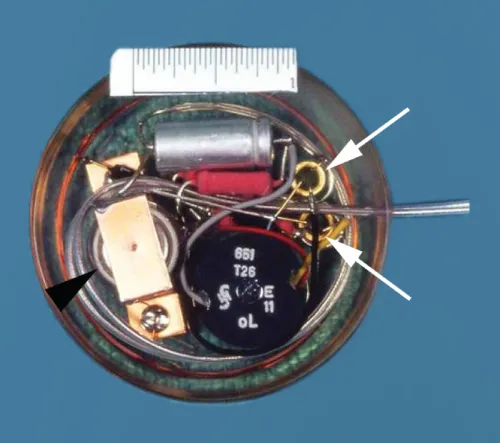
The first electrical device implanted into a patient was the cardiac pacemaker of Elmqvist (1958), so the field is now nearly 60 years old (Figure 1.1). While Chapters 79 will review some of the types of implant with respect to their clinical function, Chapters 26 will review the field on which implant engineering is based, much of which has been built in this 60-year period. If we consider that the construction work in that period is the history of neurobionics, the purpose of this chapter is to look back to the pre-history, the foundation of the field, from the time before work began and probably before it was even conceived.
Photograph of Elmqvist-Senning pacemaker of 1958. The arrowhead points two nickel-cadmium cells. The two transistors are on the right (arrows).
Figure 1.1 Elmqvist-Senning pacemaker of 1958. It is powered by two nickel-cadmium cells (arrowhead) which can be recharged by induction. The two transistors are on the right (arrows). The encapsulant is epoxy resin. An external valve oscillator was used for recharging at a frequency of 150 kHz. Scale bar = 1 inch.
We have worked in London during the historical period (see Box 1.6: MRC Neurological Prostheses Unit) and the story is slanted toward our view of the significant technology.

1.2 History in 1973

Donaldson and Davies (1973) suggested that neurological prostheses were the confluence of four streams of development: biomaterials (known from literature dating as far back as 1000 bc), electrical stimulation of nerves (Galvani 1791), electrophysiological recording (Matteucci 1842) and transistors (1948).

1.2.1 Biomaterials

A textbook by Susrata from 1000 bc describes the use of catgut for sutures. In Europe, from the 16th to the mid-19th century, linen and silk were the normal materials for sutures and ligatures; for sutures, horse hair, catgut and cotton were tried occasionally, and for ligatures, strips of leather. But these seem to have been passing fashions, and most surgeons continued to use silk or linen. Whatever the material, it was not a biomaterial in the modern sense; it was not expected to remain in the body for years, but either to be removed by the surgeon within a week or two, or to be extruded through the skin as part of the healing process within a few months.
The first internal fixation of a fracture with a metal plate and screws was performed by Lane in 1895, but Lane's plate and screws were of ordinary steel, and would certainly corrode. Stainless steel (18-8 18% chromium, 8% nickel) was patented in 1912, but the original stainless steel corroded badly in sea-water. It was not until about 1926 that a modified stainless steel, 18-8-SMo, which had an additional 2–4% of molybdenum was developed, which resisted corrosion in sea-water and so could reasonably be expected to remain uncorroded in the body. This stainless steel was widely used in the internal fixation of fractures in the 1930s, and sometimes remained uncorroded for years (Haase 1937).
The variability remained mysterious, but it was made unimportant by the invention (1932) and introduction into bone surgery (1937) of Vitallium, an alloy of cobalt, chromium and molybdenum, which has never been reported as corroding in the body (Venable and Stuck (1938). The first widely successful artificial hip (though not absolutely the first artificial hip) was the cup arthroplasty (Smith-Peterson 1939). It used a Vitallium cup which was not bonded either to the head of the femur or to the acetabulum. Modern artificial hips have a ball bonded to the femur and a cup bonded to the pelvis. Problems of fixing the ball and cup to the bones and of wear at the articulating surfaces have been largely overcome. For artificial finger joints, it has been possible to avoid articulating surfaces by using adequately flexible silicones (Williams and Roaf 1973). Silicones were first used in medicine as coatings for syringe needles for reduced blood clotting (1946). In the same year, silicone rubbers were first used for surgical repairs and, in 1956, for the first hydrocephalus shunts (Colas and Curtis 2004). Thus by 1973 the field of biomaterials was established as a collaboration between surgeons, biologists and materials scientists, who had made progress by innovation with new materials, better designs and improved surgical techniques.
Less was known about implantable electrical materials: the first electrical implant in an animal was described by Louks (1933) and that was simply a coil, insulated with Collodion varnish, connected directly to electrodes; the experiments continued for 12 days...

Table of contents

  1. Cover
  2. Title Page
  3. Copyright
  4. Table of Contents
  5. Dedication
  6. Contributors
  7. Preface
  8. Part I: Fundamentals of neural prostheses
  9. Part II: Device Design and Development
  10. Part III: Clinical Applications
  11. Part IV: Commercial and Ethical considerations
  12. Appendix: Examples of Companies Developing and/or Marketing Bionic Devices
  13. Index
  14. End User License Agreement