Aquaculture, Resource Use, and the Environment
eBook - ePub

Aquaculture, Resource Use, and the Environment

  1. English
  2. ePUB (mobile friendly)
  3. Available on iOS & Android
eBook - ePub

Aquaculture, Resource Use, and the Environment

About this book

Aquaculture, Resource Use, and the Environment places aquaculture within the larger context of global population growth, increased demand for sustainable, reliable sources of food, and the responsible use of natural resources. Aquaculture production has grown rapidly in recent decades as over-exploitation and environmental degradation have drastically reduced wild fish stocks. As fish production has increased, questions have persisted about the environmental sustainability of current aquaculture practices.

Aquaculture, Resource Use, and the Environment is a timely synthesis and analysis of critical issues facing the continued growth and acceptance of aquaculture practices and products. Chapters look at the past, present, and future demands for food, aquaculture production, and tackle key issues ranging from environmental impacts of aquaculture to practical best management practices in aquaculture production.

Providing broad coverage of issues that are essential to the continued development of aquaculture production, Aquaculture, Resource Use, and the En vironment will be vital resource for anyone involved in the field of aquaculture.
Frequently asked questions

Yes, you can cancel anytime from the Subscription tab in your account settings on the Perlego website. Your subscription will stay active until the end of your current billing period. Learn how to cancel your subscription.
No, books cannot be downloaded as external files, such as PDFs, for use outside of Perlego. However, you can download books within the Perlego app for offline reading on mobile or tablet. Learn more here.
Perlego offers two plans: Essential and Complete
  • Essential is ideal for learners and professionals who enjoy exploring a wide range of subjects. Access the Essential Library with 800,000+ trusted titles and best-sellers across business, personal growth, and the humanities. Includes unlimited reading time and Standard Read Aloud voice.
  • Complete: Perfect for advanced learners and researchers needing full, unrestricted access. Unlock 1.4M+ books across hundreds of subjects, including academic and specialized titles. The Complete Plan also includes advanced features like Premium Read Aloud and Research Assistant.
Both plans are available with monthly, semester, or annual billing cycles.
We are an online textbook subscription service, where you can get access to an entire online library for less than the price of a single book per month. With over 1 million books across 1000+ topics, we’ve got you covered! Learn more here.
Look out for the read-aloud symbol on your next book to see if you can listen to it. The read-aloud tool reads text aloud for you, highlighting the text as it is being read. You can pause it, speed it up and slow it down. Learn more here.
Yes! You can use the Perlego app on both iOS or Android devices to read anytime, anywhere — even offline. Perfect for commutes or when you’re on the go.
Please note we cannot support devices running on iOS 13 and Android 7 or earlier. Learn more about using the app.
Yes, you can access Aquaculture, Resource Use, and the Environment by Claude Boyd,Aaron McNevin in PDF and/or ePUB format, as well as other popular books in Technology & Engineering & Fisheries & Aquaculture. We have over one million books available in our catalogue for you to explore.

Chapter 1
An overview of aquaculture

Aquaculture is an old pursuit that only became common during the last 75 years. Today nearly everyone has heard of aquaculture and realizes that one can purchase either farm‐reared or wild‐caught fisheries products. The dictionary definition of aquaculture is “the cultivation or rearing of aquatic animals and plants.” But there is no consensus—even among aquaculture experts—on the best definition of aquaculture.
Despite most people having heard of aquaculture, very few, including most professional and lay environmentalists, have much knowledge of the important aquaculture species/species groups and of the various culture systems and methodologies used to produce aquatic organisms. This chapter provides a simple discussion of aquaculture species, production methods, and associated environmental issues. Land and water requirements, nutrient sources, energy use, and water management techniques will be featured in particular, because many of the negative impacts of aquaculture result from these factors.

History

The first writings about aquaculture are from China about 2,500 years ago; the writings were about carp culture that had originated several centuries before (Stickney 2000). The Egyptians may have been involved in fish culture before the Chinese, and the Romans cultured oysters and possibly other species. Shrimp culture dates back to around 800 AD in Asia and freshwater aquaculture has been practiced in several Asian countries for many centuries (Stickney 2000). Aquaculture was fairly common in Europe—especially in central Europe—during most of the second millennium AD. For example, there were 75 000 ha of carp ponds in Bohemia alone by the end of the fourteenth century—more than exist in that region today (Berka 1986). By the sixteenth century, the pond area in Bohemia reached a maximum of 180 000 ha, but the area declined considerably soon afterward.
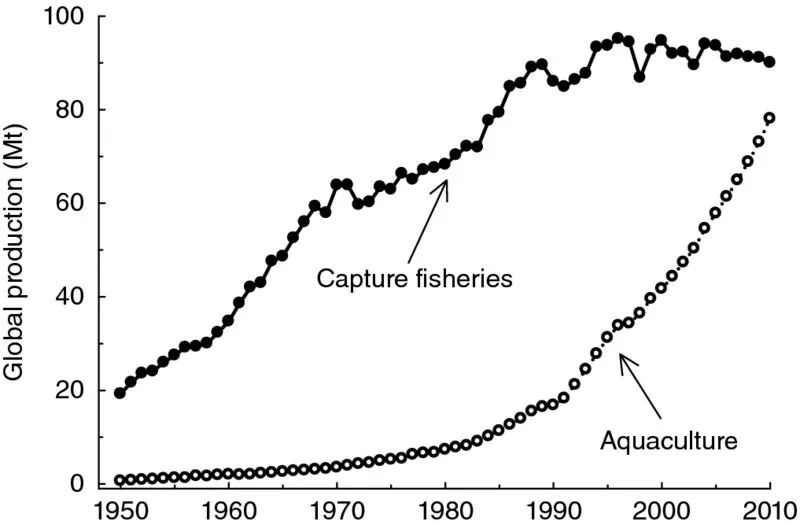
The real “boom” in aquaculture began in the 1950s and 1960s in many countries including the United States. Growth of aquaculture was relatively slow at first; in the early 1950s, it produced less than 1 Mt/year and reached only about 2.5 Mt/year by 1970. Since 1970 aquaculture has grown at an average rate of about 8% annually reaching about 63.6 Mt in 2011 (Fig. 1.1). This rapid growth in aquaculture has occurred because the capture of fish and other aquatic organisms from natural waters (Fig. 1.1) has apparently reached or exceeded its sustainable limit, and the difference in demand and wild catch must be supplied by aquaculture.
images
Figure 1.1 Total world fisheries and aquaculture production since 1950. Source: FAO (2011).

Culture species

The species for aquaculture include both plants and animals. In 2010, there were about 19 Mt of aquatic plant production and 59.9 Mt of aquatic animal production by aquaculture. The aquatic plant production was nearly all in marine water, but aquatic animal production was further separated into freshwater, brackishwater, and marine species (Table 1.1).
Table 1.1 World fisheries and aquaculture production (aquatic plants excluded) and utilization for 2011.
Sector Production (Mt)
Inland
Capture 11.5
Aquaculture 44.3
Total inland 55.8
Marine
Capture 78.9
Aquaculture 19.3
Total marine 98.2
Total capture 90.4
Total aquaculture 63.6
Total world fisheries 154.0
Utilization
Human consumption 130.8
Nonfood uses 23.2
Food fish supply (kg/capita) 18.8
Source: Modified from FAO (2012).
Aquaculture animals that will be the focus of this book consist mainly of molluscs, crustaceans, and fish. These groups also are further subdivided; for example, freshwater fish may be listed as salmonids, tilapia and other cichlids, carps and other cyprinids, catfish, etc. Nontropical aquaculture species often are classified according to water temperature optima for growth: coldwater (<10°C); coolwater (10–20°C); warmwater (>20°C). Tropical species cannot survive when water temperature declines below about 20°C for several hours or days.
A total of 527 species of aquatic organisms are reported as aquaculture species by the Statistics Unit of the Fisheries and Aquaculture Department of the Food and Agriculture Organization (FAO) of the United Nations. Finfish dominate freshwater aquaculture, and several species of carp and related fishes comprise about two‐thirds of total finfish production. Although marine animal aquaculture consists mainly of bivalve mollusc production (Table 1.2), the culture of marine fish is expected to increase in the future. Brackishwater aquaculture is mostly Penaeid shrimp culture. Although freshwater animal aquaculture production exceeds marine animal aquaculture production, in 2010 there was about 18.4 Mt of marine seaweed cultured. Add this to marine animal production and the total marine aquaculture was approximately equal to freshwater aquaculture production in 2010.
Table 1.2 World aquaculture production by culture environment—2010.
Type and culture environment Quantity (Mt)
Fish, crustaceans, and molluscs
Freshwater 36.9
Brackishwater 4.7
Marine 18.3
Subtotal 59.9
Aquatic plants
Freshwater 0.1
Brackishwater 0.5
Marine 18.4
Subtotal 19.0
Total aquatic organisms 78.9
Source: FAO. Fishery Statistics. Yearbook of Fishery Statistics. Accessed: 10/15/13. URI: ftp://ftp.fao.org/FI/STAT/summary/default.htm

Water sources and culture systems

Water is a primary requirement for aquaculture, and features of the water supply are priority considerations in selecting species and production systems suitable for a particular location. Water temperature determines whether a site is suitable for coldwater, coolwater, warmwater...

Table of contents

  1. Cover
  2. Titlepage
  3. Copyright
  4. Foreword
  5. Foreword
  6. Foreword
  7. Abbreviations
  8. Preface
  9. Chapter 1 An overview of aquaculture
  10. Chapter 2 World population
  11. Chapter 3 World food production
  12. Chapter 4 Assessing resource use and environmental impacts
  13. Chapter 5 Land use
  14. Chapter 6 Water use by aquaculture systems
  15. Chapter 7 Energy use and atmospheric emissions
  16. Chapter 8 Protein conversion and the fish meal and oil issue
  17. Chapter 9 Chemicals in aquaculture
  18. Chapter 10 Water pollution
  19. Chapter 11 Biodiversity
  20. Chapter 12 Governmental regulations
  21. Chapter 13 Best management practices
  22. Chapter 14 Eco‐label certification
  23. Chapter 15 Some final thoughts
  24. Index
  25. End User License Agreement