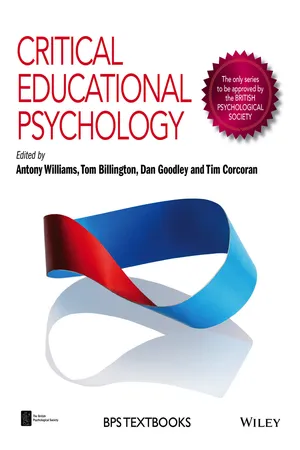
The first textbook of its kind, Critical Educational Psychology is a forward-thinking approach to educational psychology that uses critical perspectives to challenge current ways of thinking and improve practice.
eBook - ePub
Critical Educational Psychology
- English
- ePUB (mobile friendly)
- Available on iOS & Android
eBook - ePub
Critical Educational Psychology
About this book
Information
Part I
Reflexive Foundationalism: Critical Psychological Resources
In this section of the book, contributors consider the theoretical foundations required to conceptualise the notions of ‘education’, ‘psychology’ and ‘critical’. The authors recognise the need to continually re-create our foundations, precisely because we find existing ones unsatisfactory. What results is a reflective or creative foundationalism, in which values are lived out and discussions of ethics and values can never be separated from and are inherent to every act.
1
Psychology and Education: Unquestionable Goods
Ansgar Allen
Preface
Both psychology and education are defended as if they were unquestionable goods. Psychology is associated with the notion that psychological knowledge itself is intrinsically beneficial. Educational activity is similarly associated with the notion that education itself is basically good. This chapter seeks to unsettle the presumed good of each field. It explores how psychology and education define and thereby delimit our freedom to ask whether or not they are ‘good’ or ‘bad’.
1.
Educators often claim that education is under attack. As educators, they believe this is something they are compelled to defend, if only by complaining on its behalf. The collective response is so automatic that one might assume they shared a clear conception of the object under protection. They do not. Though the educational good educators are so sensitive about does achieve widespread support being repeatedly invoked as an entity worthy of protection, this educational good is also uniquely ungraspable. As defenders of a good they cannot precisely discern, educators focus on their presumed attackers by way of a distraction.
2.
Occasionally education is defended against the popular effects of psychology, or ‘psychologisation’. This is the unwelcome (some would say excessive) attribution of psychological ideas to educational problems. But psychologisation is not in itself a problem for education. It is not an imposition, even if it is sometimes imposed. Education willingly adopts psychological understandings or practices or, at least, it does so ‘unconsciously’ and without hesitation.
3.
‘Education’ is a vague signifier. Nobody seems to know what it is; they can only tell you what education sometimes does. Since those activities that traditionally coalesce around this signifier have indeed done quite a bit (of damage, some would say), we might well consider the likely ‘educationalisation’ of psychology. This would accompany the psychologisation of education as its reflection.
4.
Mass schooling – the great educational achievement of the modern state – has been a major contributor to the educationalisation of psychology. This is because psychology emerged in part as a product of 19th-century developments in schooling. From the outset these institutions served as laboratories. They furnished would-be psychologists with captive populations from which to extract data, defining many of the problems psychology set out to answer as well as the purposes those investigations would serve.
5.
While schools served as laboratories, they also functioned like prisons; prisons in turn resembled schools. Both prisons and schools share a heritage and continue to trade techniques. In 1791 Jeremy Bentham published a design for a prison, which could also serve as a school. This circular building was organised around the superintending ‘eye’ of its central observation tower. Bentham called it ‘The Panopticon’.
Many years later, Michel Foucault explored the greater political significance of Bentham’s architectural scheme in Discipline and Punish (1991 [1975]). The ‘panoptic gaze’ described in that book captured the imagination of many, eventually becoming a rather tired metaphor overused in critiques of both education and psychology. As Foucault himself soon recognised, ‘the principle of visibility’ that governed the panopticon was already ‘archaic’ insofar as it attached so much importance to observation. By contrast, the ‘procedures of power resorted to in modern societies are far more numerous and diverse and rich’ than those of panoptic surveillance (Foucault, 1996 [1977], pp. 236, 227). Education resorts to far more than panoptic surveillance; it forms us in many other ways too. So if you shake your fist at the unseemly spread of CCTV cameras1, make sure you also take a critical look at the wider education of the fist that does the shaking.
Still, when approached with caution, the panopticon makes an important point about the educationalisation of psychology. Before psychology existed in any systematic form, an institution was designed whose principles could be applied to ‘work-houses, mad-houses, lazarettos, hospitals and schools’ as well as to prisons. Bentham recalls a certain ‘King of Egypt’2 who ‘thinking to re-discover the lost original of language, contrived to breed up two children in a sequestered spot, secluded from the hour of their birth, from all converse with the rest of humankind’. Suitably inspired, Bentham declares that a panoptic school, run on similar lines, ‘might afford experiments enough that would be rather more interesting’. Perhaps a ‘foundling-hospital’, at the very least, could be run along these experimental lines, isolating individuals and examining their development under controlled conditions (Bentham, 1843 [1791], p. 64).
Insofar as Bentham’s principles were extended to early 19th-century schools, one might say that the experimental school he envisaged was, broadly speaking, in operation and generating data long before experimental psychology was founded. The so-called father of experimental psychology, Wilhelm Wundt (1832–1920), was not yet born.
6.
The typical case of an exchange between education and psychology is located in the early history of mental testing. Mental testing, we discover, was the byproduct of our proudest modern educational commitment, which goes like this:
Education for all it says.
The schools that were established to fulfil this beguilingly simple (if not deludedly cheerful) ideal offered much more than instruction. They generated norms of conduct and performance, organising behavioural space in ways that established the implicit standards against which variations between children could be measured. Within these normative confines a new category of child arrived. Though appearing fully functional at first sight, this child did not seem able to benefit from instruction. This was the so-called ‘feeble-minded’ child who was to be located at the outer limits of the normal.
Alfred Binet was appointed to a commission in 1904 that sought to perfect the distribution of such borderline cases. Many children were now located on these artificial borders of normality. Without an accurate test, it was hard to decide whether or not they would be better off in the so-called ‘special’ schools that had been established to mop up the problematic remainder of the school population. Following the arrival of universal schooling and the new problem of borderline children, the separation of this school-age population became an urgent necessity. The response was to use criteria of separation that were directly educational and behavioural (see Rose, 1999, pp. 141–142). In effect, here we have a landmark case in the educationalisation of psychology.
7.
We could not object to schools as scientific laboratories if they were not at the same time institutions designed to domesticate their populations through the knowledge they accumulate. Today’s schools continue to experiment with the formation and distribution of subjects and subjectivities. In this respect they inform psychology and set its agenda. They also connect psychology to instruments of government.
During the huge expansion of 19th-century schooling, two distinct regimes of power were devised: roughly speaking, these can be divided into the disciplinary supervision of bodies in the early 19th-century monitorial school and the pastoral care of souls in the mid-19th-century moral training school. Initially the techniques these schools developed were aimed at the working poor, the dispossessed and the colonised. These potentially dangerous populations were to be aligned with the newly defined needs of 19th-century industrial societies and their protectorates. Each regime of power borrowed from established religious practices, drawing respectively from medieval monasticism and the Christian pastorate. Developed in partial isolation, these regimes were combined towards the end of the 19th century in the modern classroom. This institutional space was to become a uniquely domesticating site for the formation of individual subjects (see Allen, 2013, 2014).
It should be clear, then, that the manipulation of bodies and the inspection of souls (including self-inspection) was a banal fact of institutional life long before psychology, as a scientific specialism, was established.
8.
This is not a matter of precedence, however. A genealogy of psychology and education reveals that they interpenetrate to such an extent that you cannot be for one, and against the other. The psychologisation of education and the educationalisation of psychology must be set within a broader context.
9.
This context is...
Table of contents
- Cover
- Series
- Title Page
- Copyright
- Contributors
- Introduction
- Part I: Reflexive Foundationalism: Critical Psychological Resources
- Part II: Ethics and Values in Practice
- Part III: Putting Critical Psychological Resources to Work in Educational Psychology
- Further Reading and Resources
- Index
- EULA
Trusted by 375,005 students
Access to over 1.5 million titles for a fair monthly price.
Study more efficiently using our study tools.
Frequently asked questions
Yes, you can cancel anytime from the Subscription tab in your account settings on the Perlego website. Your subscription will stay active until the end of your current billing period. Learn how to cancel your subscription
No, books cannot be downloaded as external files, such as PDFs, for use outside of Perlego. However, you can download books within the Perlego app for offline reading on mobile or tablet. Learn how to download books offline
Perlego offers two plans: Essential and Complete
- Essential is ideal for learners and professionals who enjoy exploring a wide range of subjects. Access the Essential Library with 800,000+ trusted titles and best-sellers across business, personal growth, and the humanities. Includes unlimited reading time and Standard Read Aloud voice.
- Complete: Perfect for advanced learners and researchers needing full, unrestricted access. Unlock 1.5M+ books across hundreds of subjects, including academic and specialized titles. The Complete Plan also includes advanced features like Premium Read Aloud and Research Assistant.
We are an online textbook subscription service, where you can get access to an entire online library for less than the price of a single book per month. With over 1.5 million books across 990+ topics, we’ve got you covered! Learn about our mission
Look out for the read-aloud symbol on your next book to see if you can listen to it. The read-aloud tool reads text aloud for you, highlighting the text as it is being read. You can pause it, speed it up and slow it down. Learn more about Read Aloud
Yes! You can use the Perlego app on both iOS and Android devices to read anytime, anywhere — even offline. Perfect for commutes or when you’re on the go.
Please note we cannot support devices running on iOS 13 and Android 7 or earlier. Learn more about using the app
Please note we cannot support devices running on iOS 13 and Android 7 or earlier. Learn more about using the app
Yes, you can access Critical Educational Psychology by Antony J. Williams, Tom Billington, Dan Goodley, Tim Corcoran, Antony J. Williams,Tom Billington,Dan Goodley,Tim Corcoran in PDF and/or ePUB format, as well as other popular books in Psychology & Education in Psychology. We have over 1.5 million books available in our catalogue for you to explore.