Although the construction and engineering sector makes important contributions to the economic, social, and environmental objectives of a nation, it has a notorious reputation for being an unsafe industry in which to work. Despite the fact that safety performance in the industry has improved, injuries and fatalities still occur frequently. To address this, the industry needs to evolve further by integrating safety into all decision making processes.
Strategic Safety Management in Construction and Engineering takes a broad view of safety from a strategic decision making and management perspective with a particular focus on the need to balance and integrate 'science' and 'art' when implementing safety management. The principles covered here include the economics of safety, safety climate and culture, skills for safety, safety training and learning, safety in design, risk management, building information modelling, and safety research methods and the research-practice nexus. They are integrated into a strategic safety management framework which comprises strategy development, implementation, and evaluation. Practical techniques are included to apply the principles in the context of the construction and engineering industry and projects. Case studies are also provided to demonstrate the localised context and applications of the principles and techniques in practice.
eBook - ePub
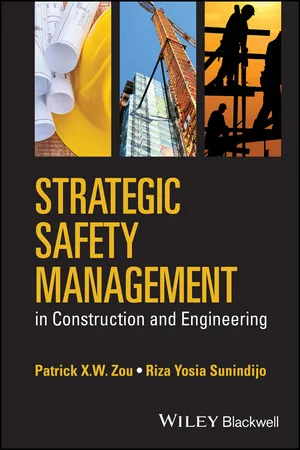
Strategic Safety Management in Construction and Engineering
- English
- ePUB (mobile friendly)
- Available on iOS & Android
eBook - ePub
Strategic Safety Management in Construction and Engineering
About this book
Information
Chapter 1
Safety Management in Construction and Engineering: An Introduction
This book addresses Safety Management in Construction and Engineering by taking a broad view of safety from a strategic decision-making and management perspective. It focuses on strategic decisions made by the boardroom and senior management, including safety strategy design, development, implementation and evaluation. The book also addresses the importance of balancing and integrating the ‘science’ and ‘art’ of safety management, together with an exploration of how safety is perceived and enacted by top management and on-site operatives. The localised on-project-site context for safety strategy implementation, monitoring and evaluation is emphasised, while case studies are provided to demonstrate the implementation of safety concepts, principles and techniques in practice.
The importance of the industry
Construction and engineering is an US $8.7 trillion market, accounting for 12.2% of the world's economic output (Global Construction Perspectives & Oxford Economics, 2013) and providing employment for about 200 million people worldwide (Murie, 2007). It is supported by a complex supply chain encompassing numerous industries ranging from steel, timber and concrete producers to furniture and carpet manufacturers. The supply chain extends further to other industries, such as trucking, shipping, manufacturing and mining, which may not have an obvious direct relationship to the construction and engineering industry (Hampson & Brandon, 2004; Jackson, 2010). The industry is important because of its size and output, which underpins various economic activities and contributes to the delivery of social and environmental objectives of a nation (Health and Safety Executive, 2009).
By way of demonstrating the importance of the construction and engineering sector, Australia and the UK are cited as examples. In Australia, the construction and engineering industry engages in three broad areas of activity: residential building (houses, apartments, flats, and so on), non-residential building (offices, shops, hotels, schools, and so on), and engineering construction (roads, bridges, rails, water and sewerage, and so on). Both the private and public sectors undertake construction and engineering activities. The private sector is engaged in all three categories, while the public sector plays a key role in initiating and undertaking engineering construction activities and those related to health and education (ABS, 2010). The construction and engineering industry is the third largest contributor to Gross Domestic Product (GDP) in the Australian economy and has a major role in determining economic growth. In 2010–11, the industry accounted for 7.7% of GDP and had significantly increased its share of GDP from 6.2% in 2002–03. It also employed 9.1% of the Australian workforce in 2010–11, making it Australia's third largest industry after health care and social assistance, and retail trade (ABS, 2012).
In the UK, the construction and engineering industry contributes about 6.7% to the nation's economy and 10% of all jobs. The UK also has the sixth largest green construction sector in the world. Due to the importance of the sector, the UK government published the Construction 2025 report, which summarises the industrial strategy for the construction sector in the coming decade. The Construction 2025 report outlines the steps that the government and the industry will take in the short and medium terms to achieve four ambitious goals: (1) a 33% reduction in both the initial cost of construction and the whole life cost of assets, based on 2009–10 levels, (2) a 50% reduction in the overall time from inception to completion for new buildings and refurbished assets, based on the industry's performance in 2013, (3) a 50% reduction in greenhouse gas emissions in the built environment as compared to the 1990 baseline, and (4) a 50% reduction in the trade gap between total exports and total imports for construction products and materials based on data in February 2013. The UK government also stresses the importance of investment in infrastructure projects and house building for the economy (HM Government, 2013).
Characteristics of the construction and engineering sector
The construction and engineering sector has unique characteristics which influence the ways construction and engineering organisations operate within the sector, including how they manage safety. These characteristics can be classified into two levels: industry-related and project-related, as discussed in the following sections.
Industry-related characteristics
There are several characteristics at this level, which influence an organisation as a whole. They typically reflect the conditions and nature of the industry. The first characteristic is that the industry is complex in nature. In 1996, Gidado (1996) explained (and it is still valid today) that this complexity originates from (1) uncertainty due to the various components needed in each activity within the production process, which come from various sources including the resources employed and the environment, and (2) interdependence among activities, which is concerned with bringing different parts together to form a work flow. Gidado (1996) further elaborated that the uncertainty has four causes: (1) the unfamiliarity of management with local resources and the local environment, (2) lack of complete specification for the activities on site, (3) the uniqueness of every construction and engineering project (with regard to materials used, type of work, project teams, location and time) and (4) the unpredictability of the environment. This uncertainty characteristic compels construction and engineering organisations to apply a decentralised approach to decision making. The interdependence is influenced by three factors: (1) the number of technologies and their interdependence, (2) the rigidity of sequence between various main operations and (3) the overlaps of stages or elements in construction and engineering processes. The organisation of the workforce into trades and the subcontracting practice intensify this interdependence, which calls for more local rather than centralised coordination (Dubois & Gadde, 2002).
The second characteristic is the low levels of entry to and exit from the construction industry and the large number of small-size enterprises. Although considered a service industry, the entry to the construction industry is different from other service industries, such as finance, insurance, real estate, professional services and business services. The level of education is the most important factor in identifying entrants into self-employment in the other service sectors, but it is less so for construction. In fact, high school dropouts are much more likely to enter self-employment in construction than college graduates (Bates, 1995). In Australia, about 90% of construction organisations employ less than five people or are identified themselves as sole proprietorships. In 2013, the construction industry had the highest number of businesses operating in Australia. Within the same period, however, there were also more than 50,000 exits, representing a 16.5% exit rate, which is higher than the average for all industries at 14.1% (ABS, 2013). All this indicates that there are low requirements to enter the industry, while at the same time the exit rate is also relatively high, thus demonstrating the dynamic nature of the industry.
The third characteristic is the intense and fierce competition and low profit margins due to the sheer number of construction and engineering businesses, especially the small-sized ones (Arditi et al., 2000).
The fourth characteristic is economic pressures, which are typically worsened by late progress payments, and unfair allocations of risk (Arditi et al., 2000; Duffy & Duffy, 2014), which lead to confrontational relationships between parties, making the industry well known for its reputation for fragmentation, conflicts, mistrust, claims and litigation (Duffy & Duffy, 2014; Kanji & Wong, 1998).
The fifth characteristic is related to the workforce, which is labour intensive. Despite the effort to automate and the general advancement of technology, the industry remains traditional and is slow in adopting new technology. Many construction sites still use relatively high rates of unskilled workers, especially those in developing countries (Giang & Pheng, 2011). Furthermore, recent trends show an increase in the proportion of older workers. Together with the physically demanding nature of the construction and engineering work and the exposure to the external environment when working on sites, they intensify the already challenging job and increase the risk of injury and chronic health conditions among older workers (Brenner & Ahern, 2000; Schwatka et al., 2012).
The sixth characteristic is gender imbalance. The industry is one of the most gender-segregated sectors where men dominate the employment in the building trades. The sector is considered as ‘tough’ due to this masculine identity. The culture of taking safety risks and working physically for long hours in primitive working conditions are considered as the norms. This ‘man's job’ is associated with physical labour, dirt, discomfort and danger, which, interestingly, creates a hierarchy within the building trades. The rougher, dirtier trades are perceived to be more masculine than the more ‘refined’ and intellectual trades. Labourers, steel-fixers, bricklayers and ground workers are at the bottom of the status hierarchy, but at the top of the masculinity hierarchy. In contrast, electricians have a high status, but they are not real men (Ness, 2012). This kind of mindset spawns resistance to change, making it extremely difficult to persuade the construction workforce to embrace safety, which is considered as an intrusion into their ‘normal’ ways of operating (Lingard & Rowlinson, 2005).
Project-related characteristics
The construction and engineering industry is also inherently a site-specific project-based activity. According to Project Management Institute (2013), a project has two characteristics: temporary and unique. First, temporary indicates that a project has a definite beginning and end in nature. The end is reached when project objectives have been achieved or when the project is terminated because its objectives cannot be met, or when the need for the project no longer exists. A project may also be terminated if the client wishes to do so.
Second, every project creates a unique result. Buildings can be constructed with the same or similar materials, by the same or different teams and by the same or different methods of construction. There are many factors that cause each construction project to be unique, such as the site location, design, specific circumstances, stakeholders and so on. These characteristics provide added challenges in construction organisations and the industry at large. While many other industries have stan...
Table of contents
- Cover
- Title Page
- Copyright
- Table of Contents
- Foreword
- Acknowledgements
- Chapter 1: Safety Management in Construction and Engineering: An Introduction
- Chapter 2: Economics of Safety
- Chapter 3: Safety Climate and Culture
- Chapter 4: Skills for Safety
- Chapter 5: Safety Training and Learning
- Chapter 6: Safety in Design, Risk Management and BIM
- Chapter 7: Research Methodology and Research–Practice Nexus
- Chapter 8: Strategic Safety Management
- Bibliography
- Index
- End User License Agreement
Trusted by 375,005 students
Access to over 1.5 million titles for a fair monthly price.
Study more efficiently using our study tools.
Frequently asked questions
Yes, you can cancel anytime from the Subscription tab in your account settings on the Perlego website. Your subscription will stay active until the end of your current billing period. Learn how to cancel your subscription
No, books cannot be downloaded as external files, such as PDFs, for use outside of Perlego. However, you can download books within the Perlego app for offline reading on mobile or tablet. Learn how to download books offline
Perlego offers two plans: Essential and Complete
- Essential is ideal for learners and professionals who enjoy exploring a wide range of subjects. Access the Essential Library with 800,000+ trusted titles and best-sellers across business, personal growth, and the humanities. Includes unlimited reading time and Standard Read Aloud voice.
- Complete: Perfect for advanced learners and researchers needing full, unrestricted access. Unlock 1.5M+ books across hundreds of subjects, including academic and specialized titles. The Complete Plan also includes advanced features like Premium Read Aloud and Research Assistant.
We are an online textbook subscription service, where you can get access to an entire online library for less than the price of a single book per month. With over 1.5 million books across 990+ topics, we’ve got you covered! Learn about our mission
Look out for the read-aloud symbol on your next book to see if you can listen to it. The read-aloud tool reads text aloud for you, highlighting the text as it is being read. You can pause it, speed it up and slow it down. Learn more about Read Aloud
Yes! You can use the Perlego app on both iOS and Android devices to read anytime, anywhere — even offline. Perfect for commutes or when you’re on the go.
Please note we cannot support devices running on iOS 13 and Android 7 or earlier. Learn more about using the app
Please note we cannot support devices running on iOS 13 and Android 7 or earlier. Learn more about using the app
Yes, you can access Strategic Safety Management in Construction and Engineering by Patrick X. W. Zou,Riza Yosia Sunindijo,Riza Yosia Sunindijo in PDF and/or ePUB format, as well as other popular books in Technology & Engineering & Industrial Health & Safety. We have over 1.5 million books available in our catalogue for you to explore.