Impedance Source Power Electronic Converters brings together state of the art knowledge and cutting edge techniques in various stages of research related to the ever more popular impedance source converters/inverters.
Significant research efforts are underway to develop commercially viable and technically feasible, efficient and reliable power converters for renewable energy, electric transportation and for various industrial applications. This book provides a detailed understanding of the concepts, designs, controls, and application demonstrations of the impedance source converters/inverters.
Key features:
Comprehensive analysis of the impedance source converter/inverter topologies, including typical topologies and derived topologies.
Fully explains the design and control techniques of impedance source converters/inverters, including hardware design and control parameter design for corresponding control methods.
Presents the latest power conversion solutions that aim to advance the role of power electronics into industries and sustainable energy conversion systems.
Compares impedance source converter/inverter applications in renewable energy power generation and electric vehicles as well as different industrial applications.
Provides an overview of existing challenges, solutions and future trends.
Supported by calculation examples, simulation models and results.
Highly accessible, this is an invaluable resource for researchers, postgraduate/graduate students studying power electronics and its application in industry and renewable energy conversion as well as practising R&D engineers. Readers will be able to apply the presented material for the future design of the next generation of efficient power electronic converters/inverters.
1Electrical and Computer Engineering Program, Texas A&M University at Qatar, Qatar Foundation, Doha, Qatar
2Department of Electrical and Computer Engineering, Texas A&M University, College Station, TX, USA
3Department of Energy Technology, Aalborg University, Aalborg East, Denmark
4Department of Electrical Machines and Power Engineering, Helwan University, Cairo, Egypt
Significant research efforts are underway to develop commercially viable, technically feasible, highly efficient, and highly reliable power converters for renewable energy, electric transportation, and various industrial applications. This chapter presents state-of-the-art knowledge and cutting-edge techniques in various stages of research related to impedance source converters/inverters, including the concepts, advantages compared to existing technology, classification, current status, and future trends.
1.1 General Introduction to Electrical Power Generation
1.1.1 Energy Systems
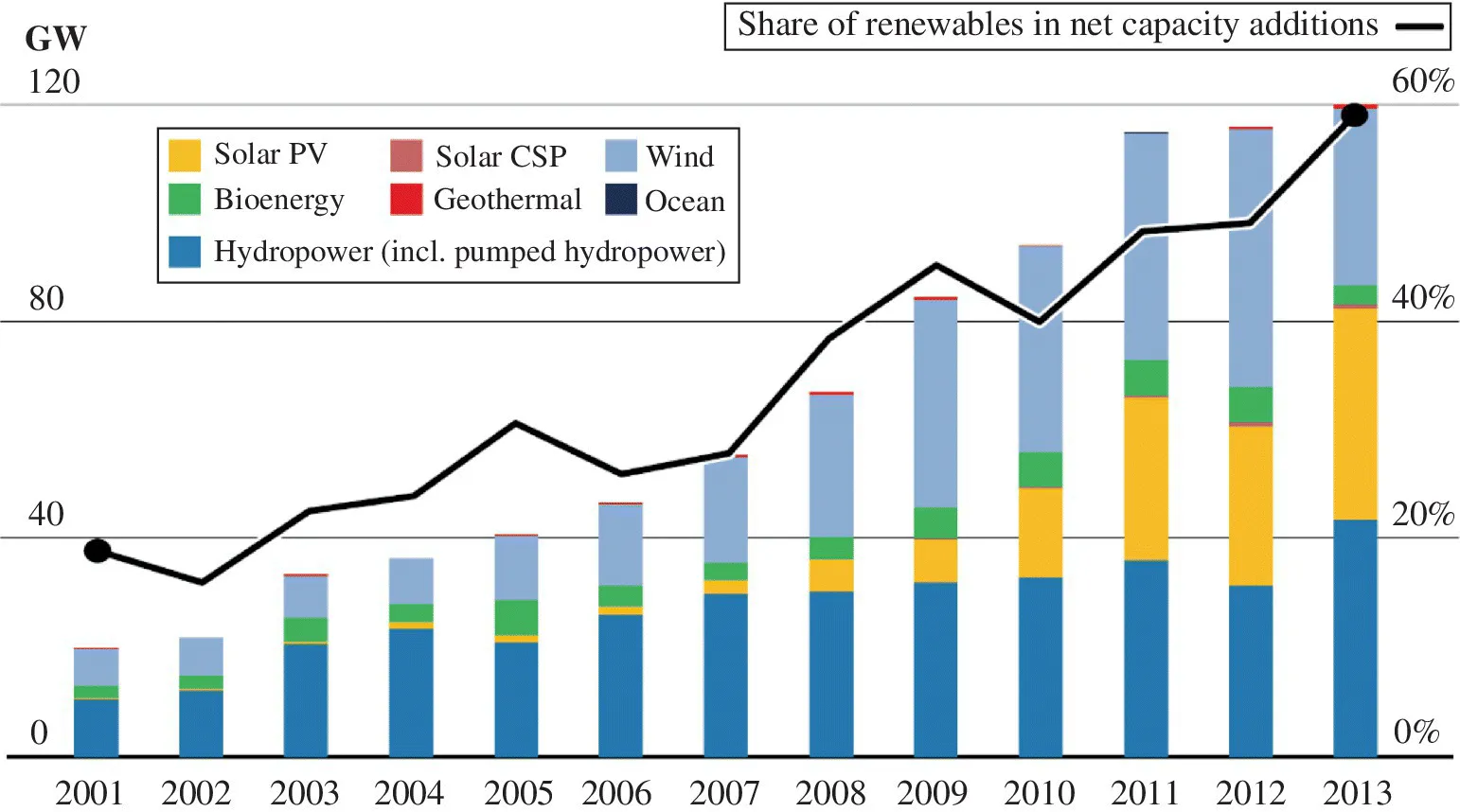
Electric power generation comprises traditional power generation, such as hydroelectric, thermal and nuclear power production, and renewable energy sources, which already has a large penetration joined by photovoltaic (PV) and wind energy [1]. Climatic constraints and large amounts of pollution require us to limit our development and utilization of traditional energy. Renewable energy and energy savings are receiving a greater attention as a sustainable and environmentally friendly alternative. Figure 1.1 shows the the levels of annual global renewable energy in gigawatts (GW), including solar PV, concentrating solar power (CSP), wind, bioenergy, geothermal, ocean, and hydropower [2]. It can be seen that globally installed renewable energy shows a rapid increase since 2007. To 2013, the share of renewables in net capacity additions has reached 60%, doubling the share in 2007.
Figure 1.1 Global renewable energy annual changes in gigawatts (2001–2013) [2].
(Source: Reproduced with permission of REN21)
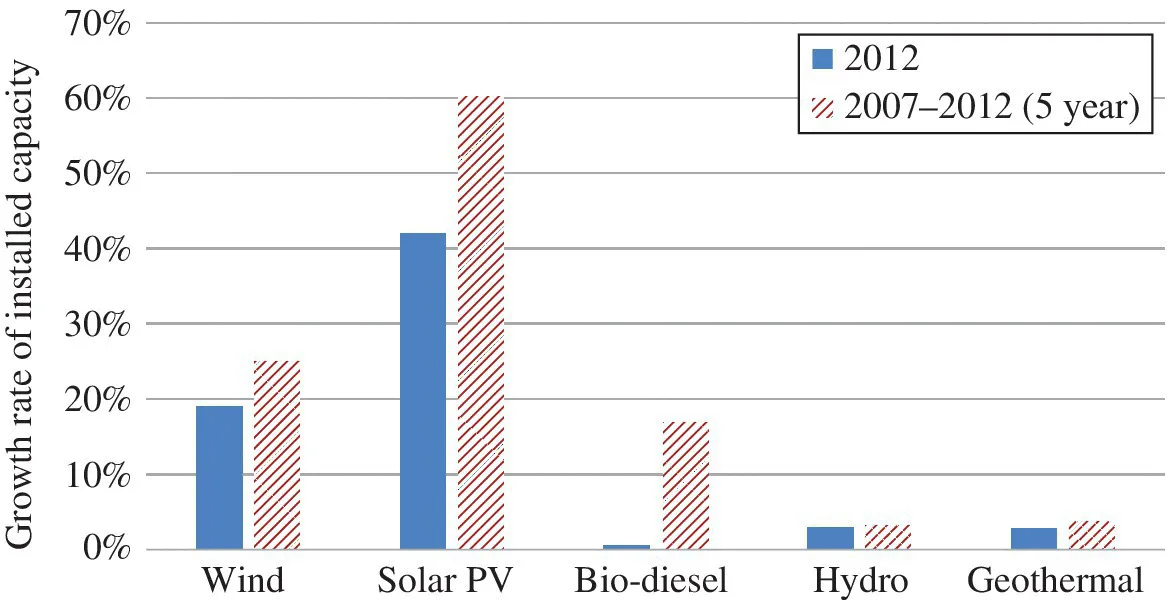
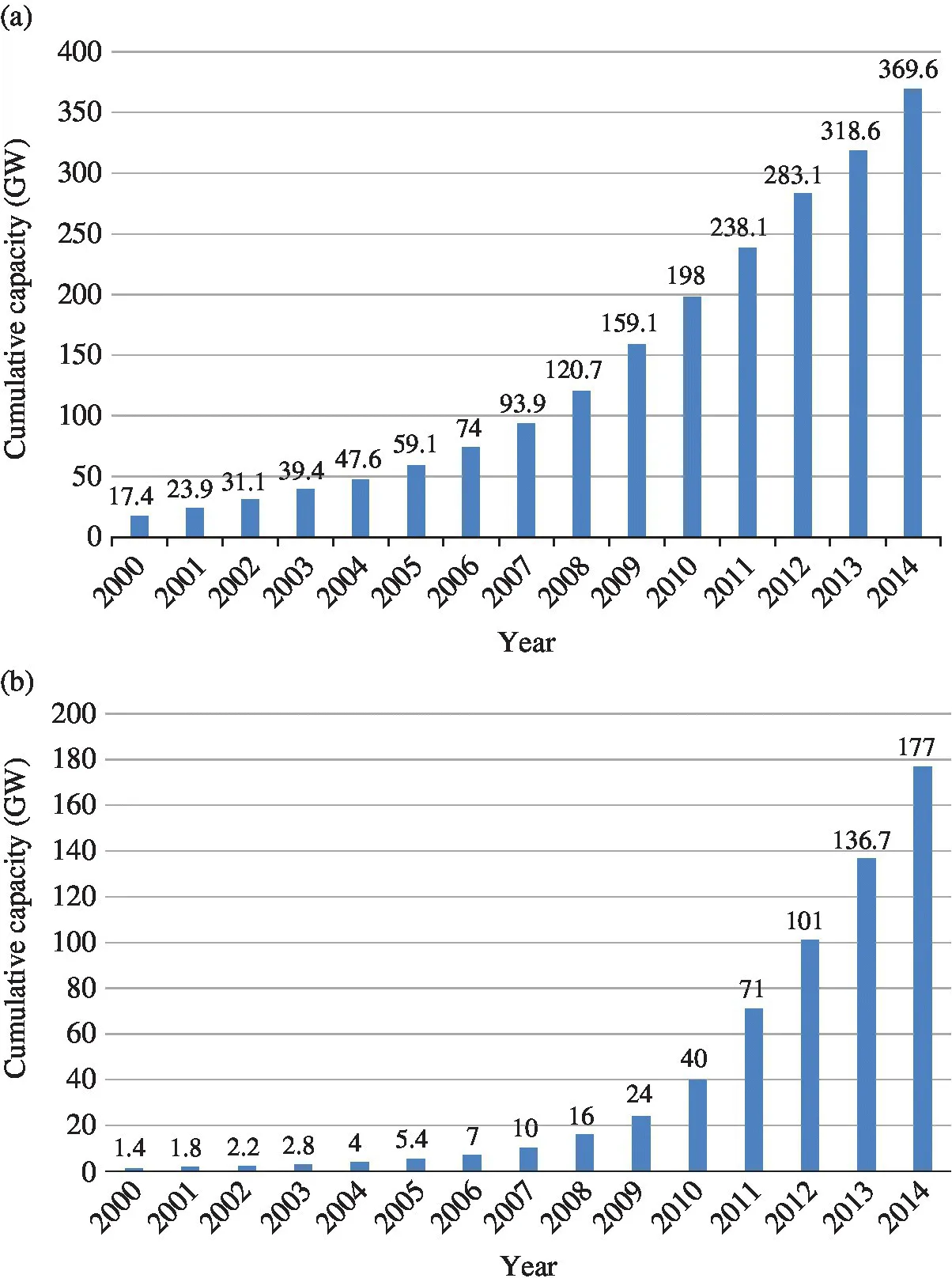
Among global renewable energy sources, wind and solar energy are the leading potential sources of electricity for the 21st century for several reasons: they utilize an abundant energy source (the sun or wind) and have no emissions. Furthermore, solar power can be easily integrated into buildings, and so on. Figure 1.2 shows the growth rates of installed capacity of different renewable energies in 2012 and in five years from 2007 to 2012 [2]; Figure 1.3(a) and (b) show globally installed wind and PV power capacity to 2014 [3, 4]. The cumulative capacity of wind reached 369.6 GW in 2014, and that of PV in 2014 is 177 GW. It can be seen that they have had a fast growth rate since 2007. In addition, fuel cells (FCs) have achieved global attention as an alternative power source for hybrid electric vehicles (HEVs). Fuel cell vehicles (FCVs) have generated interests among industrialists, environmentalists, and consumers. An FCV ensures the air quality, with the wide driving range and convenience of a conventional internal combustion engine vehicle.
Figure 1.2 Growth rates of installed capacity of different renewable energies [2].
(Source: Reproduced with permission of REN21)
Figure 1.3 Globally installed (a) wind power capacity [3]
Used under CC0 1.0 Universal Public Domain Dedication https://creativecommons.org/publicdomain/zero/1.0/deed.en) and (b) PV power capacity (to 2014) [4].
(Source: Reproduced with permission of IEA Photovoltaic Power System Programme)
Nevertheless, power generated by renewable energy sources is intermittent and heavily depends on the environmental conditions. For instance, the power incident on a solar panel, the panel temperature, and the solar panel voltage affect the utilization of solar power generation; similarly, wind speed, wind turbine angular speed, and pitch angle are critical to the amount of harvested wind power. They are unpredictable because of the weather and the seasons. The resultant impact of stochastic fluctuations will have a negative effect on the utility grid in grid-connected mode and on loads in standalone mode. Moreover, power consumption also presents its own characteristics of seasonal and human living habits. In spring and autumn, there are relatively more fine days with a lot of renewable energy compared with the other seasons. These seasons also have good weather; thus, electric loads such as air conditioners may be used less often. Consequently, increased generation from renewable energy power systems and reduced loads cause a voltage rise on the power distribution line. At weekends, during which the systems continue to produce the same amount of power and industrial loads are lower, the grid voltage and frequency could easily become high. Overvoltage may exceed the upper tolerance limit at the point of common coupling; usually grid overvoltage protection will regulate the output power of the renewable energy system if the AC voltage exceeds the control range. Fuel cells prefer to be operated at constant power to prolong their lifetime and it is also more efficient in this way. However, the traction power of a vehicle is ever-changing.
An energy storage unit installed in a renewable energy system may be used to compensate for the insufficient energy through charging and discharging the energy storage unit, so that renewable energy power systems can become more reliable by acquiring the possibility to cope with some important auxiliary services. Similarly, to balance the difference and also to handle regenerative energy, a battery is often used as an energy storage device in FCVs. Basically, the main source of the vehicle’s power is the FC; the secondary power source is the battery, which stores excess energy from the FC, and from regenerative braking [5].
Efficient energy transfer and high reliability of power electronics, involved in the interface between the energy sources and the grid or loads, are essential for converting the fluctuating powers into suitable voltage and frequency AC power [6]. According to the c...
Table of contents
Cover
Title Page
Table of Contents
Preface
Acknowledgment
Bios
1 Background and Current Status
2 Voltage-Fed Z-Source/Quasi-Z-Source Inverters
3 Current-Fed Z-Source Inverter
4 Modulation Methods and Comparison
5 Control of Shoot-Through Duty Cycle: An Overview
11 Energy Stored Z-Source/Quasi-Z-Source Inverters
12 Z-Source Multilevel Inverters
13 Design of Z-Source and Quasi-Z-Source Inverters
14 Applications in Photovoltaic Power Systems
15 Applications in Wind Power
16 Z-Source Inverter for Motor Drives Application: A Review
17 Impedance Source Multi-Leg Inverters
18 Model Predictive Control of Impedance Source Inverter
19 Grid Integration of Quasi-Z Source Based PV Multilevel Inverter
20 Future Trends
Index
End User License Agreement
Trusted by 375,005 students
Access to over 1.5 million titles for a fair monthly price.
Study more efficiently using our study tools.
Frequently asked questions
Yes, you can cancel anytime from the Subscription tab in your account settings on the Perlego website. Your subscription will stay active until the end of your current billing period. Learn how to cancel your subscription
No, books cannot be downloaded as external files, such as PDFs, for use outside of Perlego. However, you can download books within the Perlego app for offline reading on mobile or tablet. Learn how to download books offline
We are an online textbook subscription service, where you can get access to an entire online library for less than the price of a single book per month. With over 1.5 million books across 990+ topics, we’ve got you covered! Learn about our mission
Look out for the read-aloud symbol on your next book to see if you can listen to it. The read-aloud tool reads text aloud for you, highlighting the text as it is being read. You can pause it, speed it up and slow it down. Learn more about Read Aloud
Yes! You can use the Perlego app on both iOS and Android devices to read anytime, anywhere — even offline. Perfect for commutes or when you’re on the go. Please note we cannot support devices running on iOS 13 and Android 7 or earlier. Learn more about using the app
Yes, you can access Impedance Source Power Electronic Converters by Yushan Liu,Haitham Abu-Rub,Baoming Ge,Frede Blaabjerg,Omar Ellabban,Poh Chiang Loh in PDF and/or ePUB format, as well as other popular books in Technology & Engineering & Power Resources. We have over 1.5 million books available in our catalogue for you to explore.