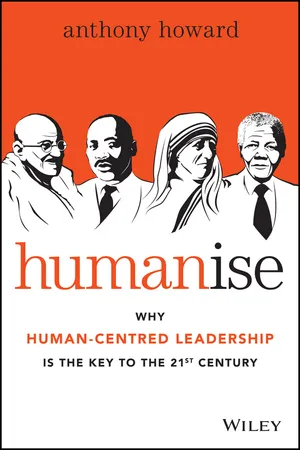
Humanise
eBook - ePub

Humanise

Why Human-Centred Leadership is the Key to the 21st Century

  1. English
  2. ePUB (mobile friendly)
  3. Available on iOS & Android
eBook - ePub

Humanise

Why Human-Centred Leadership is the Key to the 21st Century

About this book

Legendary leaders change the world by putting leadership at the service of humanity

Humanise is a comprehensive look at human-centred leadership, providing insight and guidance for those who want to change the world. A deep examination of the concept of moral leadership, this book examines what it is, how it's acquired, and how it can be applied in business, government, and society. Readers will gain insight into predominant leadership styles exemplified in governments and organizations around the world, and discover the missing pieces that come together to more effectively guide people through challenges and transitions. With a focus on building a solid foundation, a strong moral compass, and deep empathy for others, this book shows you how to be a leader wherever you are, build your leadership capability, and make a positive impact on the world.

We are facing a crisis of leadership. Where are the new Mandelas? What type of person is that? What are their qualities and attributes? Who will lead us into the future? Humanise is a book for people who want to be the very best version of themselves, the best leader they can be, and impact the world for good.

  • Discover a different perspective on the leadership crisis throughout the world
  • Create your own leadership foundation starting with your purpose and principles
  • Turn your personal moral values into a leadership style that will benefit and inspire others
  • Influence the individuals and world around you to become a part of the solution

Following in the footsteps of Mandela and Ghandi, this book explains why great leadership is human-centred, and how you can become such a leader, no matter who you are or what position you are in. For those interested in picking up the torch and guiding the way, Humanise provides a roadmap to the version of you you've always wanted to be, and that the world needs you to be.

Trusted by 375,005 students

Access to over 1.5 million titles for a fair monthly price.

Study more efficiently using our study tools.

Information

Publisher
Wiley
Year
2015
Print ISBN
9780730316640
Edition
1
eBook ISBN
9780730316657
Subtopic
Leadership

PART I
The challenge facing human-centred leaders

A framework for future leadership

Part I provides a framework for thinking about the future and the kind of leadership required. I review five key changes that attract my attention because of their relevance to Human-Centred Leadership.
Chapter 1 introduces the sigmoid curve and the game-changer curve, two helpful models for thinking about the changes and transitions occurring at this time. I then propose that we live in a ‘leaderless' world and lack the quality of leadership that is required to lead us into the future through these shifts. Technology trends, examined in chapter 2, demand profound shifts in our moral and leadership capacity, while we need to develop a new moral foundation for business, government and society (chapter 3). Chapter 4 reflects on the humanisation of machines and the mechanisation of humanity and suggests we are about to witness a crossover where one could dominate the other.
Given these kinds of shifts it is time to upgrade our moral capability to match our technological capability. The key to this will be human-centred leaders who put people first and who integrate the technical and moral aspects of life and leadership.

CHAPTER 1
The future and the future of leadership

A water taxi ride from Marco Polo airport across the lagoon into Venice is one of life's great experiences. A few minutes after landing on a flight from London I was sitting in the stern of a motorboat skimming across the sparkling water. While my watch advanced an hour, time unravelled in this historic crossroads of people and culture. As we approached the legendary Hotel Danieli, housed in a regal fourteenth-century palazzo, gondolas bobbed in the water, the gondoliers resplendent in their simple striped shirts. Tourists filled Piazza San Marco, ignoring the glare of the midday sun in order to spend a few moments being blinded by beauty.
As I strolled the quiet empty streets that night my thoughts turned again to the relentlessness of change. Venice helps us maintain perspective when we consider the transitions, trends and shifts confronting our world. Venice may be sinking, but slowly. The sea may be rising, but slowly. The passenger ships deliver new loads of tourists by their thousands each day, leaving the city to silence and local life each night.
Venice reminds us that people adapt in the midst of change. We generally get on with living, muddle through and find a way forward through all that shifts, often with considerably more resilience than we tend to recognise.
While Venetians face a remorselessly rising sea level, what do you face? What are the sea changes in your world that will change the way you go about your life? What forces are changing business, government and society, and how will they change us? How can we understand this change?

Navigating this chapter

This chapter introduces two models for understanding change, the sigmoid curve and the game-changer curve, that will help you make sense of some of the shifts and transitions, and understand what happens during change, particularly at inflexion points.
  • ‘A future of unbounded possibility' considers the impact you can make by your choices, points out that we live in a leaderless world and raises questions about who can lead us into the future through these shifts.
  • ‘Five big shifts revealed through a human lens' introduces my perspective on the shifts before you as you take up the challenge of Human-Centred Leadership.

Two models for understanding change

Much of this book is about change and responses to change. These two models offer a way of understanding change and seeing where we may be on the change curve.

The sigmoid curve

‘The only constant is change' has become a rather tired aphorism, trotted out as if change is something unique to this moment. Change, however, is a function of time — and vice versa. It has been with us since the spark of the Big Bang and will be with us until the universe fizzles out. It's unrelenting, unstoppable and often uncomfortable.
Twenty years ago Charles Handy, in his book The Empty Raincoat, explained the concept of the sigmoid curve as a way of understanding change.1
The sigmoid curve starts with a standard lifecycle curve (see figure 1.1), which shows a simple timeline: products are launched, grow to maturity, and then begin to decline and eventually disappear. Manufacturers, for instance, pay attention to this curve as they invest in R&D to bring new products to market, steadily build market share and then enjoy a period of healthy sales and margins. Over time sales begin to decline as the market becomes saturated, competitors enter the market or technology becomes outdated. Eventually the product fades from view. Take a short moment to reflect on products you have used over the years — to play music or contact friends perhaps — and you will recognise this cycle.
c0*f00*.webp
Figure 1.1: lifecycle curve
In order to avoid the inevitable decline, you need to rethink what you are doing — that is, innovate — as you approach the top of the curve, when everything appears to be going fabulously well. Doing this can sometimes lead to a temporary dip, for instance as profits decline due to increased R&D investment, although success will launch a new curve. This new upswing motion forms an inflexion point and creates the sigmoid curve (see figure 1.2, overleaf).
c0*f00*.webp
Figure 1.2: the sigmoid curve
Changing direction when things are going well is not easy. In business sales are booming, profits are up, people enjoy working for a market leader, customers love you … In government the economy is strong, debt is being paid down, unemployment is low … In your personal life relationships are flourishing, communication is honest and frequent, the world seems radiant … This is often the calm before the storm, the comfort before the seven-year itch, the illusory satisfaction of supportive polls or market research.
Wise leaders take steps to prepare for the future, just as navigators know the sun does not shine forever and always keep a close eye on weather and water. They know a storm will roll in at some point and always maintain a state of readiness.
Looking away from what is successful at the moment to what could be successful in the future requires strong leadership. It requires courage to confront the chaos and confusion that marks inflexion points and to navigate the fog of uncertainty.

The game-changer curve

Many people sense that the change we are going through in the world at this time is in some way different from previous changes. When they talk about energy or the environment, the economy or society, governments or business, they talk about a ‘gap' that separates today from tomorrow. This kind of change is not a transition along a continuum, such as on a sigmoid curve, but a transition from one continuum to another. In other words, a game-changing event causes a break or disruption in the curve (see figure 1.3, with thanks to Chris Bangle, former Chief of Design for BMW, who first alerted me to this concept).
c0*f00*.webp
Figure 1.3: the game changer
This concept of a disruptive, game-changing shift can help you understand why what is happening today feels more uncomfortable than previous changes. While some changes mark a journey from one place to another, as if following a winding road, contemporary changes are more like leaping across an abyss.
Digital disruption is one example of a game changer. Artificial intelligence is about to be unleashed on knowledge work, which will have a far greater impact than the computerisation of manufacturing jobs. Having been relatively passive observers as machines took over manu...

Table of contents

  1. Cover
  2. Epigraph
  3. Titlepage
  4. Copyright
  5. Dedication
  6. About the author
  7. Acknowledgements
  8. Preface
  9. Introduction: Discovering Human-Centred Leadership
  10. PART I The challenge facing human-centred leaders
  11. PART II Foundations for human-centred leaders
  12. PART III Human-Centred Leadership in action
  13. Conclusion: Human-Centred Leaders Change the World
  14. Bibliography
  15. Index
  16. Advert
  17. End User License Agreement

Frequently asked questions

Yes, you can cancel anytime from the Subscription tab in your account settings on the Perlego website. Your subscription will stay active until the end of your current billing period. Learn how to cancel your subscription
No, books cannot be downloaded as external files, such as PDFs, for use outside of Perlego. However, you can download books within the Perlego app for offline reading on mobile or tablet. Learn how to download books offline
We are an online textbook subscription service, where you can get access to an entire online library for less than the price of a single book per month. With over 1.5 million books across 990+ topics, we’ve got you covered! Learn about our mission
Look out for the read-aloud symbol on your next book to see if you can listen to it. The read-aloud tool reads text aloud for you, highlighting the text as it is being read. You can pause it, speed it up and slow it down. Learn more about Read Aloud
Yes! You can use the Perlego app on both iOS and Android devices to read anytime, anywhere — even offline. Perfect for commutes or when you’re on the go.
Please note we cannot support devices running on iOS 13 and Android 7 or earlier. Learn more about using the app
Yes, you can access Humanise by Anthony Howard in PDF and/or ePUB format, as well as other popular books in Business & Leadership. We have over 1.5 million books available in our catalogue for you to explore.