This volume of the series was designed to provide a comprehensive primer on the existing best practices and emerging developments in the study and design research on crime and criminology. The work as a whole includes chapters on the measurement of criminal typologies, the offenders, offending and victimization, criminal justice organizations, and specialized measurement techniques. Each chapter is written by experts in the field and they provide an excellent survey of the literature in the relevant area. More importantly, each chapter provides a description of the various methodological and substantive challenges presented in conducting research on these issues and denotes possible solutions to these dilemmas. An emphasis was placed on research that has been conducted outside of the United States and was designed to give the reader a broader more global understanding of the social context of research.
The goal of this volume is to provide a definitive reference for professionals in the field, researchers, and students. This volume in the Handbooks in Criminology and Criminal Justice series identifies the principal topical areas of research in this field and summarizes the various methodological and substantive challenges presented in conducting research on these issues. In each chapter, authors provide a summary of the prominent data collection efforts in the topical area, provide an overview of the current methodological work, discuss the challenges in the measurement of central concepts in the subject area, and identify new horizons emerging in data collection and measurement. We encouraged authors to discuss work conducted in an international context and to incorporate discussion of qualitative methodologies when appropriate.
The empirical examination of criminal violence typically centers on four interrelated units of analysis: (1) individuals, (2) groups such as gangs and gang networks, (3) events, and (4) places. While there is certainly a high degree of overlap across each of these different units (e.g., gang members are more likely to target suitable victims in high-risk community contexts), the present chapter attempts to disentangle each of these various dimensions of violent crime. Its overall purpose is to help inform theory and practice and highlight the most promising violent crime prevention approaches that attempt to understand and address each of these various dimensions of violent crime.
The chapter is outlined as follows. First, a review of violent crime across individuals, groups, events, and places is provided. Second, for each of the various units of analysis, in-depth methodological and analytical discussions are presented regarding consistent findings in the literature as well as the latest developments in data analysis and research. Third, the chapter concludes with a discussion of promising police-led strategies designed to reduce violent crime that focus on places, incidents, individuals, and groups. Evaluation approaches used by researchers to test the utility of these police-led approaches are also highlighted.
Individual-Level Violence
A large body of research attempts to distinguish violent criminal behavior from more general forms of crime and deviance, while yet other research suggests that patterns in violence are simply a product of versatile criminal behavior (Osgood et al., 1988). These varying perspectives stem from a broader set of theoretical and analytical approaches, which attempt to explain antisocial behavior at the individual level. Gottfredson and Hirschi (1990) proposed that criminality is best explained by a general theory of crime, on the grounds that stable individual differences in criminal behavior are general rather than specific and are linked to low self-control and high impulsivity. From this perspective, those individuals who are more likely to seize the opportunity and commit criminal (and occasionally violent) acts are also more likely than most others to begin offending early on in their life, to offend more persistently, to engage in a variety of crimes, and to desist in later life (Dean, Brame, and Piquero, 1996; Hirschi and Gottfredson, 1995). In contrast to this perspective, some researchers have illustrated that offending patterns are dynamic rather than static.
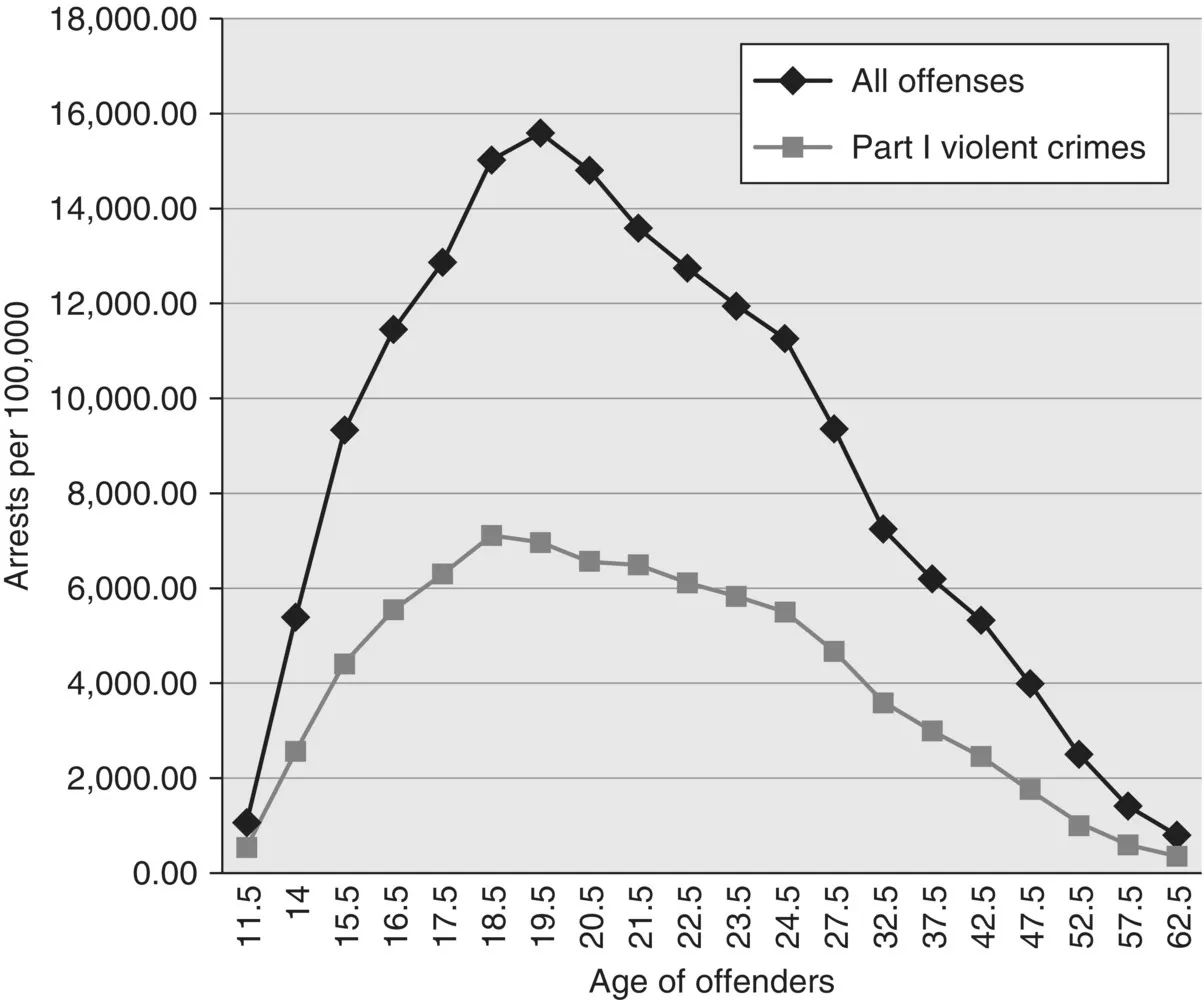
For instance, Loeber (1990) argued that higher rates of overall offending predict an increased likelihood of violence. Farrington (1986) showed that the adolescent peak of offending within the age-crime curve reflects a temporary increase in the number of people involved in antisocial and delinquent behavior. Likewise, Moffitt (1993) proposed that there are two qualitatively distinct categories of individuals who engage in antisocial, delinquent, and criminal behaviors: adolescent-limited offenders and life-course-persistent offenders. Adolescent-limited offenders are offenders who tend to be temporarily involved in antisocial behavior during specific periods, calibrated with their own physical and social development. This larger group of individuals eventually age out. Comparatively, life-course-persistent offenders form a smaller group of individuals who engage in crime continuously. Figure 1.1 displays the average age–crime curve for all general arrests and violent arrests for 2000–2011 reported to the Federal Bureau of Investigations (FBI) (Bureau of Justice Statistics, 2014a).
Figure 1.1 Age–crime curve for US arrests, 2000–2011.
Methodologically speaking, when researchers examine the intersection of age, race, gender, and offense-specific patterns of violence, it is important to understand that officially reported data such as arrests and crime incidents can be inherently biased (Cernkovich, Giordano, and Pugh, 1985). Arrests that serve as the starting point of official records of crime are funneled through police decision-making (Smith and Visher, 1981). Research indicates that police officers can observe similar patterns of behavior in different groups (e.g., males vs. females; blacks vs. whites) and then give different responses to similar incidents. For example, in a study that examined police officers’ decisions to arrest in cases that involved physical violence between citizens, Smith (1987) specifically found that a number of contextual factors influenced police decisions to arrest, which included victim attributes (e.g., police were less likely to arrest in violent encounters involving black or female victims) and neighborhood context (e.g., police were more likely to arrest and less likely to use mediation in lower-status neighborhoods). Labeling theory helps explain social responses to crime and deviance. Sociologist Howard Becker (1963) argued that the application of a label to a person influences the way institutions of social control respond to that individual’s behavior. In short, official arrest and incident data have the potential to be filtered through a lens of interpretation and decision-making processes that take place among police officers. Thus, while official data provide a relatively strong foundation for the measurement of criminal violence, such sources also have a number of serious limitations (e.g., unreported crimes; police officer decision-making; selection bias among citizens who report incidents) for those who attempt to more fully understand the nature and magnitude of violent crime. Indeed, data triangulation is a critical dimension for understanding individual patterns of offending over the life course.
Self-reported data provide more detailed information on behavioral patterns and are not influenced by the same potential biases as officially reported data. However, data from self-reports have an altogether different set of strengths and limitations. There are seemingly two important factors that researchers need to consider when examining self-report data related to violence. First, does the analysis focus on general crime and deviance or on specific crimes, such as violence and serious offenses? Analyses derived from data that focus only on more serious types of violence have the potential to ignore less serious and more typical types of crime (e.g., minor property offenses). Any theoretical test of violent offending should specifically model the causal processes that lead to violence; and those causal processes should be somewhat distinct from more general (and minor) offending patterns, if indeed offense specialization exists. Otherwise the sequencing of events may be quite similar, and violent crime is simply reflective of more general and more common types of crime.
Second, researchers must assess whether self-reports are drawn from institutionalized or noninstitutionalized populations. In the early 1990s, the National Research Council (NRC) argued that self-report studies from the general population are unsuitable for the study of violent crime. The NRC (1993) cited three reasons for this position: (1) the base rate of violent crimes is too low to generate reliable estimates; (2) truly violent persons are not typically included in general population samples; and (3) information about the sequencing of different types of offenses is not collected. The important point here is that self-reports from members of the general population are much less likely to give information on violence due to the relative infrequency of violence among the general population. Comparatively, when a richer context of violence and more details about it can be ascertained from institutionalized and previously violent populations, the information gleaned from these respondents is not generalizable to the broader population; in other words, more detailed narratives about violence can be better obtained from populations with a propensity toward violence. Relying on the strengths and weaknesses of these different data sources, researchers have attempted to assess whether violent offending is specialized in nature.
Reiss and Roth (1993, p. 381) specifically asked: “What are the differences between people who commit violent acts and those who commit more general, delinquent criminal, or antisocial acts?” Studies have consistently indicated that violent offenders tend to commit more crimes than nonviolent offenders. Thus, at the individual level, violent crimes seem to be a byproduct of overall offending patterns (simply put, they would be crimes at a higher overall rate). Additionally, there is no evid...
Table of contents
Cover
Title Page
Table of Contents
Notes on Contributors
Introduction
Part I: Measurement of Criminal Typologies
Part II: Offenders, Offending, and Victimization
Part III: Criminal Justice Organizations and Outcomes
Part IV: Specialized Measurement Techniques
Index
End User License Agreement
Trusted by 375,005 students
Access to over 1.5 million titles for a fair monthly price.
Study more efficiently using our study tools.
Frequently asked questions
Yes, you can cancel anytime from the Subscription tab in your account settings on the Perlego website. Your subscription will stay active until the end of your current billing period. Learn how to cancel your subscription
No, books cannot be downloaded as external files, such as PDFs, for use outside of Perlego. However, you can download books within the Perlego app for offline reading on mobile or tablet. Learn how to download books offline
Perlego offers two plans: Essential and Complete
Essential is ideal for learners and professionals who enjoy exploring a wide range of subjects. Access the Essential Library with 800,000+ trusted titles and best-sellers across business, personal growth, and the humanities. Includes unlimited reading time and Standard Read Aloud voice.
Complete: Perfect for advanced learners and researchers needing full, unrestricted access. Unlock 1.5M+ books across hundreds of subjects, including academic and specialized titles. The Complete Plan also includes advanced features like Premium Read Aloud and Research Assistant.
Both plans are available with monthly, semester, or annual billing cycles.
We are an online textbook subscription service, where you can get access to an entire online library for less than the price of a single book per month. With over 1.5 million books across 990+ topics, we’ve got you covered! Learn about our mission
Look out for the read-aloud symbol on your next book to see if you can listen to it. The read-aloud tool reads text aloud for you, highlighting the text as it is being read. You can pause it, speed it up and slow it down. Learn more about Read Aloud
Yes! You can use the Perlego app on both iOS and Android devices to read anytime, anywhere — even offline. Perfect for commutes or when you’re on the go. Please note we cannot support devices running on iOS 13 and Android 7 or earlier. Learn more about using the app
Yes, you can access The Handbook of Measurement Issues in Criminology and Criminal Justice by Beth M. Huebner, Timothy S. Bynum, Beth M. Huebner,Timothy S. Bynum in PDF and/or ePUB format, as well as other popular books in Social Sciences & Criminology. We have over 1.5 million books available in our catalogue for you to explore.