A practical introductory guide to optical design covering geometrical optics, simple wave-optics and diffraction, using Excel software
• explains practical calculation methods for designing optical systems with fully worked-out examples and avoiding complex mathematical methods
• includes practical calculations for ray tracing, laser beam (Gaussian beam) focusing, and diffraction calculations; the ray tracing and the diffraction calculations are done by using the VBA program which Excel provides as a supporting tool
• describes basic optical theory and application methods, and provides readers with calculation methods for designing laser optical systems with numerous practical calculation examples. After finishing the book, even inexperienced readers should have the ability to design laser optical systems
• covers large areas of geometrical optics and diffraction theory, providing a good overview and reference for beginners or non-specialist engineers
• accompanied by a website including password protected electronic files
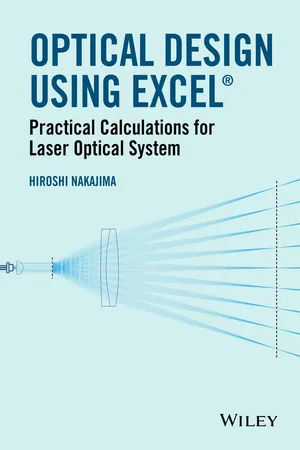
eBook - ePub
Optical Design Using Excel
Practical Calculations for Laser Optical Systems
- English
- ePUB (mobile friendly)
- Available on iOS & Android
eBook - ePub
About this book
Information
Chapter 1
Geometrical Optics
1.1 Characteristics of Lasers
This book is about optical calculation methods and the principles for applying these methods to actual optical devices. Most of these devices use lasers, so we will begin by briefly examining the characteristics of lasers. The following exposition will be especially beneficial for readers whose understanding of lasers is rather limited.
The term LASER is an acronym for “Light Amplification by Stimulated Emission of Radiation.” Lasers have special characteristics that distinguish them from most light-emitting devices: a narrow, low-divergence beam (sharp directivity), and a very narrow wavelength spectrum (monochromaticity). These features of lasers make them ideally suited for the generation of high intensity beams.
The history of lasers goes back about half a century to 1960, when the first working laser was demonstrated. Lasers are now widely used in a variety of fields, including optical storage (e.g., CD drives and DVD drives), fiber-optic communication, manufacturing (especially for cutting, bending, welding, and marking materials), scientific measurement, and medicine. This diversity of application is due to the following four properties of lasers, which give them a commercial and scientific edge over other light-emitting devices.
- 1. Monochromaticity: Radiation that has a very narrow frequency band (or wavelength band) is said to possess the property of monochromaticity. Because the band is so narrow, the radiation can be regarded as having a single frequency (or alternatively, a single wavelength). Laser light typically has a very narrow frequency band (or wavelength band), which makes it an ideal example of the property of monochromaticity. ...
Table of contents
- Cover
- Title Page
- Copyright
- Table of Contents
- About the Author
- Preface
- Chapter 1: Geometrical Optics
- Chapter 2: Examples of Simple Optical Design Using Paraxial Theory
- Chapter 3: Ray Tracing Applications of Paraxial Theory
- Chapter 4: Two-Dimensional Ray Tracing
- Chapter 5: Three-Dimensional Ray Tracing
- Chapter 6: Mathematical Formulae for Describing Wave Motion
- Chapter 7: Calculations for Focusing Gaussian Beams
- Chapter 8: Diffraction: Theory and Calculations
- Chapter 9: Calculations for Gaussian Beam Diffraction
- Appendix A: Paraxial Theory: A Detailed Account
- Appendix B: Table of Refractive Indices for BK7
- Appendix C: Equations for Plane Waves, Spherical Waves, and Gaussian Beams
- Appendix D: Numerical Integration Methods
- Appendix E: Fresnel Diffraction and Fraunhofer Diffraction
- Appendix F: Wave-Front Conversion by a Lens
- Appendix G: List of Excel Calculation Files on the Companion Web Site
- Index
- End User License Agreement
Trusted by 375,005 students
Access to over 1.5 million titles for a fair monthly price.
Study more efficiently using our study tools.
Frequently asked questions
Yes, you can cancel anytime from the Subscription tab in your account settings on the Perlego website. Your subscription will stay active until the end of your current billing period. Learn how to cancel your subscription
No, books cannot be downloaded as external files, such as PDFs, for use outside of Perlego. However, you can download books within the Perlego app for offline reading on mobile or tablet. Learn how to download books offline
Perlego offers two plans: Essential and Complete
- Essential is ideal for learners and professionals who enjoy exploring a wide range of subjects. Access the Essential Library with 800,000+ trusted titles and best-sellers across business, personal growth, and the humanities. Includes unlimited reading time and Standard Read Aloud voice.
- Complete: Perfect for advanced learners and researchers needing full, unrestricted access. Unlock 1.5M+ books across hundreds of subjects, including academic and specialized titles. The Complete Plan also includes advanced features like Premium Read Aloud and Research Assistant.
We are an online textbook subscription service, where you can get access to an entire online library for less than the price of a single book per month. With over 1.5 million books across 990+ topics, we’ve got you covered! Learn about our mission
Look out for the read-aloud symbol on your next book to see if you can listen to it. The read-aloud tool reads text aloud for you, highlighting the text as it is being read. You can pause it, speed it up and slow it down. Learn more about Read Aloud
Yes! You can use the Perlego app on both iOS and Android devices to read anytime, anywhere — even offline. Perfect for commutes or when you’re on the go.
Please note we cannot support devices running on iOS 13 and Android 7 or earlier. Learn more about using the app
Please note we cannot support devices running on iOS 13 and Android 7 or earlier. Learn more about using the app
Yes, you can access Optical Design Using Excel by Hiroshi Nakajima in PDF and/or ePUB format, as well as other popular books in Technology & Engineering & Electrical Engineering & Telecommunications. We have over 1.5 million books available in our catalogue for you to explore.