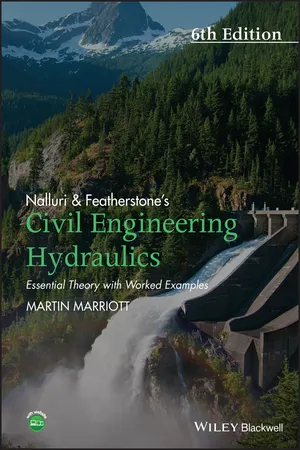
An update of a classic textbook covering a core subject taught on most civil engineering courses. Civil Engineering Hydraulics, 6th edition contains substantial worked example sections with an online solutions manual. This classic text provides a succinct introduction to the theory of civil engineering hydraulics, together with a large number of worked examples and exercise problems. Each chapter contains theory sections and worked examples, followed by a list of recommended reading and references. There are further problems as a useful resource for students to tackle, and exercises to enable students to assess their understanding. The numerical answers to these are at the back of the book, and solutions are available to download from the book?s companion website.
A fluid is a substance which deforms continuously, or flows, when subjected to shear stresses. The term fluid embraces both gases and liquids; a given mass of liquid will occupy a definite volume whereas a gas will fill its container. Gases are readily compressible; the low compressibility, or elastic volumetric deformation, of liquids is generally neglected in computations except those relating to large depths in the oceans and in pressure transients in pipelines.
This text, however, deals exclusively with liquids and more particularly with Newtonian liquids (i.e. those having a linear relationship between shear stress and rate of deformation).
Typical values of different properties are quoted in the text as needed for the various worked examples. For more comprehensive details of physical properties, refer to tables such as Kaye and Laby (1995) or internet versions of such information.
1.2 Engineering units
The metre–kilogram–second (mks) system is the agreed version of the international system (SI) of units that is used in this text. The physical quantities in this text can be described by a set of three primary dimensions (units): mass (kg), length (m) and time (s). Further discussion is contained in Chapter 9 regarding dimensional analysis. The present chapter refers to the relevant units that will be used.
The unit of force is called newton (N) and 1 N is the force which accelerates a mass of 1 kg at a rate of 1 m/s2 (1 N = 1 kg m/s2).
The unit of work is called joule (J) and it is the energy needed to move a force of 1 N over a distance of 1 m. Power is the energy or work done per unit time and its unit is watt (W) (1 W = 1 J/s = 1 N m/s).
1.3 Mass density and specific weight
Mass density (ρ) or density of a substance is defined as the mass of the substance per unit volume (kg/m3) and is different from series specific weight (γ), which is the force exerted by the earth’s gravity (g) upon a unit volume of the substance (γ = ρg: N/m3). In a satellite where there is no gravity, an object has no specific weight but possesses the same density that it has on the earth.
1.4 Relative density
Relative density (s) of a substance is the ratio of its mass density to that of water at a standard temperature (4°C) and pressure (atmospheric) and is dimensionless.
For water, ρ = 103 kg/m3, γ = 103 × 9.81 ≃ 104 N/m3 and s = 1.
1.5 Viscosity of fluids
Viscosity is that property of a fluid which by virtue of cohesion and interaction between fluid molecules offers resistance to shear deformation. Different fluids deform at different rates under the action of the same shear stress. Fluids with high viscosity such as syrup deform relatively more slowly than fluids with low viscosity such as water.
All fluids are viscous and ‘Newtonian fluids’ obey the linear relationship
(1.1)
where τ is the shear stress (N/m2), du/dy the velocity gradient or the rate of deformation (rad/s) and μ the coefficient of dynamic (or absolute) viscosity ...
Table of contents
Cover
TitlePage
Copyright
Preface to the Sixth Edition
About the Author
Symbols
Chapter 1 Properties of Fluids
Chapter 2 Fluid Statics
Chapter 3 The kinematics of fluids deals with space
Chapter 4 Flow of Incompressible Fluids in Pipelines
Chapter 5 Pipe Network Analysis
Chapter 6 Pump–Pipeline System Analysis and Design
Chapter 7 Boundary Layers on Flat Plates and in Ducts
Chapter 8 Steady Flow in Open Channels
Chapter 9 Dimensional Analysis, Similitude and Hydraulic Models
Chapter 10 Ideal Fluid Flow and Curvilinear Flow
Chapter 11 Gradually Varied Unsteady Flow from Reservoirs
Chapter 12 Mass Oscillations and Pressure Transients in Pipelines
Chapter 13 Unsteady Flow in Channels
Chapter 14 Uniform Flow in Loose-Boundary Channels
Chapter 15 Hydraulic Structures
Chapter 16 Environmental Hydraulics and Engineering Hydrology
Chapter 17 Introduction to Coastal Engineering
Answers
Index
Eula
Trusted by 375,005 students
Access to over 1.5 million titles for a fair monthly price.
Study more efficiently using our study tools.
Frequently asked questions
Yes, you can cancel anytime from the Subscription tab in your account settings on the Perlego website. Your subscription will stay active until the end of your current billing period. Learn how to cancel your subscription
No, books cannot be downloaded as external files, such as PDFs, for use outside of Perlego. However, you can download books within the Perlego app for offline reading on mobile or tablet. Learn how to download books offline
Perlego offers two plans: Essential and Complete
Essential is ideal for learners and professionals who enjoy exploring a wide range of subjects. Access the Essential Library with 800,000+ trusted titles and best-sellers across business, personal growth, and the humanities. Includes unlimited reading time and Standard Read Aloud voice.
Complete: Perfect for advanced learners and researchers needing full, unrestricted access. Unlock 1.5M+ books across hundreds of subjects, including academic and specialized titles. The Complete Plan also includes advanced features like Premium Read Aloud and Research Assistant.
Both plans are available with monthly, semester, or annual billing cycles.
We are an online textbook subscription service, where you can get access to an entire online library for less than the price of a single book per month. With over 1.5 million books across 990+ topics, we’ve got you covered! Learn about our mission
Look out for the read-aloud symbol on your next book to see if you can listen to it. The read-aloud tool reads text aloud for you, highlighting the text as it is being read. You can pause it, speed it up and slow it down. Learn more about Read Aloud
Yes! You can use the Perlego app on both iOS and Android devices to read anytime, anywhere — even offline. Perfect for commutes or when you’re on the go. Please note we cannot support devices running on iOS 13 and Android 7 or earlier. Learn more about using the app
Yes, you can access Nalluri And Featherstone's Civil Engineering Hydraulics by Martin Marriott in PDF and/or ePUB format, as well as other popular books in Technology & Engineering & Civil Engineering. We have over 1.5 million books available in our catalogue for you to explore.