- Discusses the latest developments and places increased emphasis on modes of thinking, contested key concepts, and on geopolitics, climate change and terrorism
- Explores the influence of the practice-based methods in geography and concepts including postcolonialism, feminist geographies, the notion of the Anthropocene, and new understandings of the role of non-human actors in networks of power
- Offers an accessible introduction to political geography for those in allied fields including political science, international relations, and sociology
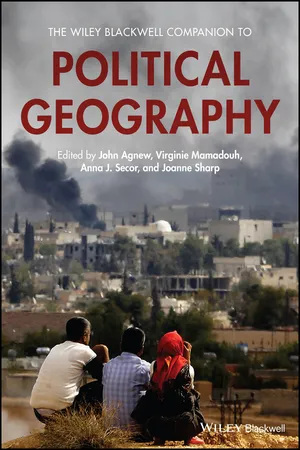
eBook - ePub
The Wiley Blackwell Companion to Political Geography
- English
- ePUB (mobile friendly)
- Available on iOS & Android
eBook - ePub
The Wiley Blackwell Companion to Political Geography
About this book
The Wiley Blackwell Companion to Political Geography aims to account for the intellectual and worldly developments that have taken place in and around political geography in the last 10 years. Bringing together established names in the field as well as new scholars, it highlights provocative theoretical and conceptual debates on political geography from a range of global perspectives.
Information
Chapter 1
Introduction
John Agnew1, Virginie Mamadouh2, Anna J. Secor3, and Joanne Sharp4
1University of California at Los Angeles, California, USA
2University of Amsterdam, The Netherlands
3University of Kentucky, Lexington, Kentucky, USA
4University of Glasgow, Glasgow, Scotland, UK
In the summer of 2014, Kobani became the epicenter of struggles to redraw the political map of the world region known as the Middle East. Located in Syria at the Turkish border, Kobani is routinely described as a Kurdish city (of roughly 50,000 inhabitants before the war) because the majority of its population is ethnic Kurds. It is also known by its Arabic name – Ayn al-Arab (the Arabs’ spring in Arabic, spring as in “well”) – a toponym that the Syrian regime imposed in its Arabization campaign of the 1980s. Kobani has been part of the Syrian state since it was created as a French protectorate under the authority of the League of Nations after the First World War and the dismantling of the Ottoman Empire. In fact, the Treaty of Sèvres (1920) had also proposed an Ottoman successor state that would have encompassed most of the region’s ethnic Kurds, but Kurdistan did not survive the Turkish revolution and the final Peace Treaty signed in Lausanne in 1923. With the lands that would have been Kurdistan ultimately divided between Turkey, Syria, Iraq, and Iran, Kurdish nationalism has been variously incited and repressed in the region ever since.
Before becoming the epicenter of conflict, for two years Kobani had been part of Rojava, the territories controlled by Kurdish forces in the north and northeast of Syria during the Syrian civil war. In September 2014, Kobani came under siege by Islamic State (IS), a religious movement that emerged during the Iraq war against Western forces. By the time of the siege, IS had gained control of significant territories in northern Iraq and northern Syria. These were regions where autonomous Kurdish authorities had become more or less well established during the Iraq war and the Syrian civil war respectively. In claiming these territories, IS forces attempted to cleanse them of populations hostile to its rule, such as Christian minorities and Yezidis, either by forcing them to convert to IS’s particular interpretation and practice of Sunni Islam, or through practices of displacement, massacre, and the sexual enslavement of women. With IS on the move, hundreds of thousands of Syrians fled over the nearby Turkish border. Yet because of its own “Kurdish question” and its opposition to claims for Kurdish autonomy in eastern Turkey, the Turkish government was slow to heed its Western allies’ calls for intervention in Kobani. By early October 2014, Kobani had become the place where the struggle for the future of Kurdistan (in Syria and beyond) was being fought, while the geopolitical stakes of the war against Islamic State became clear: The outcome of this struggle had the potential to redraw the political map of the region.
Kurdish rule in Kobani and the IS siege on the city both need to be understood in relation to broader historical and material developments. The Syrian civil war, which had led to Kobani becoming part of the Kurdish territory of Rojava, evolved from protests challenging the regime of President Bashar al-Assad that began in March 2011. These protests were directly connected to the uprisings that rocked the region and collectively became known as the Arab Spring, a ferment that led to regime change or civil war in several Arab states, including Tunisia, Egypt, Libya, and Syria. The international community intervened selectively in these events (sometimes militarily, as in Libya), but largely seemed unable (and sometimes unwilling) to act to protect human lives and human rights in the region or to promote democracy and security. By 2014, as Syria was plunged deep into civil war and the power of IS grew, some young people from Western countries (many of whom had no previous links with the region) traveled to Syria to support the movement. This flow of fighters revealed the interconnections between the Arab world and Europe and, at the same time, generated widespread sentiments of insecurity that echoed the anxieties of the early 2000s following the 9/11 attacks on New York and Washington and, later on, those on Madrid and London – anxieties that were stoked by the swelling flows of refugees into Europe.
The tragic and highly complex situation of Kobani and its connections to historical, regional, and global dynamics illustrate the importance of geopolitical literacy and the potential for political geographical analysis to illuminate the dynamics and contingencies of current affairs. The complex play of alliances between states and non-state actors, of international organizations and transnational networks, is unintelligible without an understanding of the history and geography of intergroup relations and the geopolitical battles that have shaped the political map of the region. Moreover, we can only begin to make sense of these historical and geographical features with the analytical tools that political geography provides for us. The key concepts presented in the first section of this volume are mighty instruments for analyzing competing claims to power, statehood and sovereignty, the role of territory and borders, the loss of security, and the invocation of justice, as well as more general issues of citizenship, scale, and governance.
The chapters collected in the second section, “Theorizing Political Geography,” provide a series of lenses offering different perspectives; in reading these, one might ask oneself what a feminist geography, a children’s geography, or a postcolonial geography of a situation might look like. How, for the case of Kobani, might these various approaches bring different aspects of the conflict under the spotlight? How might they open up opportunities for different resolutions, through different (territorial) arrangements? Finally, the themes presented in the other sections of the Companion – written before the Summer 2014 confrontation between Islamic State and Kurdish forces in Northern Syria – also provide tools for obtaining a better grasp of specific dimensions of ongoing events. These chapters present state-of-the-art political geographical approaches to nationalist movements (think of Kurdish parties), religious movements (IS), social movements (grassroots protests against Assad’s regime), social media (the mobilization of the Kurdish diaspora in Western Europe), electoral geography (the difficult organization of elections in newly established states and postautocratic regimes), sexual politics (the sexual enslavement of girls and women in conquered territory), migration (the large flows of Syrian refugees into Lebanon and Turkey), imperialism and world views (the resistance to Western influences in the Arab world), the role of regional institutions (such as the Arab League and the European Union), urban materialities (the fate of Kobani does indeed echo that of many cities under siege in recent history, such as Beirut), and more. Some of the themes might seem less directly relevant to the particular case of Kobani, but even then they do shape the context in which the international community operates when it weighs up the possibility of intervening in the region, how and at what cost. Indeed, the rise of the BRICS economies – Brazil, Russia, India, China, and South Africa – and the demand for resources make the stability of the region a global security issue, on top of the moral issues regarding human rights; however, the financial and climate crises limit the (material) capabilities of many states to act.
The scholarly work covered by the Companion does not provide ready-made solutions to the tragic events in and around Kobani. Political geography is no magic. The production of academic knowledge is a slow and painstaking process and its circulation is characterized by serious oddities (addressed in the last chapter of this volume) that should not prevent academics from making sure that their expertise informs their politics and that their voices are heard in public debate. More importantly, engagement with political geography can greatly enhance anyone’s ability to make sense of ongoing events in order to develop their own opinions and boost their agency in the issue – an engagement that necessarily takes place under the constraints of existing conditions, although understanding these constraints better is a necessary step toward empowerment and change.
Introducing political geography
This book is a new edition of a Companion to Political Geography published more than a decade ago (Agnew, Mitchell, & Toal 2003). It focuses on recent developments in the field. For much of its history, the subdiscipline of political geography has been centered on the study of the state and its territory. At the time when geography was being established as an academic discipline in Western universities at the end of the nineteenth and into the twentieth century, political geography – a term coined by French statesman Turgot in the eighteenth century and established by German geographer Friedrich Ratzel with his landmark volume Politische Geographie (1897) – was at the heart of the production of geographical knowledge in service to imperialist and nation-building projects (Godlewska & Smith 1994). Geography at the time was largely understood in physical terms and the political was generally restricted to questions of the state (Agnew et al. 2003). Political geographical analysis thus involved explaining the success and actions of states and their elites based on their physical locations and resources. At the turn of the century, British geographer and politician Halford Mackinder offered a global model linking world history to geography in an influential lecture at the Royal Geographical Society. He warned that the arrival of the railway had made the British Empire, as a sea power, increasingly vulnerable to threats from control over the “heartland” of Eurasia and that Germany as a land power (after the Russian Revolution and German defeat in the First World War he substituted Russia) and potential allies in Eastern Europe could replace the British as the dominant world power (Mackinder 1904). Geopolitics, a term coined by Swedish political scientist Rudolf Kjellén (1916) to capture what he saw as the geographical basis of world politics, emerged as a metonym for political geography and an expression of an organicist conception of the state and interimperialist rivalry (Parker 1985). Because geopolitics as statecraft later became associated with justifications for German territorial expansionism and ethnic cleansing in Eastern Europe during the Second World War, the latter part of the twentieth century saw not only “geopolitics” but also political geography being pushed aside in favor of more supposedly objective fields of study.
That the trajectory of political geography in the second part of the twentieth century and into the twenty-first is...
Table of contents
- Cover
- Title page
- Table of Contents
- Notes on Contributors
- Chapter 1: Introduction
- Key Concepts in Political Geography
- Theorizing Political Geography
- Doing Politics
- Material Political Geographies
- Doing Political Geography
- Index
- End User License Agreement
Trusted by 375,005 students
Access to over 1.5 million titles for a fair monthly price.
Study more efficiently using our study tools.
Frequently asked questions
Yes, you can cancel anytime from the Subscription tab in your account settings on the Perlego website. Your subscription will stay active until the end of your current billing period. Learn how to cancel your subscription
No, books cannot be downloaded as external files, such as PDFs, for use outside of Perlego. However, you can download books within the Perlego app for offline reading on mobile or tablet. Learn how to download books offline
Perlego offers two plans: Essential and Complete
- Essential is ideal for learners and professionals who enjoy exploring a wide range of subjects. Access the Essential Library with 800,000+ trusted titles and best-sellers across business, personal growth, and the humanities. Includes unlimited reading time and Standard Read Aloud voice.
- Complete: Perfect for advanced learners and researchers needing full, unrestricted access. Unlock 1.5M+ books across hundreds of subjects, including academic and specialized titles. The Complete Plan also includes advanced features like Premium Read Aloud and Research Assistant.
We are an online textbook subscription service, where you can get access to an entire online library for less than the price of a single book per month. With over 1.5 million books across 990+ topics, we’ve got you covered! Learn about our mission
Look out for the read-aloud symbol on your next book to see if you can listen to it. The read-aloud tool reads text aloud for you, highlighting the text as it is being read. You can pause it, speed it up and slow it down. Learn more about Read Aloud
Yes! You can use the Perlego app on both iOS and Android devices to read anytime, anywhere — even offline. Perfect for commutes or when you’re on the go.
Please note we cannot support devices running on iOS 13 and Android 7 or earlier. Learn more about using the app
Please note we cannot support devices running on iOS 13 and Android 7 or earlier. Learn more about using the app
Yes, you can access The Wiley Blackwell Companion to Political Geography by John A. Agnew, Virginie Mamadouh, Anna Secor, Joanne Sharp, John A. Agnew,Virginie Mamadouh,Anna Secor,Joanne Sharp in PDF and/or ePUB format, as well as other popular books in Physical Sciences & Geography. We have over 1.5 million books available in our catalogue for you to explore.