Handbook for Construction Planning and Scheduling
eBook - ePub

Handbook for Construction Planning and Scheduling

  1. English
  2. ePUB (mobile friendly)
  3. Available on iOS & Android
eBook - ePub

Handbook for Construction Planning and Scheduling

About this book

The authoritative industry guide on good practice for planning and scheduling in construction

This handbook acts as a guide to good practice, a text to accompany learning and a reference document for those needing information on background, best practice, and methods for practical application.Ā 

A Handbook for Construction Planning & Scheduling presents the key issues of planning and programming in scheduling in a clear, concise and practical way. The book divides into four main sections: Planning and Scheduling within the Construction Context; Planning and Scheduling Techniques and Practices; Planning and Scheduling Methods; Delay and Forensic Analysis. The authors include both basic concepts and updates on current topics demanding close attention from the construction industry, including planning for sustainability, waste, health and safety and Building Information Modelling (BIM).

The book is especially useful for early career practitioners - engineers, quantity surveyors, construction managers, project managers - who may already have a basic grounding in civil engineering, building and general construction but lack extensive planning and scheduling experience. Students will find the website helpful with worked examples of the methods and calculations for typical construction projects plus other directed learning material.

This authoritative industry guide on good practice for planning and scheduling in construction is written in a direct, informative style with a clear presentation enabling easy access of the relevant information with a companion website providing additional resources and learning support material.

  • the authoritative industry guide on construction planning and scheduling
  • direct informative writing style and clear presentation enables easy access of the relevant information
  • companion website provides additional learning material.
Frequently asked questions

Yes, you can cancel anytime from the Subscription tab in your account settings on the Perlego website. Your subscription will stay active until the end of your current billing period. Learn how to cancel your subscription.
No, books cannot be downloaded as external files, such as PDFs, for use outside of Perlego. However, you can download books within the Perlego app for offline reading on mobile or tablet. Learn more here.
Perlego offers two plans: Essential and Complete
  • Essential is ideal for learners and professionals who enjoy exploring a wide range of subjects. Access the Essential Library with 800,000+ trusted titles and best-sellers across business, personal growth, and the humanities. Includes unlimited reading time and Standard Read Aloud voice.
  • Complete: Perfect for advanced learners and researchers needing full, unrestricted access. Unlock 1.4M+ books across hundreds of subjects, including academic and specialized titles. The Complete Plan also includes advanced features like Premium Read Aloud and Research Assistant.
Both plans are available with monthly, semester, or annual billing cycles.
We are an online textbook subscription service, where you can get access to an entire online library for less than the price of a single book per month. With over 1 million books across 1000+ topics, we’ve got you covered! Learn more here.
Look out for the read-aloud symbol on your next book to see if you can listen to it. The read-aloud tool reads text aloud for you, highlighting the text as it is being read. You can pause it, speed it up and slow it down. Learn more here.
Yes! You can use the Perlego app on both iOS or Android devices to read anytime, anywhere — even offline. Perfect for commutes or when you’re on the go.
Please note we cannot support devices running on iOS 13 and Android 7 or earlier. Learn more about using the app.
Yes, you can access Handbook for Construction Planning and Scheduling by Andrew Baldwin,David Bordoli in PDF and/or ePUB format, as well as other popular books in Technology & Engineering & Construction & Architectural Engineering. We have over one million books available in our catalogue for you to explore.

Appendix 1
BIM Case Study: One Island East

Introduction

One Island East is the name of a 70-storey, Grade A, commercial building located at North Point on Hong Kong Island. Completed in 2008, it is one of the first commercial buildings that was designed and constructed using building information modelling (BIM) including virtual construction. The adoption of these technologies enabled improvements in quality and significant savings in time and cost. The adoption of these technologies changed design and construction organisation and processes. Using BIM for the production of this building has formed the basis for efficient facilities management. One Island East comprises one of the most substantial BIM implementations for a commercial building. The building was awarded the American Institute of Architects’ 2008 BIM Award for design delivery and process innovation. This appendix outlines the production of the model and then focuses on the use of the model for planning and scheduling the construction work.

Building the model

The BIM for One Island East was produced using Gehry Technologies Digital ProjectĀ® software which is based on Dassault SystĆØmesĀ® software. It comprises two main products: CATIAĀ® (for product modelling) and DEMIAĀ® (for process modelling). CATIAĀ® enables integration and interoperability with Microsoft ProjectĀ® and PrimaveraĀ® planning and scheduling software.
The project had already reached the completion of the schematic stage of design when it was decided to adopt BIM for the detailed design stage onwards. Modelling was undertaken on the basis of a single 3D BIM project database. All the elements of the building were modelled by the creation of rule-based parametric object data including the comprehensive modelling of the mechanical, electrical and plumbing systems.
The BIM model was used to facilitate the detailed design of the building, the drawing production, design coordination and cost implication of design decisions. To do this, it was necessary to manage the design team and manage the design model.
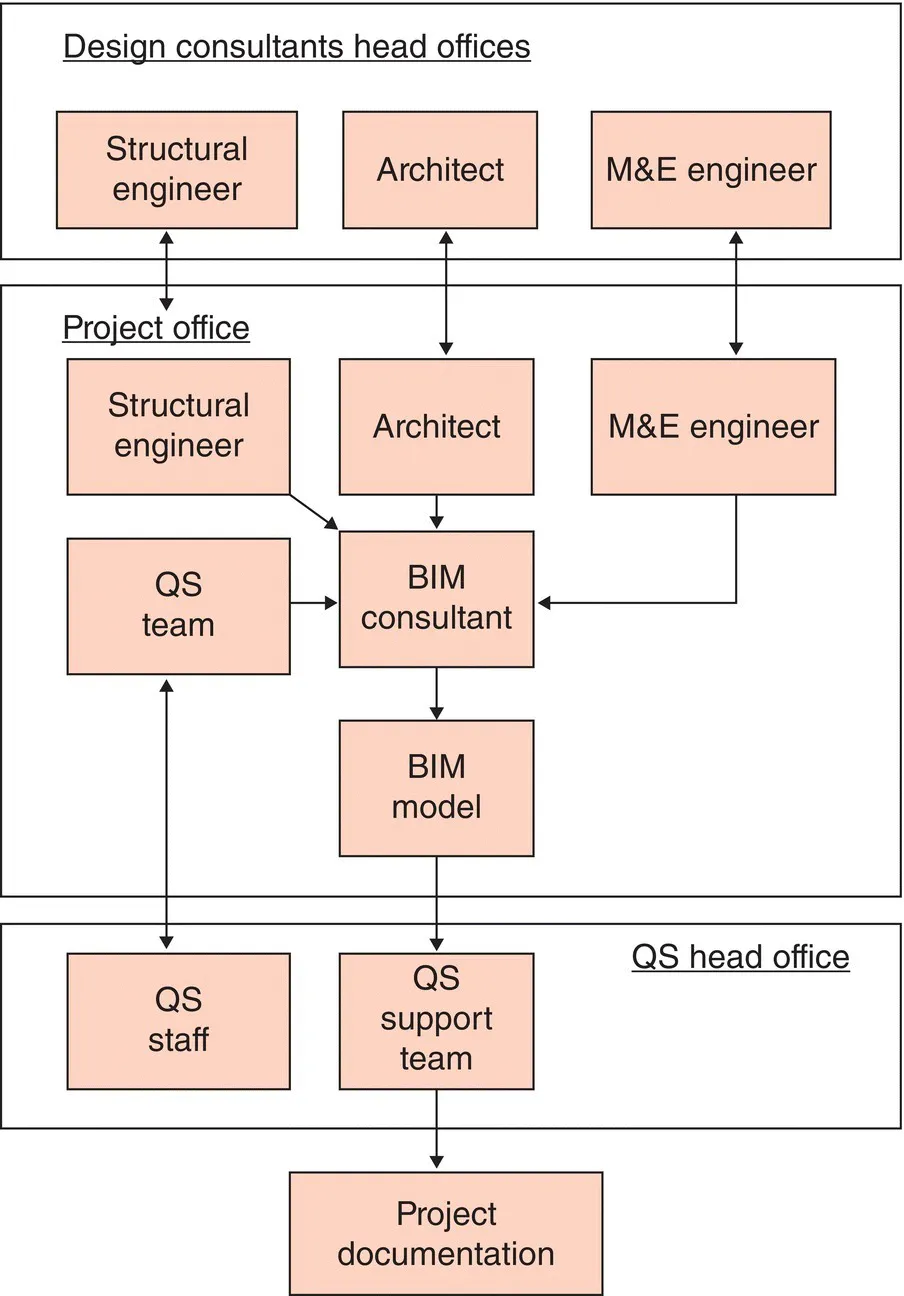
Gehry Technologies were awarded the contract for managing the design process and the production of the BIM model. The Architect (Wong and Ouyang (HK) Ltd), the Structural Engineer (Ove Arup and Partners (HK) Ltd), M&E consultants (Meinhardt (M&E) Ltd) and the Quantity Surveyors (Levett and Bailey) formed the key members of the design team. In addition to staff in these organisations’ head offices, it was decided to co-locate design team members in a single project design office close to the construction site. Here, between 25 and 50 designers worked collaboratively on the design. Key to ensuring fast construction was clash detection and resolution before construction commenced. The design team using the BIM model resolved a total of more than 2000 clashes and design errors prior to tendering. The completeness of the BIM model based on the building elements and the components enabled accurate cost estimates to be prepared and maintained whenever design changes were made.
Figure A1.1 shows a schematic diagram of the organisation of the design team.
a1-fig-0001
ā€ƒ
Figure A1.1 A schematic diagram of the design team.

The tendering process

The contract for the construction of the building was awarded following a selective tendering process. As part of this process, all the construction companies who tendered for the work were required to prepare a simulation model of how they proposed to undertake the construction process. To do this, they were provided with a copy of the BIM model and assistance with training on how to extract and use the data. Additional training and guidance was provided by BIM experts at Hong Kong Polytechnic University, HKPU.
The successful contractor (Gammon Construction) was required under the contract to take responsibility for the BIM, to maintain the model during the construction process and to hand over the updated model with the completed building, thus ensuring that on completion the client (Swire Properties) was in possession of a comprehensive, accurate model of the building that could be used for facilities management.
At the time of tendering, the data contained in all the main building elements were complete together with their main attributes: size, volume, weight, etc. Tendering was therefore on the basis of precise quantities. The BIM tool enabled many of the quantities to be measured automatically. There was no need for the contractors to measure the quantities of work. (However, the building model did not include all the reinforcing steel bars in the structural elements. For accuracy, the contractors bidding decided to calculate the quantity and price of the reinforcement in the structure manually using the ratio of reinforcement to concrete for individual elements.)
Using the model, Gammon were able to analyse the construction process and be confident that a four-day construction cycle could be achieved. The detail in the model enabled accurate cost estimates to be prepared.

Modelling the building process: Planning, scheduling and visualisation

During the construction of the building, the building model generated virtual construction models that became the central management tool for the production process, identifying construction problems and assisting the construction team to identify and solve construction problems before they impacted production on-site.
The BIM elements became a key part of the process of determining the construction sequence. (An example of this was the re-fabrication of the floor table formwork across the stages of construction where the outriggers changed the profile of the building.)
The visualisation and demonstration of construction sequences to the construction team (including subcontractor gangs of workers) enabled all concerned to contribute to ensuring the optimum construction process. The use of visualisation enabled production to be examined from a number of different aspects, for example, spatial requirements when moving temporary works and site safety, ensuring a fast safe production schedule.
The integration of Primavera scheduling software with Digital Project enabled planning engineers to link the BIM components to the activities in the Primavera construction model and produce updated schedules and 4D simulations of the construction sequence. (This integration was achieved by incorporating Primavera activity data in the building model ā€˜tree structure’.)
This integration was two-way, enabling modelling staff to import project (and sub-project) data, work breakdown structures and construction activities from Primavera into the Digital Project modelling environment. The impact of changes in the construction schedule on the building product could therefore be assessed.
This way of working ensured that construction proceeded to schedule. Gammon estimate that the use of the visualisation saved 20 days off the construction schedule. (The building was completed in March 2008 ahead of the 24-month construction schedule.) It is estimated that there was a 20% saving on the cost of construction.

Appendix 2
The Shepherd Way and Collaborative Planning

Shepherd Construction have reviewed the principles and methods of Last PlannerĀ® and Lean Construction to produce a ā€˜company-wide’ approach to Collaborative Planning. This is a four-stage process involving the whole construction ā€˜team’ who work together to create and agree a ā€˜lean’ production schedule, identify risks to production performance and agree an implement solutions. They work to deliver the agreed schedule by identifying and removing constraints, producing weekly plans and measuring and monitoring performance against the agreed schedule. Examination of performance and investigation as to what has gone well and where problems have arisen identifies issues and areas for improvement throughout the programme.

Collaborative Planning

The Shepherd Way requires the team to establish a schedule collaboratively. This is a schedule that is agreed by all; it is a stable schedule, one fixed by a ā€˜team’ comprising representatives from all the trades involved. Working collaboratively, uncertainty is removed. The agreed way of working seeks to fully utilise the team’s skills and experience. Opportunities for improved ways of working and increased production are explored, incorporated in the way of working or disregarded. Potential risks are evaluated and measures taken to mitigate the risk. Production issues are examined together with common interface problems. Forward planning identifies mobilisation needs and ensures that production may commence when anticipated.

Collaborative behaviours

Collaborative working require...

Table of contents

  1. Cover
  2. Title page
  3. Copyright page
  4. Notes on Contributors
  5. Foreword
  6. Preface
  7. Acknowledgements
  8. Section I: Planning and Scheduling within the Construction Context
  9. Section II: Planning and Scheduling Techniques and Practices
  10. Section III: Planning and Scheduling Methods
  11. Section IV: Delay and Forensic Analysis
  12. Appendix 1: BIM Case Study
  13. Appendix 2: The Shepherd Way and Collaborative Planning
  14. Appendix 3: Building Information Modelling (BIM) and English Law
  15. Glossary
  16. References
  17. Advertisements
  18. Index
  19. Access the Companion Website
  20. Downloadable additional content
  21. End User License Agreement