Diet and exercise have long been recognized as important components of a healthy lifestyle, as they have a great impact on improving cardiovascular and cerebrovascular functions, lowering the risk of metabolic disorders, and contributing to healthy aging. As a greater proportion of the world's population is living longer, there has been increased interest in understanding the role of nutrition and exercise in long-term neurological health and cognitive function.
Diet and Exercise in Cognitive Function and Neurological Diseases discusses the role and impact that nutrition and activity have on cognitive function and neurological health. The book is divided into two sections. The first section focuses on diet and its impact on neurobiological processes. Chapters focus on the impacts of specific diets, such as the Mediterranean, ketogenic and vegan diets, as well as the role of specific nutrients, fats, fatty acids, and calorie restriction on neurological health and cognitive function. The second section of the book focuses on exercise, and its role in maintaining cognitive function, reducing neuroinflammatory responses, regulating adult neurogenesis, and healthy brain aging. Other chapters look at the impact of exercise in the management of specific neurological disorders such Multiple Sclerosis and Parkinson's Disease.
Diet and Exercise in Cognitive Function and Neurological Diseases is a timely reference on the neurobiological interplay between diet and exercise on long-term brain health and cognitive function.
1 Nutrition, Genes, and Neuroscience: Implications for Development, Health, and Disease
Margaret Joy Dauncey
Wolfson College, University of Cambridge, Cambridge, UK
1.1 Introduction
Nutrition–gene interactions play a pivotal role in cognitive function and neurological disease throughout life. Nutrition is one of many environmental factors that profoundly alter the phenotypic expression of a given genotype, with major implications for development, metabolism, health, and disease [1–4]. These effects are mediated by changes in expression of multiple genes and can involve epigenetic mechanisms: nutrition is one of many epigenetic regulators that modify gene expression without changes in DNA sequence. Responses to nutrition are in turn affected by individual genetic variability. The effects of nutrition on gene expression are exerted throughout the life cycle, with prenatal and early postnatal life being especially critical periods for optimal development. Changes in gene expression may be dynamic and short term, stable and long term, and even heritable between cell divisions and across generations.
This review focuses on the following key topics. First, a short overview is provided on the role of nutrition in cognitive neuroscience. Second, mechanisms underlying nutrition–gene interactions are discussed, especially in relation to the roles of epigenetics and genetic variability in neuroscience. Third, attention is focused on the importance of environment and epigenetics in neurological health and disease. Finally, the role of early nutrition in brain development and later neurological disease is addressed. Overall, this review highlights the critical importance of nutrition–gene interactions to optimal neurological function and prevention and treatment of multiple neurological disorders.
1.2 Nutrition and Cognitive Neuroscience
The role of nutrition in cognitive neuroscience is highly complex because, as with all aspects of nutrition, it is multifactorial. It is not concerned simply with the impact of a single chemical on the brain but with numerous interactions between multiple nutrients, metabolites, food, and other environmental and genetic factors. Nevertheless, considerable evidence now links many aspects of nutrition with cognition, mental health and well-being, neurological dysfunction, and disease [1–9]. Protective roles are suggested for the Mediterranean diet, optimal energy status, fish, fruits, vegetables, polyphenols, omega-3 polyunsaturated fatty acids, iron, zinc, copper, and numerous vitamins. There are many inconsistencies between studies, in part because of methodological differences associated with the multifactorial nature of the subject. However, taken together, strong evidence clearly links optimal energy status and the Mediterranean diet with optimal cognitive function and prevention of cognitive decline and neurological dysfunction.
1.2.1 Specific Nutrients
Clearly, it is difficult to assess the precise benefits of specific nutrients on neurological and cognitive function. Nevertheless, significant links have been reported in studies on many nutrients including long-chain polyunsaturated fatty acids, vitamins A–E, and trace elements [1, 4, 8, 10–16]. Interactions and synergism between specific nutrients are especially important and may help in part to explain inconsistencies between studies and the importance of an optimal balanced diet.
Despite some controversy, substantial evidence suggests a vital role of omega-3 polyunsaturated fatty acids, including eicosapentaenoic acid (EPA) and docosahexaenoic acid (DHA), in neurodevelopment, cognition, mental health, and neurodegeneration. They enhance memory, mood, and behavior and reduce depression. By contrast, deficiency of omega-3 fatty acids is linked with increased risk of attention-deficit/hyperactivity disorder, depression, dementia, Alzheimer’s disease, and schizophrenia. Moreover, diets high in trans and saturated fats adversely affect cognitive function. The balance between omega-3 and omega-6 fatty acid intakes may be especially critical for optimal mental health. Competitive inhibition occurs between these two groups of fatty acids, and Western diets low in omega-3 and high in omega-6 may contribute to reduced accretion of DHA, inhibition of secondary neurite growth, and impaired brain development and function.
Trace elements including copper, zinc, and iron are important in neurodevelopment, neurotransmitter synthesis, and energy metabolism and have key roles in cognition. Low plasma copper is linked with cognitive decline, and zinc deficiency is linked with attention-deficit/hyperactivity disorder in children; impaired memory and learning in adolescents; and stress, depression, and cognitive decline in adults. There is a fine balance between the beneficial and harmful effects of many trace elements, and interactions between trace elements are important for optimal brain function. These may be especially important during critical stages of development and periods of vulnerability to neurological diseases.
1.2.2 Mediterranean Diet
It is increasingly apparent that the overall balance of specific nutrients and foods in the diet is important for optimal function. In relation to cognition and prevention of neurological disorders, a protective role has been reported for fish, fruit, and vegetables. Considerable attention is now focused on defining an optimal balanced diet, and future studies should improve understanding of optimal nutrition throughout the life course. In this context, the traditional Mediterranean diet is regarded as especially beneficial [17, 18]. It is characterized by high intakes of vegetables, fruits, cereals, fish, and unsaturated fats such as olive oil; a low to moderate intake of wine during meals; and low intakes of red and processed meats, dairy foods, and saturated fats. Higher adherence to this diet may contribute to the prevention of several brain disorders including depression, cognitive impairment, Alzheimer’s disease, and Parkinson’s disease. However, it is also apparent that suboptimal energy status and overnutrition, even of an optimal Mediterranean diet, are not beneficial to neurological function, and the importance of energy status is therefore discussed in Section 1.2.3.
1.2.3 Energy Status
Many studies link energy status with cognitive function and neurological disorders. The term energy status is used here to include energy intake, physical activity, energy metabolism, and related changes in body composition. It is a broader and less precise term than energy balance and reflects the multifaceted influence of this critical component of nutrition. Moreover, in some studies, it can be difficult to determine whether effects on brain function are due to changes in energy intake and/or energy expenditure: studies on physical activity do not always control energy intake, while those on energy intake do not always control physical activity.
The interactions between energy status and cognition are multifactorial and complex. Nevertheless, evidence highlights close links between energy status and mental health [1, 4, 19, 20]. Physical activity is beneficial to mental health and well-being: it decreases the risk of depression and improves mood and self-esteem. Regular aerobic exercise increases brain volume and reduces the risk of cognitive impairment, dementia, and Alzheimer’s disease in older adults. Undernutrition, without malnutrition, reduces age-related deficits in cognitive function, whereas overnutrition can result in cognitive dysfunction.
High-energy diets and a sedentary lifestyle are leading to increased prevalence of obesity and diabetes. There is a link between these conditions and risk of impaired cognitive function, depression, and dementia that is age related [21, 22]: obesity in midlife years 40–50s is linked with increased dementia, whereas by the late 70s the risk has inverted and obesity may even be protective of dementia. Moreover, patients with severe mental illness such as schizophrenia are at greater risk of metabolic syndrome and associated obesity, type 2 diabetes, and dyslipidemia [23]. Mechanisms involving chronic inflammation, cell signaling pathways, metabolic dysfunction, and genetic factors also link overnutrition with numerous disorders including Alzheimer’s disease [24]. Indeed, Alzheimer’s can be regarded as a neuroendocrine degenerative disorder that has elements of both insulin/insulin-like growth factor (IGF) resistance and insulin deficiency, suggesting that it be referred to as “type 3 diabetes” [25].
Nutrition affects neurological function and cognition via numerous influences on cell membranes, enzymes, neurotransmitters, metabolism, neurogenesis, and synaptic plasticity. Many of these diverse effects are mediated by expression of multiple genes and associated regulatory networks. An additional layer of complexity is provided by individual genetic variability: the differences in protein-coding and noncoding regions of the genome have major influences on individual response to nutrition.
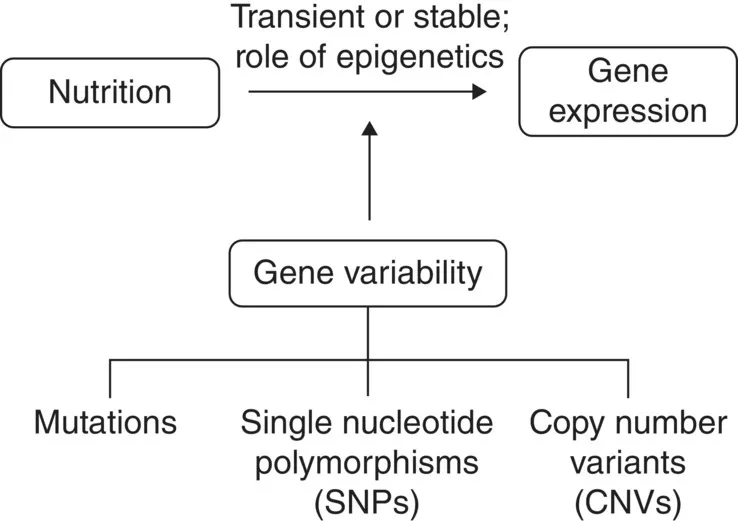
The term “nutritional genomics” is often used interchangeably with “nutrigenomics” and involves the study of nutrition–gene interactions. This includes both the effects of nutrition on gene expression (“nutrigenomics”) and the effects of genetic variability on responses to nutrition (“nutrigenetics”) [2, 26, 27]. Figure 1.1 outlines key mechanisms involved in nutrition–gene interactions.
Fig. 1.1 Overview of nutrition–gene interactions.
Modified from Dauncey, M.J. Recent advances in nutrition, genes and brain health. Proceedings of the Nutrition Society 2012, 71, 581–591.
1.3.1 Nutritional Regulation of Gene Expression
Considerable progress is to be made in understanding the molecular mechanisms and neural pathways underlying the effects of nutrition on gene expression [2, 4, 6, 24, 28, 29]. Cellular and nuclear receptors play a key role in mediating the effects of nutrition on numerous genes involved in neural function and brain plasticity.
Nutrition has both direct and indirect effects on gene expression, with the latter being exerted via cell signaling pathways. In relation to direct effects, many nutrients and metabolites are ligands for nuclear receptors/transcript...
Table of contents
Cover
Title page
Copyright page
Dedication
Hippocrates 440BC
Contributors
Foreword: Kirk I. Erickson
Foreword: Shin Murakami
Preface
Acknowledgments
1 Nutrition, Genes, and Neuroscience: Implications for Development, Health, and Disease
2 Neurochemical Effects of Western Diet Consumption on Human Brain
3 Effect of Mediterranean Diet on Human Health in Seniors: Relationship with Telomers
4 Effect of a Mediterranean Diet on Mental and Physical Quality of Life
5 Ketogenic Diets for the Treatment of Neurologic Disease
6 Levels of n-3 Fatty Acids and their Metabolites in the Brain: Their Impact on Brain Function and Neurological Disorders
7 Homocysteine Levels in Neurological Disorders
8 Table Salt and Dementia
9 Contribution of Diet and Exercise in the Pathogenesis of Major Depression
10 Role of Diet and Exercise in Diabetic Retinopathy
11 The Effect of Western Diet on Cognition in Humans
12 Role of Diet and Exercise in Intervention of Age-Induced Impairments
13 Hormesis and Cognitive Function: An Evolutionary/Adaptive Arabesque Leading to Longevity
14 Polyphenols and Cognitive Function
15 Prevention of Dementia Through Modifiable Risk Factors
16 Physical Exercise Improves Cognition in Brain Disorders: Alzheimer’s Disease
17 Molecular, Biochemical, and Physiological Basis of Beneficial Actions of Exercise
18 Beneficial Effects of Exercise and Cognitive Training on Cognitive Functions in Older Adults: Introduction of Smart Aging Studies
19 Exercise and Cognitive Functions
20 Role of Sleep in Cognition, Immunity, and Disease and Its Interaction with Exercise
21 Effect of Forced and Voluntary Exercise on Neural Plasticity Mediated by Astrocytes
22 Effect of Exercise on the Aging Brain
23 The Effects of Exercise on Neuronal Survival
24 Exercise and Cognitive Function in Older Adults
25 Research Issues and Clinical Implications of Exercise Effects in the Treatment of Depressive and Anxiety Disorders
26 Exercise-Induced Protection Against Aging and Neurodegenerative Diseases: Role of Redox- and Mitochondrial-Based Alterations
27 Exercise, Neuroplasticity, and Growth Factors in Adolescence
28 Summary, Perspective, and Direction for Future Studies
Index
End User License Agreement
Trusted by 375,005 students
Access to over 1.5 million titles for a fair monthly price.
Study more efficiently using our study tools.
Frequently asked questions
Yes, you can cancel anytime from the Subscription tab in your account settings on the Perlego website. Your subscription will stay active until the end of your current billing period. Learn how to cancel your subscription
No, books cannot be downloaded as external files, such as PDFs, for use outside of Perlego. However, you can download books within the Perlego app for offline reading on mobile or tablet. Learn how to download books offline
Perlego offers two plans: Essential and Complete
Essential is ideal for learners and professionals who enjoy exploring a wide range of subjects. Access the Essential Library with 800,000+ trusted titles and best-sellers across business, personal growth, and the humanities. Includes unlimited reading time and Standard Read Aloud voice.
Complete: Perfect for advanced learners and researchers needing full, unrestricted access. Unlock 1.5M+ books across hundreds of subjects, including academic and specialized titles. The Complete Plan also includes advanced features like Premium Read Aloud and Research Assistant.
Both plans are available with monthly, semester, or annual billing cycles.
We are an online textbook subscription service, where you can get access to an entire online library for less than the price of a single book per month. With over 1.5 million books across 990+ topics, we’ve got you covered! Learn about our mission
Look out for the read-aloud symbol on your next book to see if you can listen to it. The read-aloud tool reads text aloud for you, highlighting the text as it is being read. You can pause it, speed it up and slow it down. Learn more about Read Aloud
Yes! You can use the Perlego app on both iOS and Android devices to read anytime, anywhere — even offline. Perfect for commutes or when you’re on the go. Please note we cannot support devices running on iOS 13 and Android 7 or earlier. Learn more about using the app
Yes, you can access Diet and Exercise in Cognitive Function and Neurological Diseases by Akhlaq A. Farooqui,Tahira Farooqui in PDF and/or ePUB format, as well as other popular books in Biological Sciences & Neuroscience. We have over 1.5 million books available in our catalogue for you to explore.