This book addresses the steps needed to monitor health assessment systems and the anticipation of their failures: choice and location of sensors, data acquisition and processing, health assessment and prediction of the duration of residual useful life. The digital revolution and mechatronics foreshadowed the advent of the 4.0 industry where equipment has the ability to communicate. The ubiquity of sensors (300,000 sensors in the new generations of aircraft) produces a flood of data requiring us to give meaning to information and leads to the need for efficient processing and a relevant interpretation. The process of traceability and capitalization of data is a key element in the context of the evolution of the maintenance towards predictive strategies.
eBook - ePub
From Prognostics and Health Systems Management to Predictive Maintenance 1
Monitoring and Prognostics
- English
- ePUB (mobile friendly)
- Available on iOS & Android
eBook - ePub
From Prognostics and Health Systems Management to Predictive Maintenance 1
Monitoring and Prognostics
About this book
Information
1
PHM and Predictive Maintenance
1.1. Anticipative maintenance and prognostics
1.1.1. New challenges and evolution of the maintenance function
1.1.1.1. Industrial maintenance
According to the standard EN 13306 (2001), maintenance can be defined as a “combination of all technical, administrative and managerial actions during the life cycle of an item intended to retain it in, or restore it to, a state in which it can perform the required function” [EN 01]. It also includes a set of actions of troubleshooting, repairing, controlling and verifying physical equipment, and it should contribute to the improvement of industrial processes. From the traditional viewpoint, the maintenance function guarantees dependability characteristics of equipment, in particular its availability. Therefore, globally it aims to understand the failure mechanisms and to act accordingly in order to ensure that the system (the good) can perform the function that it has been conceived for. However, the missions of the maintenance function are no longer limited to the implementation of means to ensure the “goods service”. Different requirements in terms of quality, safety and costs have emerged, and the challenges and prerogatives of the maintenance function have evolved in the last 20 years.
1.1.1.2. Challenges and prerogatives of the maintenance function
The challenges of the maintenance function can be discussed from different points of view. First of all, as industrial equipment becomes more and more complex, it requires greater competence in maintenance. Furthermore, the company evolves within a strongly competitive environment and the financial concerns are very prominent. Therefore, maintenance doesn’t escape the cost reduction rule. At another level, for some years, the industrial managers have been facing more significant environmental and social constraints. It is not sufficient anymore to be content with technical and economic performance, but it becomes necessary, or even compulsory, to take into account the environmental “constraints”: a factory produces waste, pollutes, and contributes to the greenhouse effect, etc. This is coupled with the respect for human dignity, which constitutes a social constraint. The latter aspects have recently led to drafting of legislative texts that strongly encourage companies to include the notion of sustainable development in their strategy. The concrete result is the pursuit of a triple performance, where business performance of course remains essential, but is also complemented by new human/social and environmental requirements. The prerogatives of the maintenance function have thus been studied, and it has had to evolve with regard to the growing challenges:
- – It aims to increment the equipment availability while reducing the direct exploitation costs (technical and economic).
- – It has to ensure a safe operation of equipment, namely avoiding accidents which can be judged as detrimental to the environment (environmental).
- – It is responsible for satisfactory work conditions and for human safety (social).
1.1.1.3. Evolution of the maintenance function
In view of the ever-growing requirements, maintenance costs have rapidly risen in recent years. For example, it is estimated that in the USA, the maintenance costs amounted to $200 billion in 1979, and that they have seen a growth of about 10 to 15% in the following years [BEN 04]. However, an important part of this maintenance cost could be avoided: poor planning leads to waste of supplementary maintenance hours, perhaps on equipment without a major role in production continuity. This increase of costs alone doesn’t justify the need to reconsider the traditional maintenance approaches. First of all, production systems evolve continuously and newer technologies have appeared, thanks to automation (as machines could ensure production without human intervention). Next, companies seek to rapidly adapt the production quantity and quality in relation to variations in client’s demand, which requires a high level of flexibility for the industrial equipment. Therefore, although maintenance activity is today considered an activity in its own right, the companies do not hesitate anymore to outsource it in order to benefit from the strong core competencies of the service providers. This evolution is due to a large extent to the development of sciences and technologies of information and communication (STIC). At another level, in the last few years, new maintenance architectures have appeared. One of the most recent is that of s-maintenance (“s” for semantics). This maintenance incorporates the concept of e-maintenance, and it is based on the principle of sharing and generating knowledge, formalized by ontology [KAR 09b]. However, before the development of maintenance architecture aiming to reduce the distance between these actors, it is the maintenance strategies themselves that evolve. Indeed, today the maintainers wish to go beyond the static maintenance (without an anticipation of the evolution of the equipment state), and to implement more “dynamic” maintenance strategies. The following section is dedicated to the analysis of this evolution.
1.1.2. Towards an anticipation of failure mechanisms
1.1.2.1. Cartography of maintenance forms
Before the 1960s, the main mission of a company’s maintenance service was the intervention on broken equipment in order to repair it as soon as possible. This kind of maintenance, known as corrective, has been complemented gradually by an approach that anticipated failure mechanisms, that is, by a maintenance carried out before the failure occurred. These two vast kinds of maintenance – corrective and preventive – present certain variations described below. Figure 1.1 shows their global structure.
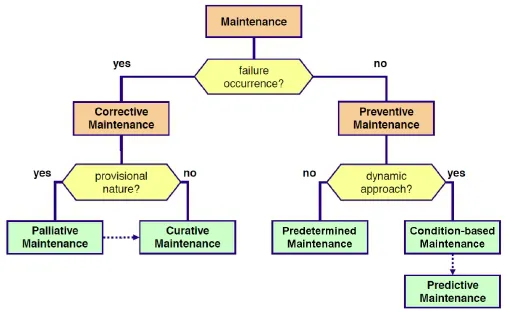
Figure 1.1. Forms of maintenance according to the standard EN 13306 (2001) [EN 01]. For the color version of this figure, see www.iste.co.uk/zerhouni1/phm.zip
1.1.2.2. Corrective and preventive maintenances
The standard EN 13306 (2001) defines corrective maintenance as a “maintenance carried out after fault recognition and intended to put an item into a state in which it can perform a required function.” [EN 01]. This kind of maintenance is generally suitable in case of equipment for which:
- – the consequences of the breakdown are not critical,
- – the repairs are easy and does not require a lot of time and
- – the investment costs are low.
We can distinguish two forms of corrective maintenance. When the intervention of the maintenance is provisional, we refer to it as “palliative maintenance”. If the works are definitive, we refer to “curative maintenance”.
Preventive maintenance aims to reduce the risks of a failure occurring. The standard EN 13306 (2001) defines it as a “maintenance carried out at predetermined intervals or according to prescribed criteria and intended to reduce the probability of failure or the degradation of the operation of an item.” [EN 01]. When maintenance intervention is performed at fixed and predefined intervals of time, the term “predetermined maintenance” is used. This kind of maintenance is triggered following a schedule (hours of work, kilometers completed, etc.), and is achieved by periodically replacing the parts, without a prior inspection and whatever the degradation state of the goods. Predetermined maintenance can lead to overcare, that is, an excess of useless interventions, and thus financial wastes for the company. In order to remedy this, other forms of preventi...
Table of contents
- Cover
- Table of Contents
- Title
- Copyright
- Introduction
- 1 PHM and Predictive Maintenance
- 2 Acquisition: From System to Data
- 3 Processing: From Data to Health Indicators
- 4 Health Assessment, Prognostics and Remaining Useful Life - Part A
- 5 Health Assessment, Prognostics, and Remaining Useful Life - Part B
- Conclusion and Open Issues
- Bibliography
- Index
- End User License Agreement
Trusted by 375,005 students
Access to over 1.5 million titles for a fair monthly price.
Study more efficiently using our study tools.
Frequently asked questions
Yes, you can cancel anytime from the Subscription tab in your account settings on the Perlego website. Your subscription will stay active until the end of your current billing period. Learn how to cancel your subscription
No, books cannot be downloaded as external files, such as PDFs, for use outside of Perlego. However, you can download books within the Perlego app for offline reading on mobile or tablet. Learn how to download books offline
Perlego offers two plans: Essential and Complete
- Essential is ideal for learners and professionals who enjoy exploring a wide range of subjects. Access the Essential Library with 800,000+ trusted titles and best-sellers across business, personal growth, and the humanities. Includes unlimited reading time and Standard Read Aloud voice.
- Complete: Perfect for advanced learners and researchers needing full, unrestricted access. Unlock 1.5M+ books across hundreds of subjects, including academic and specialized titles. The Complete Plan also includes advanced features like Premium Read Aloud and Research Assistant.
We are an online textbook subscription service, where you can get access to an entire online library for less than the price of a single book per month. With over 1.5 million books across 990+ topics, we’ve got you covered! Learn about our mission
Look out for the read-aloud symbol on your next book to see if you can listen to it. The read-aloud tool reads text aloud for you, highlighting the text as it is being read. You can pause it, speed it up and slow it down. Learn more about Read Aloud
Yes! You can use the Perlego app on both iOS and Android devices to read anytime, anywhere — even offline. Perfect for commutes or when you’re on the go.
Please note we cannot support devices running on iOS 13 and Android 7 or earlier. Learn more about using the app
Please note we cannot support devices running on iOS 13 and Android 7 or earlier. Learn more about using the app
Yes, you can access From Prognostics and Health Systems Management to Predictive Maintenance 1 by Rafael Gouriveau,Kamal Medjaher,Noureddine Zerhouni in PDF and/or ePUB format, as well as other popular books in Technology & Engineering & Aeronautic & Astronautic Engineering. We have over 1.5 million books available in our catalogue for you to explore.