Modeling of Photovoltaic Systems Using MATLAB
eBook - ePub

Modeling of Photovoltaic Systems Using MATLAB

Simplified Green Codes

  1. English
  2. ePUB (mobile friendly)
  3. Available on iOS & Android
eBook - ePub

Modeling of Photovoltaic Systems Using MATLAB

Simplified Green Codes

About this book

Modeling of PHOTOVOLTAIC SYSTEMS Using MATLABĀ®

Provides simplified MATLABĀ® codes for analysis of photovoltaic systems, describes the model of the whole photovoltaic power system, and shows readers how to build these models line by line.

This book presents simplified coded models for photovoltaic (PV)-based systems using MATLABĀ® to help readers understand the dynamic behavior of these systems. Through the use of MATLABĀ®, the reader has the ability to modify system configuration, parameters, and optimization criteria. Topics covered include energy sources, storage, and power electronic devices. The book contains six chapters that cover systems' components from the solar source to the end user. Chapter 1 discusses modeling of the solar source, and Chapter 2 discusses modeling of the PV source. Chapter 3 focuses on modeling of PV systems' power electronic features and auxiliary power sources. Modeling of PV systems' energy flow is examined in Chapter 4, while Chapter 5 discusses PV systems in electrical power systems. Chapter 6 presents an application of PV system models in systems' size optimization. Common control methodologies applied to these systems are also modeled in this book.

  • Covers the basic models of the whole PV power system, enabling the reader modify the models to provide different sizing and control methodologies
  • Examines auxiliary components to PV systems, including wind turbines, diesel generators, and pumps
  • Contains examples, drills, and codes

Modeling of Photovoltaic Systems Using MATLABĀ®: Simplified Green Codes is a reference for researchers, students, and engineers who work in the field of renewable energy, and specifically in PV systems.
Frequently asked questions

Yes, you can cancel anytime from the Subscription tab in your account settings on the Perlego website. Your subscription will stay active until the end of your current billing period. Learn how to cancel your subscription.
At the moment all of our mobile-responsive ePub books are available to download via the app. Most of our PDFs are also available to download and we're working on making the final remaining ones downloadable now. Learn more here.
Perlego offers two plans: Essential and Complete
  • Essential is ideal for learners and professionals who enjoy exploring a wide range of subjects. Access the Essential Library with 800,000+ trusted titles and best-sellers across business, personal growth, and the humanities. Includes unlimited reading time and Standard Read Aloud voice.
  • Complete: Perfect for advanced learners and researchers needing full, unrestricted access. Unlock 1.4M+ books across hundreds of subjects, including academic and specialized titles. The Complete Plan also includes advanced features like Premium Read Aloud and Research Assistant.
Both plans are available with monthly, semester, or annual billing cycles.
We are an online textbook subscription service, where you can get access to an entire online library for less than the price of a single book per month. With over 1 million books across 1000+ topics, we’ve got you covered! Learn more here.
Look out for the read-aloud symbol on your next book to see if you can listen to it. The read-aloud tool reads text aloud for you, highlighting the text as it is being read. You can pause it, speed it up and slow it down. Learn more here.
Yes! You can use the Perlego app on both iOS or Android devices to read anytime, anywhere — even offline. Perfect for commutes or when you’re on the go.
Please note we cannot support devices running on iOS 13 and Android 7 or earlier. Learn more about using the app.
Yes, you can access Modeling of Photovoltaic Systems Using MATLAB by Tamer Khatib,Wilfried Elmenreich in PDF and/or ePUB format, as well as other popular books in Physical Sciences & Energy. We have over one million books available in our catalogue for you to explore.

Information

Publisher
Wiley
Year
2016
Print ISBN
9781119118107
eBook ISBN
9781119118121
Edition
1
Subtopic
Energy

1
MODELING OF THE SOLAR SOURCE

1.1 INTRODUCTION

Solar energy is the portion of the Sun’s radiant heat and light, which is available at the Earth’s surface for various applications of generating energy, that is, converting the energy form of the Sun into energy for useful applications. This is done, for example, by exciting electrons in a photovoltaic cell, supplying energy to natural processes like photosynthesis, or by heating objects. This energy is free, clean, and abundant in most places throughout the year and is important especially at the time of high fossil fuel costs and degradation of the atmosphere by the use of these fossil fuels. Solar energy is carried on the solar radiation, which consists of two parts: extraterrestrial solar radiation, which is above the atmosphere, and global solar radiation, which is at surface level below the atmosphere. The components of global solar radiation are usually measured by pyranometers, solarimeters, actinography, or pyrheliometers. These measuring devices are usually installed at selected sites in specific regions. Due to high cost of these devices, it is not feasible to install them at many sites. In addition, these measuring devices have notable tolerances and accuracy deficiencies, and consequently wrong/missing records may occur in a measured data set. Thus, there is a need for modeling of the solar source considering solar astronomy and geometry principles. Moreover, the measured solar radiation values can be used for developing solar radiation models that describe the mathematical relations between the solar radiation and the meteorological variables such as ambient temperature, humidity, and sunshine ratio. These models can be later be used to predict solar radiation at places where there is no solar energy measuring device installed.

1.2 MODELING OF THE SUN POSITION

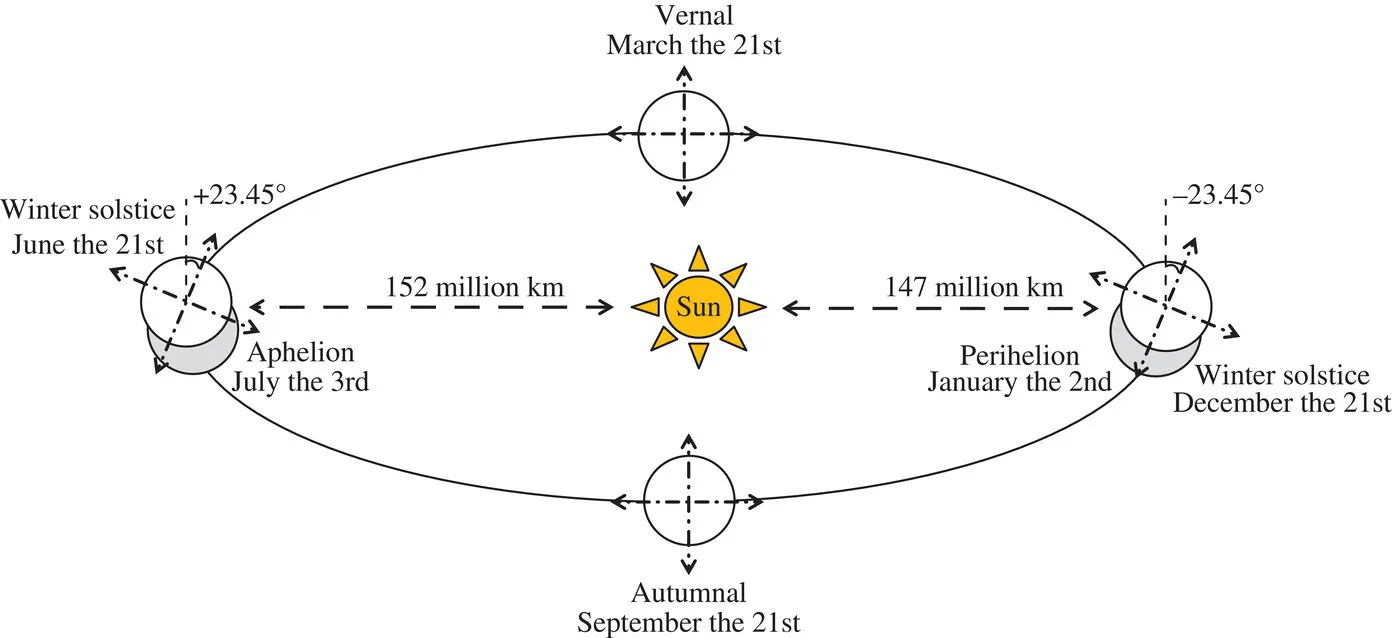
As a fact, the Earth rotates around the Sun in an elliptical orbit. Figure 1.1 shows the Earth rotation orbit around the Sun. The length of each rotation the Earth makes around the Sun is about 8766 h, which approximately stands for 365.242 days.
Diagram of Earth’s elliptical orbit around the Sun indicating winter solstice, autumnal, vernal, aphelion (152 million km), and perihelion (147 million km).
FIGURE 1.1 Earth rotation orbit around the Sun.
From the figure, it can be seen that there are some unique points at this orbit. The winter solstice occurs on December 21, at which the Earth is about 147 million km away from the Sun. On the other hand, at the summer solstice, which occurs on June 21, the Earth is about 152 million km from the Sun. However, to provide more accurate points, the Earth is closest to the Sun (147 million km) on January 2, and this point...

Table of contents

  1. COVER
  2. TITLE PAGE
  3. TABLE OF CONTENTS
  4. ABOUT THE AUTHORS
  5. FOREWORD
  6. ACKNOWLEDGMENT
  7. 1 MODELING OF THE SOLAR SOURCE
  8. 2 MODELING OF PHOTOVOLTAIC SOURCE
  9. 3 MODELING OF PV SYSTEM POWER ELECTRONIC FEATURES AND AUXILIARY POWER SOURCES
  10. 4 MODELING OF PHOTOVOLTAIC SYSTEM ENERGY FLOW
  11. 5 PV SYSTEMS IN THE ELECTRICAL POWER SYSTEM
  12. 6 PV SYSTEM SIZE OPTIMIZATION
  13. INDEX
  14. END USER LICENSE AGREEMENT