- English
- ePUB (mobile friendly)
- Available on iOS & Android
eBook - ePub
Communication Skills for Nurses
About this book
Survive placements and practice with this essential guide for all student nurses.
Providing words of wisdom and advice from real-life student nurses, Communication Skills for Nurses is a handy, portable, and fun introduction to the key communication and interpersonal skills you'll need on placement and as a registered nurse.
Special features:
- Developed by students, for students
- Clear, straightforward, and jargon-free
- Explains how to use your interpersonal skills effectively, communicate with patients with specific conditions, and handle both criticisms and compliments
- Features tips and advice from real life nursing students
- Examples and questions based on real life nursing and healthcare situations

Frequently asked questions
Yes, you can cancel anytime from the Subscription tab in your account settings on the Perlego website. Your subscription will stay active until the end of your current billing period. Learn how to cancel your subscription.
No, books cannot be downloaded as external files, such as PDFs, for use outside of Perlego. However, you can download books within the Perlego app for offline reading on mobile or tablet. Learn more here.
Perlego offers two plans: Essential and Complete
- Essential is ideal for learners and professionals who enjoy exploring a wide range of subjects. Access the Essential Library with 800,000+ trusted titles and best-sellers across business, personal growth, and the humanities. Includes unlimited reading time and Standard Read Aloud voice.
- Complete: Perfect for advanced learners and researchers needing full, unrestricted access. Unlock 1.4M+ books across hundreds of subjects, including academic and specialized titles. The Complete Plan also includes advanced features like Premium Read Aloud and Research Assistant.
We are an online textbook subscription service, where you can get access to an entire online library for less than the price of a single book per month. With over 1 million books across 1000+ topics, we’ve got you covered! Learn more here.
Look out for the read-aloud symbol on your next book to see if you can listen to it. The read-aloud tool reads text aloud for you, highlighting the text as it is being read. You can pause it, speed it up and slow it down. Learn more here.
Yes! You can use the Perlego app on both iOS or Android devices to read anytime, anywhere — even offline. Perfect for commutes or when you’re on the go.
Please note we cannot support devices running on iOS 13 and Android 7 or earlier. Learn more about using the app.
Yes, you can access Communication Skills for Nurses by Claire Boyd,Janet Dare in PDF and/or ePUB format, as well as other popular books in Medicine & Nursing. We have over one million books available in our catalogue for you to explore.
Information
Chapter 1
. . . . . . . . . . . . . . . . . . . . .
MODELS OF COMMUNICATION
LEARNING OUTCOMES
This chapter will explore communication models that are used frequently as part of a nurse's role.
WHAT IS A COMMUNICATION MODEL?
A communication model is chiefly a process in which information is channelled, then imparted by the sender to the receiver through a medium. When the receiver gets the information they decode the message and may give the sender feedback.
Theorists have analysed the communication process many times and how individuals interact with each other. There are different models of communication that are relevant to a nurse. These are the linear, interactive and transactional models.
Linear Model
The best-known model of communication is the one devised by Shannon and Weaver (1949) and was originally known as ‘a mathematical model of communication'. It is a simple linear model that is easily understood.

Linear
Arranged in or extending along a straight or nearly straight line or in one direction.
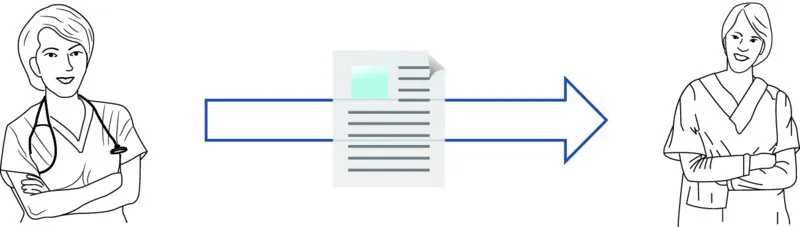
Linear communication consists of a sender creating a message. They send it to the receiver without any feedback. See Figure 1.1.

Figure 1.1 A linear model of communication. Adapted from: Shannon and Weaver (1949).
This model has five main parts:
- information source: where the message is produced,
- transmitter: where the message is encoded (relayed),
- channel: the carrier of the signal,
- receiver: where the message is decoded,
- destination: where the message ends up.
What this model is suggesting is that during a conversation between two people, at any one time only one person is expressing and sending the information, and the second person is only receiving and absorbing the information. When the information is received and decoded the roles may be reversed, and the second person becomes the sender and the first person the receiver. An example of linear communication is a letter or an email.
One of the advantages of Shannon and Weaver's model is that it is simple and easily understood, and can be applied to most types of communication. However, this type of model has been challenged because it does not take into account simultaneous interaction and transactional feedback. An example of this could be when we try to communicate with people from different cultures; in such cases, the message is relayed by one or more of our five senses (sight, touch, hearing, taste or smell). We observe the listener's body language and if they have not heard our message or it has been misinterpreted then we are able to adapt our communication or adjust our tone of voice to accommodate the listener.
Communication relies on the active participation of both sender and receiver, and cannot be accurately represented by a linear system.
Interactive Model
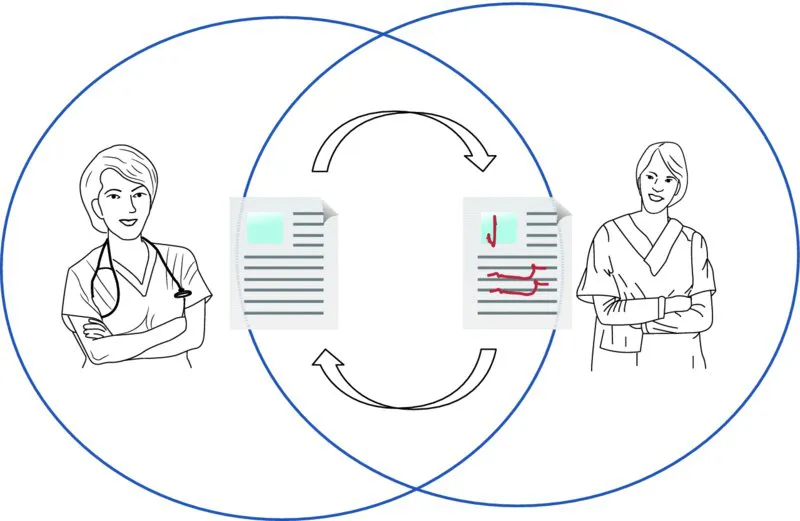
Wilbur Schramm was one of the early theorists to demonstrate a circular model of communication. He proposed that both the sender and receiver interpret the message, rather than assessing the message's meaning (see Figure 1.2).

Figure 1.2 An interactive model of communication. Adapted from: Schramm (1954).
Schramm (1955; cited in Wood 2009) saw communication as a two-way process with both the speaker and the listener providing and receiving verbal or non-verbal feedback. Both the speaker and the listener take turns to speak and listen to each other. Other characteristics of messages that impact communication between two individuals are intonation and pitch patterns, accents, facial expressions, quality of voice and gestures. This model also indicates that the speaker and listener communicate better if they have had the same experiences. However, this may mean that both the receiver and sender are limited by their experience. Nevertheless, there must be some experience common to both in order for the communication to be useful and for the intended message to be conveyed. For example, if you were asking someone who did not speak the same language as you if they wanted sugar in their coffee, you would most probably point to the sugar and then the cup of coffee, hoping that the other individual has had some common experience of putting sugar in their coffee. However, if the receiver comes from a culture where sugar is not used, then your communication will be ineffective.
Two people from completely different cultures who speak different languages and who have no common experiences may find that communication becomes nearly impossible without help from a third party such as a translator or an interpreter.
Common ground or mutual understanding is important in communication and essential for interpersonal communication.
Transactional Model
The transactional model builds on the interactive model by adding non-verbal communication methods such as gestures, eye contact, use of silence, positioning, facial expressions and body language. ...
Table of contents
- Cover
- Series
- Titlepage
- Copyright
- PREFACE
- INTRODUCTION
- ACKNOWLEDGEMENTS
- 1 MODELS OF COMMUNICATION
- 2 TRANSACTIONAL ANALYSIS
- 3 METHODS OF COMMUNICATION
- 4 PRESENTING YOURSELF AND YOUR ORGANISATION
- 5 INTERPERSONAL SKILLS
- 6 TEAM WORK AND THE MULTIDISCIPLINARY TEAM
- 7 COMMUNICATION BARRIERS
- 8 ACTIVE LISTENING
- 9 ADMITTING PATIENTS
- 10 SITUATION, BACKGROUND, ASSESSMENT, RESPONSE (SBAR)
- 11 DOCUMENTATION
- 12 MANAGING CRITICISM AND COMPLIMENTS
- 13 COMMUNICATION SCENARIOS
- 14 CARE AND COMPASSION IN NURSING
- ANSWERS TO ACTIVITIES AND TEST YOUR KNOWLEDGE
- INDEX
- END USER LICENSE AGREEMENT