- Comprehensive reference book useful for people working for a multiple systems operator
- Includes chapter introductions
- Written by 13 experts in various fields such as network services and soft defined networks
- English
- ePUB (mobile friendly)
- Available on iOS & Android
eBook - ePub
Cable Networks, Services, and Management
About this book
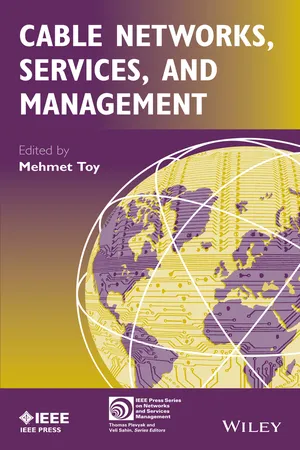
This is the first book describing cable networks, services, and their management in greater detail by thirteen experts in various fields covering network architectures and services, operations, administration, maintenance, provisioning, troubleshooting (OAMPT) for residential services; network architectures, services, and OAMPT for business services; Software Defined Networks (SDN) and Virtualization concepts
Information
1
INTRODUCTION AND OVERVIEW
Mehmet Toy
1.1 INTRODUCTION
Cable companies (multiple system operators or MSOs) have been offering phone and TV services over copper medium as the basic residential services for a long time. With the proliferation of broadband, fiber, and wireless technologies, fiber is deployed to provide TV, voice, and Internet services (i.e., triple play) while serving rates over cable are increased with new techniques in supporting triple-play services.
MSOs have been providing residential services over coaxial cable using the Data Over Cable Service Interface Specification (DOCSIS) protocol that permits the addition of high-speed data transfer to an existing cable TV (CATV) system in Mbps currently and aims at supporting capacities of at least 10 Gbps downstream and 1 Gbit/s upstream.
Toward the end of 1990s, MSOs initiated PacketCable project to deliver real-time communication services, namely Voice over Internet Protocol (VoIP). Later, content distribution network (CDN) is created to deliver content to deliver video distribution over IP. IP television (IPTV) system delivered television using IP over a packet-switched network such as a LAN or the Internet. For delivering IP multimedia services, IP Multimedia Subsystem (IMS) architectural framework was introduced by 3rd Generation Partnership Project (3GPP). MSOs provide both residential and commercial services over IMS platform today.
In recent years, in order to centralize data and video applications on a single platform to reduce overall system cost, MSOs introduced Converged Cable Access Platform (CCAP).
In addition to residential services, MSOs have been offering services to small- and medium-sized enterprises (SMEs), and large businesses. Metro Ethernet services in the form of private line, virtual private line, and multipoint-to-multipoint services are among them. In order to optimize MSO networks and improve quality and rates of service offerings, DOCSIS 3.1, DOCSIS provisioning of EPON (DPoE), EPON protocol over coax (EPoC), and Wi-Fi systems have been introduced. CCAP will support business services as well.
Chapter 2 describes architecture and services for DOCSIS 3.0/3.1, CCAP, CDN, IP TV, and PacketCable and Wi-Fi for residential services.
Chapter 3 describes operational systems and management architectures, service orders, provisioning, fault management, performance management, billing systems and formats, and security for residential services.
Chapter 4 describes architecture and services for Carrier Ethernet, DPoE, EPoC, CCAP, IMS for business services.
Chapter 5 describes operational systems and management architectures, service orders, provisioning, fault management, performance management, billing systems and formats, and security for business services.
Finally, Chapter 6 explains the future directions for cable networks by describing cloud services, virtualization, SDN, and the author’s proposed self-managed network concepts with their applications.
1.2 RESIDENTIAL NETWORK ARCHITECTURES AND SERVICES
MSOs provide residential services over coaxial cable using the Data Over Cable Service Interface Specification (DOCSIS) protocol. PacketCable project was initiated to deliver real-time communications services, namely VoIP. Later, Content Distribution Networks (CDN) is created to deliver content to deliver video distribution over IP. The goal is to serve content to end-users with high availability and high performance. In order to deliver television using IP over a packet-switched network such as a LAN or the Internet, Internet Protocol television (IPTV) system was introduced. Many advanced communications services to users are delivered by IP Multimedia Subsystem (IMS).
In order to reduce cost by centralizing data and video applications on a single platform, MSOs introduced Converged Cable Access Platform (CCAP). CCAP is expected to dramatically increase system capacity and density to enable the MSOs the ability to protect and maximize existing infrastructure investment, and provide orderly migration of existing video services to IP video.
The DOCSIS system allows transparent bi-directional transfer of Internet Protocol (IP) traffic, which is called High Speed Data (HSD) Internet or Broadband service, between the cable system head-end and customer location, over an all-coaxial or hybrid-fiber/coax (HFC) cable network. The service is supported by a Cable Modem Termination System (CMTS) or a CCAP at the head-end, and a Cable Modem (CM) at customer location. It is also possible to support this service with a PON system at head-end and Optical Networking Unit (ONU) at customer location.
The CMTS and CCAP head-end devices reside within the MSO’s core network and are generally considered secure. The CM provides the demarcation point between the subscriber and the MSO’s network. It is considered unsecure and untrusted. Due to the different nature of each of these devices as well as differing business and technical requirements, they are managed differently from the MSO’s back office.
DOCSIS 3.0 protocol is the currently deployed within MSO networks today. DOCSIS 3.0 and DOCSIS 3.1 systems were designed to support high capacities with predictable Quality of Service (QoS). The DOCSIS 3.0 protocol supports 240 Mbps in the upstream and 1.3 Gbps in the downstream, while the DOCSIS 3.1 protocol increases the upstream and downstream capacities significantly promising 2 Gbps and 10 Gbps on the upstream and downstream respectively.
In 1990s, MSOs began looking for value-added services such as VoIP that could ride on top of their newly deployed DOCSIS technology. The PacketCable project was initiated for the delivery of real-time communications services over the two-way cable plant. PacketCable 1.5 was designed to provide traditional voice telephone service, and subsequently PacketCable 2.0 was designed to provide advanced multi-media services beyond basic voice.
In order to reach a large population of leased or consumer-owned devices, enable linear and on-demand video to non-technical subscribers, and provide a viewing experience similar to traditional TV, MSOs developed IPTV service delivery architecture. The video services comprise local linear video, national linear video, video-on-demand (VOD), and pay-per-view (PPV).
National VOD programming is typically delivered to MSOs over satellite as well, where the video asset and its associated metadata are placed on a satellite by the content programmers, beamed by the satellite to all of the MSOs who are authorized to distribute that content, received by the MSOs, and placed onto the appropriate VOD distribution servers and represented in a navigational client so that customers can find the video content.
Content Distribution Networks (CDN) are created to deliver content, whether video or web pages as quickly as possible, with the least latency, at the lowest cost, to the widest quantity of consumers who are spread over a disparate geographic area. A CDN is an interconnected network of servers used to deliver web assets to consuming devices in an efficient manner, taking advantage of caching of content to reduce or eliminate the retransmission of a single asset to multiple consumers. This chapter describes deploying a CDN for video distribution over IP, the architecture of a CDN, services supplied by a CDN and areas for future CDN research.
CCAP will dramatically increase system capacity and density to enable MSOs the ability to protect and maximize existing critical infrastructure investment, by delivering various access technologies from the same chassis. It will play a vital role in completing a smooth transition to IP video transport and an “all IP” service offering more generally, in lock-step with the ongoing evolution of the HFC plant and every increasing capacity needs per user.
Wi-Fi is becoming a network of choice for both service providers (SPs) and consumers alike. This chapter reviews some of the recent technological advances in the Wi-Fi domain and describes residential network architecture and services over DOCSIS, CDN, Packet Cable, IMS and CCAP.
1.3 OAMPT (OPERATIONS, ADMINISTRATION, MAINTENANCE, PROVISIONING, TROUBLESHOOTING) FOR RESIDENTIAL SERVICES
OAMPT capabilities are necessary to order and maintain the residential services described in Chapter II. In addition to OAMPT, services need to be billed to subscribers.
Service order process begins with sales. Once the service order is in, the provisioning process installs equipment at customer premises, sets-up equipment at customer premises and central offices, sets-up user accounts, and creates new circuits. The provisioning processes will also include checklists that need to be strictly adhered to and signed off, and integration and commissioning processes which will involve sign-off to other parts of the business life cycle.
Operations encompass automatic monitoring of the environment, detecting and determining faults and alerting network administration. Network administration collects performance statistics, accounts data for the purpose of billing, plans capacity based on usage data, maintains system reliability, administers network security, and maintains the service database for periodic billing.
Maintenance involves routine equipment checks, upgrading software and hardware, fixes, new feature enablement, backup and restore, standard network equipment configuration changes as a result of policy or design, and monitoring facilities. When there is a failure, failed components are identified by diagnostic tools and troubleshooting.
OAMPT for residential services are challenging mainly due to the involvement of a very large number of Customer Premises Equipment (CPE), facilities and connections (i.e., in the order of millions). As a result, automation for each OAMPT function is crucial for MSOs. Autoprovisioning of CPE and connections, administration of network security via DOCSIS protocol and back office systems are developed to resolve these scalability issues.
The DOCSIS service and device management approach uses FCAPS (Fault, Configuration, Accounting, Performance, and Security) model, to organize the requirements for the configuration and management of the CMTS/CCAP and CM devices.
Fault management is a proactive and on-demand network management function that allows abnormal operation on the network to be detected, diagnosed, and corrected. When an abnormal condition is detected, an autonomous event (often referred to as an alarm notification) is sent to the network operations center (NOC) to alert the MSO of a possible fault condition in the network affecting a customer’s service. Once the MSO receives the event notification, further troubleshooting and diagnostics can be performed by the MSO to correct the fault condition and restore the service to proper operation.
Configuration Management provides a set of network management functions that enables system configuration building and instantiating, installation and system turn up, network and device provisioning, auto-discovery, backup and restore, software download, status, and control (e.g., checking or changing the service state of an interface). DOCSIS Configuration Management is typically performed at the network layer (e.g., device provisioning at the CMTS/CCAP and CM).
Accounting Management is a network management function that allows MSOs to measure the use of network services by subscribers for the purposes of cost estimation and subscriber billing. Subscriber Accounting Management Interface Specification (SAMIS), as defined in DOCSIS, is an example of an implemented Accounting Management function.
Performance Management is a proactive and on-demand network management function which is gathering and analyzing “statistical data for the purpose of monitoring and correcting the behavior and effectiveness of the network, network elements (NEs), or other equipment and to aid in planning, provisioning, maintenance and the measurement of quality.” A Performance Management network layer and service-level use case might include the NOC performing periodic (15 min, for example) collections of Quality of Service (QoS) measurements from network elements to perform monitoring and identification of any potential performance issues that may be occurring with the service being monitored.
Security Management provides for the management of network and operator security, as well as providing an umbrella of security for the telecommunications management network functions including authentication, access control, data confidentiality, data integrity, event detection, and reporting.
The CM and CMTS reside within the Network Layer where services are provided to end subscribers and various metrics are collected about network and service performance, among other things. Various management servers reside in the Network Management Layer within the MSO back office to provision, monitor and administer the CM within the Network Layer.
The major service and network management features introduced in the DOCSIS 3.1 protocol specification include configuration, monitoring and reporting on the feature set DOCSIS Light Sleep Mode (DLS), Backup Primary Channels, Active Queue Management (AQM) and Proactive Network Maintenance (PNM). The DOCSIS service and device management approach used for the DOCSIS 3.1 network remains the same as the DOCSIS 3.0 network for the CM management model. With respect to DOCSIS 3.1 management of the CMTS, the management model is aligned with the CCAP management approach, where configuration management...
Table of contents
- COVER
- SERIES PAGE
- TITLE PAGE
- COPYRIGHT PAGE
- PREFACE
- CONTRIBUTORS
- 1 INTRODUCTION AND OVERVIEW
- 2 RESIDENTIAL NETWORK ARCHITECTURES AND SERVICES
- 3 OPERATIONS, ADMINISTRATION, MAINTENANCE, PROVISIONING, AND TROUBLESHOOTING FOR RESIDENTIAL SERVICES
- 4 BUSINESS NETWORK ARCHITECTURES AND SERVICES
- 5 OPERATIONS, ADMINISTRATION, MAINTENANCE, PROVISIONING, AND TROUBLESHOOTING FOR BUSINESS SERVICES
- 6 FUTURE DIRECTIONS IN CABLE NETWORKS, SERVICES AND MANAGEMENT
- INDEX
- END USER LICENSE AGREEMENT
Trusted by 375,005 students
Access to over 1.5 million titles for a fair monthly price.
Study more efficiently using our study tools.
Frequently asked questions
Yes, you can cancel anytime from the Subscription tab in your account settings on the Perlego website. Your subscription will stay active until the end of your current billing period. Learn how to cancel your subscription
No, books cannot be downloaded as external files, such as PDFs, for use outside of Perlego. However, you can download books within the Perlego app for offline reading on mobile or tablet. Learn how to download books offline
Perlego offers two plans: Essential and Complete
- Essential is ideal for learners and professionals who enjoy exploring a wide range of subjects. Access the Essential Library with 800,000+ trusted titles and best-sellers across business, personal growth, and the humanities. Includes unlimited reading time and Standard Read Aloud voice.
- Complete: Perfect for advanced learners and researchers needing full, unrestricted access. Unlock 1.5M+ books across hundreds of subjects, including academic and specialized titles. The Complete Plan also includes advanced features like Premium Read Aloud and Research Assistant.
We are an online textbook subscription service, where you can get access to an entire online library for less than the price of a single book per month. With over 1.5 million books across 990+ topics, we’ve got you covered! Learn about our mission
Look out for the read-aloud symbol on your next book to see if you can listen to it. The read-aloud tool reads text aloud for you, highlighting the text as it is being read. You can pause it, speed it up and slow it down. Learn more about Read Aloud
Yes! You can use the Perlego app on both iOS and Android devices to read anytime, anywhere — even offline. Perfect for commutes or when you’re on the go.
Please note we cannot support devices running on iOS 13 and Android 7 or earlier. Learn more about using the app
Please note we cannot support devices running on iOS 13 and Android 7 or earlier. Learn more about using the app
Yes, you can access Cable Networks, Services, and Management by Mehmet Toy in PDF and/or ePUB format, as well as other popular books in Technology & Engineering & Electrical Engineering & Telecommunications. We have over 1.5 million books available in our catalogue for you to explore.