Family Capital
eBook - ePub

Family Capital

Working with Wealthy Families to Manage Their Money Across Generations

  1. English
  2. ePUB (mobile friendly)
  3. Available on iOS & Android
eBook - ePub

Family Capital

Working with Wealthy Families to Manage Their Money Across Generations

About this book

The lifelong guide to effective family wealth management strategy

Family Capital provides a unique and practical lesson on wealth management. Instead of lectures and dry discussion, this engaging book follows an archetypal wealthy family through several generations and collateral family units to show you what effective family capital management looks like long-term. You will actually listen in on meetings between the family and its wealth advisor as they grapple with the many challenges family investors face. Expert wealth advisor Gregory Curtis provides advice and insight along the way, explaining why each strategy is effective, and how you can put it to work for you. You'll learn how to find an advisor you can trust, how to evaluate their performance, and how you can take the lead role in managing your wealth with the right advisor by your side. Estate planning and portfolio design are explored thoroughly to help you understand what makes sense for your family, and the companion website provides important forms and additional resources that help you put your plan into action.

You've worked hard and done well, but the work isn't over. It's important to protect your wealth and make the right decisions to ensure that your family capital remains strong enough to benefit future generations. This book gives you a lifelong guide to effective wealth management, with expert insight to answer your most pressing questions.

  • Find your ideal wealth advisor
  • Design and build your investment portfolio
  • Monitor your investments and your advisor's performance
  • Utilize trusts and other estate planning vehicles to your fullest benefit

The best way to learn something new is to hear lived experiences alongside expert commentary. Family Capital provides real-world perspective balanced by professional context, so you can tailor your next move to best suit your own situation.

Trusted by 375,005 students

Access to over 1.5 million titles for a fair monthly price.

Study more efficiently using our study tools.

Information

Publisher
Wiley
Year
2016
Print ISBN
9781119094135
Edition
1
eBook ISBN
9781119094128

Chapter 1
George Titan III and His Catastrophic Mistake

Preparation and Use

George Titan III was the third child and only son of George Titan Jr. and his wife, Mary (see Chapter 1). George had a difficult career at Titan Industries, and was let go by Smythson Brothers following its acquisition of Titan. However, when his father died George became the patriarch of that branch of the family and inherited responsibility for its investment portfolio. His sister, Grace, would probably have been a better choice, but in those days it was assumed that the males in the family would handle business and investment matters.
And this is an important point. In some families in the early and mid-twentieth century, the brains of the family happened to fall mainly on the female side. But decision-making responsibilities continued to lie in the male line, right up until fairly recently. This meant that those families were fielding second-string players instead of their best, and sometimes that situation would come back to bite them. As we will see, such was the case with the George Titan III branch of the family.

How Not to Manage Your Family's Money

For decades, the capital of the children of George Titan Jr. had been managed by a local Pittsburgh trust company, the one selected by George Titan Jr. years earlier. But shortly after World War II the trust company was acquired by a local bank, and over the years that bank decided it wanted to become a world-class investment manager and to compete globally for investment business.
Up to that point, the family's portfolio had been managed very cautiously, with half the capital always invested in bonds. But as time went by, and as their bank advisor developed many new products, they sold those products to George III, convincing him to invest more and more aggressively.

Quick Note

This episode illustrates the danger of a family behaving too passively in the face of industry changes. The acquisition of the trust company by a bank completely changed the identity and nature of George Titan's advisor, but he went along with it without, apparently, realizing how consequential the change was.
Note that there is nothing wrong with investing aggressively. Many families have done it with great success for many years. But aggressive investing leaves precious little margin for error. If you're driving your car at 40 miles per hour, a lot of bad things can happen on the road and you'll still have plenty of time to adjust. But at 80 miles per hour, you'd better be on high alert at all times. George III thought of himself as a far-above-average investor, but as we will see, he was confusing brilliance with a bull market.

The American Stock Market Turns Sour

The late 1960s had seen strong equity markets in the United States, but the year is now 1974 and it is mid-July. George III is 70 years old and has been overseeing the family investment portfolio from his office at Lawburn (the Titan family office) for many years.
George III considered himself to be an astute investor, and both under the local trust company and, later, under the bank, George believed that the family's capital had been well-managed. Following the Allied victory in World War II, the United States had become the world's most powerful country. It's main competitors at the time—Germany, Japan, and Britain—had all been devastated in the war and the U.S. economy expanded rapidly.
The American stock market had kept pace with this growth, so that even net of the family's rather heavy spending—about 5% of the capital's value every year—the portfolio had continued to grow in both nominal and real terms. Basically, since the end of World War II the U.S. stock market had been on a consistent upward march. During the decade of the 1950s, for example, the Dow rose from just over 200 to over 600. The surge slowed a bit in the 1960s, but even so the Dow rose to 800 during that decade, and there were several official bull markets late in the decade (1962–1966 and 1967–1968).
In 1972, the Dow Jones Industrial Average had gained 15%, and most investors believed that the good times would continue. The 1970s would be at least as good as the 1960s, and maybe as good as the 1950s. Time magazine, for example, in early January 1973, predicted that 1973 was “shaping up as a gilt-edged year.”1
But the prognosticators were badly off-target. On January 11, 1973, the Dow began a dive that would result in one of the worst bear markets in history. Over the following 699 days, through December 1974, the Dow dropped 45%. Making matters worse, inflation, which had been just over 3% in 1972, jumped to 12.3% in 1974. In other words, in inflation-adjusted terms the losses were even greater. And while the market was crashing, so was the U.S. economy, where GDP growth dropped from +7.2% in 1972 to –2.1% in 1974. (Matters were even worse elsewhere. The London FT 30 Index, a predecessor of today's FT 100 Index, dropped 73% during the bear market.)
All this stunned George III who, as noted earlier, had presided over two decades of excellent returns and who had forgotten that those returns were driven mainly by strong market conditions and not by his excellent investment judgment. As the markets continued to sink throughout 1973 and into 1974, George began to raise hell with his bank investment managers.
But those advisors believed that investors should think long term. Sure, the market was currently in a bear phase, their thinking went, but that wasn't a permanent condition. Sooner or later, the market would turn up again, and when it did, families like the Titans needed to be heavily exposed to stocks in order to take advantage of the rebound.
But the result of this thinking was that the bank was continually “averaging down,” as George indignantly put it, selling good bonds to buy bad stocks. Whatever the bank bought, it promptly went down.

Quick Note

Here is a case of the family's advisor giving them reasonably good advice, but not couching it in terms the family could accept. Quarter-after-quarter of “averaging down” convinced George Titan that the bank didn't know what it was doing, that it was just operating on automatic pilot.
By the first quarter of 1974, George was getting questions from his wife and (adult) children about what was going on in the portfolio. They were naturally concerned that, as the value of their capital plummeted, their spending might have to be cut. In an effort to keep the pressure off, George III didn't cut the family's spending, but as a result, that spending grew and grew as a percentage of the capital that supported it.
As noted earlier, at the end of the 1960s the George III branch of the family had been spending 5% of its capital every year. This was too high, but George III was analogizing his family to the endowments of the nonprofit organizations on whose boards he served, most of which spent about 5% per year. But George had forgotten that nonprofit endowments don't pay taxes and that, typically, they are large enough to pay much lower investment management fees than families pay. Moreover, endowed institutions have a fallback in the event of poor outcomes: they can go out and raise more money. Try that as a family.
George's family should have been spending more like 3% of their capital each year, even in good times. But as the value of the portfolio plummeted throughout 1973 and 1974, and as the family's spending remained constant, the percentage they were spending grew and grew, causing the capital to decline even faster. By early summer of 1974, the George III branch of the Titan family was spending more than 8% of the portfolio's value.
The family's account managers at the bank were alarmed by the high spending, and they would sometimes (very gently) raise the issue with George III. But the patriarch's view was that it was none of the bank's business how much the family spent, and so the conversation went nowhere.

George III Makes a Fateful Decision

As his family's losses deepened, George III found himself losing sleep. He became difficult to live with, snapping at Mary and avoiding his friends. Finally, at the end of June 1974, George III took a room at the Rolling Rock Club, locked his door, and spent the better part of three days reviewing the performance of the family's portfolio under his management—going all the way back to World War II.
As he worked his way forward from the war years to the present day, George noticed something he'd never focused on before. As mentioned above, immediately after the war everything went America's way. But this was because our competitors in Europe and Japan had been flattened in the war while America was hardly touched.
By the 1960s, while things still looked good in America and while the market was still moving up, albeit not so sharply, it was obvious to George that looks were deceiving. Europe and Japan were recovering rapidly, thanks in many cases to generous help from America, and competition from those quarters was beginning to bite. Already steel from Germany and Japan was beginning to show up in the United States, and it was not only cheaper than our own steel, it was in many cases of better quality.
American investors, lulled into somnolence by two decades of easy money, had been asleep at the switch. But in the early 1970s those investors woke up and realized that America had fallen behind Europe and Japan, to say nothing of a resurgent Soviet Union. Suddenly, no one wanted to own stocks.
George returned to his office and scheduled a family meeting for mid-July. That meeting would also be held at the Rolling Rock Club, a tony country club founded by Pittsburgh's Mellon family. George had reserved a secluded meeting room behind the Card Room, most easily a...
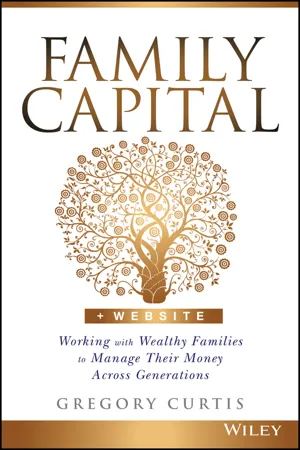
Table of contents

  1. Cover
  2. Title Page
  3. Copyright
  4. Table of Contents
  5. Preface
  6. Acknowledgments
  7. Prologue: The Titan Family in America
  8. Chapter 1: George Titan III and His Catastrophic Mistake
  9. Chapter 2: Ned and Rose Succeed Jake as Co-Heads of the Family
  10. Chapter 3: The Titans Search for and Engage a New Financial Advisor
  11. Chapter 4: First Meeting: Governance, Investment Strategy, and Other Introductory Matters
  12. Chapter 5: The Titans Create an Investment Policy Statement
  13. Chapter 6: Establishing the Titan Family's Investment Objectives
  14. Chapter 7: The Titans Grapple with Asset Allocation
  15. Chapter 8: The Manager Search Meeting
  16. Chapter 9: Reviewing the Performance of the Investment Accounts
  17. Chapter 10: Miscellaneous Investment-Related Discussions
  18. Chapter 11: Miscellaneous Non-Investment Discussions
  19. About the Website
  20. About the Author
  21. Index
  22. End User License Agreement

Frequently asked questions

Yes, you can cancel anytime from the Subscription tab in your account settings on the Perlego website. Your subscription will stay active until the end of your current billing period. Learn how to cancel your subscription
No, books cannot be downloaded as external files, such as PDFs, for use outside of Perlego. However, you can download books within the Perlego app for offline reading on mobile or tablet. Learn how to download books offline
Perlego offers two plans: Essential and Complete
  • Essential is ideal for learners and professionals who enjoy exploring a wide range of subjects. Access the Essential Library with 800,000+ trusted titles and best-sellers across business, personal growth, and the humanities. Includes unlimited reading time and Standard Read Aloud voice.
  • Complete: Perfect for advanced learners and researchers needing full, unrestricted access. Unlock 1.5M+ books across hundreds of subjects, including academic and specialized titles. The Complete Plan also includes advanced features like Premium Read Aloud and Research Assistant.
Both plans are available with monthly, semester, or annual billing cycles.
We are an online textbook subscription service, where you can get access to an entire online library for less than the price of a single book per month. With over 1.5 million books across 990+ topics, we’ve got you covered! Learn about our mission
Look out for the read-aloud symbol on your next book to see if you can listen to it. The read-aloud tool reads text aloud for you, highlighting the text as it is being read. You can pause it, speed it up and slow it down. Learn more about Read Aloud
Yes! You can use the Perlego app on both iOS and Android devices to read anytime, anywhere — even offline. Perfect for commutes or when you’re on the go.
Please note we cannot support devices running on iOS 13 and Android 7 or earlier. Learn more about using the app
Yes, you can access Family Capital by Gregory Curtis in PDF and/or ePUB format, as well as other popular books in Business & Wealth Management. We have over 1.5 million books available in our catalogue for you to explore.