LTE Small Cell Optimization
eBook - ePub

LTE Small Cell Optimization

3GPP Evolution to Release 13

  1. English
  2. ePUB (mobile friendly)
  3. Available on iOS & Android
eBook - ePub

LTE Small Cell Optimization

3GPP Evolution to Release 13

About this book

LTE network capabilities are enhanced with small cell deployment, with optimization and with new 3GPP features. LTE networks are getting high loaded which calls for more advanced optimization. Small cells have been discussed in the communications industry for many years, but their true deployment is happening now. New 3GPP features in Release 12 and 13 further push LTE network performance.

This timely book addresses R&D and standardization activities on LTE small cells and network optimization, focusing on 3GPP evolution to Release 13. It covers LTE small cells from specification to products and field results; Latest 3GPP evolution to Release 13; and LTE optimization and learnings from the field.
Frequently asked questions

Yes, you can cancel anytime from the Subscription tab in your account settings on the Perlego website. Your subscription will stay active until the end of your current billing period. Learn how to cancel your subscription.
No, books cannot be downloaded as external files, such as PDFs, for use outside of Perlego. However, you can download books within the Perlego app for offline reading on mobile or tablet. Learn more here.
Perlego offers two plans: Essential and Complete
  • Essential is ideal for learners and professionals who enjoy exploring a wide range of subjects. Access the Essential Library with 800,000+ trusted titles and best-sellers across business, personal growth, and the humanities. Includes unlimited reading time and Standard Read Aloud voice.
  • Complete: Perfect for advanced learners and researchers needing full, unrestricted access. Unlock 1.4M+ books across hundreds of subjects, including academic and specialized titles. The Complete Plan also includes advanced features like Premium Read Aloud and Research Assistant.
Both plans are available with monthly, semester, or annual billing cycles.
We are an online textbook subscription service, where you can get access to an entire online library for less than the price of a single book per month. With over 1 million books across 1000+ topics, we’ve got you covered! Learn more here.
Look out for the read-aloud symbol on your next book to see if you can listen to it. The read-aloud tool reads text aloud for you, highlighting the text as it is being read. You can pause it, speed it up and slow it down. Learn more here.
Yes! You can use the Perlego app on both iOS or Android devices to read anytime, anywhere — even offline. Perfect for commutes or when you’re on the go.
Please note we cannot support devices running on iOS 13 and Android 7 or earlier. Learn more about using the app.
Yes, you can access LTE Small Cell Optimization by Harri Holma, Antti Toskala, Jussi Reunanen, Harri Holma,Antti Toskala,Jussi Reunanen in PDF and/or ePUB format, as well as other popular books in Technology & Engineering & Mobile & Wireless Communications. We have over one million books available in our catalogue for you to explore.

1
Introduction

Harri Holma
  1. 1.1 Introduction
  2. 1.2 LTE Global Deployments and Devices
  3. 1.3 Mobile Data Traffic Growth
  4. 1.4 LTE Technology Evolution
  5. 1.5 LTE Spectrum
  6. 1.6 Small Cell Deployments
  7. 1.7 Network Optimization
  8. 1.8 LTE Evolution Beyond Release 13
  9. 1.9 Summary
  10. References

1.1 Introduction

Mobile broadband technology has experienced an incredibly fast evolution during the last 10 years. The first High-Speed Downlink Packet Access (HSDPA) network was launched 2005 enabling the high-speed mobile broadband and the first iPhone was launched 2007 creating the massive need for the mobile broadband. The data rates have increased more than 100-fold and the data volumes by more than 1000-fold during the last 10 years. The HSDPA started with 3.6 Mbps while the latest Long-Term Evolution (LTE)-Advanced networks deliver user data rates of 300 Mbps during 2014 and 450 Mbps during 2015. But still, we have just seen the first part of the mobile broadband era – the fast evolution continues forward. Also, the number of mobile broadband subscribers is increasing rapidly with affordable new smartphones providing the internet access for the next billions of users.
This chapter shortly introduces the status of LTE networks globally, the traffic growth, LTE in Third Generation Partnership Project (3GPP) and the spectrum aspects. The chapter also discusses the importance of the small cell deployments, the network optimization and the LTE.

1.2 LTE Global Deployments and Devices

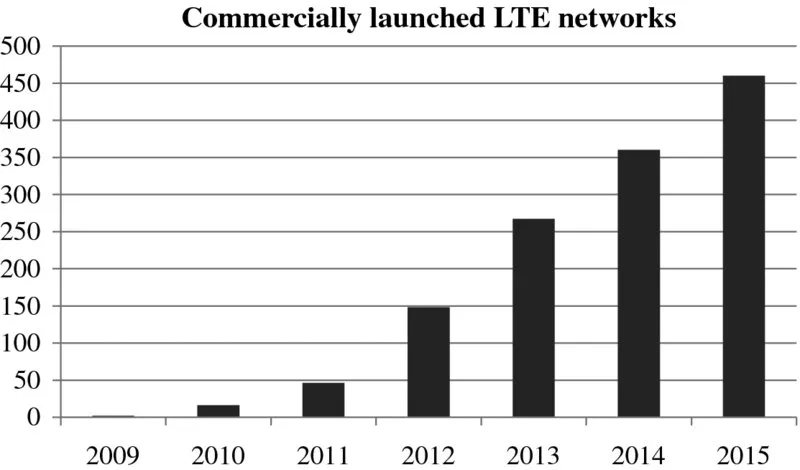
The first commercial LTE network was opened by Teliasonera in Sweden in December 2009 marking the new era of high-speed mobile communications. The number of commercial LTE networks has already increased to 460 in more than 140 countries by end 2015. The fast growth of launches has happened during 2012–2015. It is expected that more than 500 operators in more than 150 countries will soon have commercial LTE network running. The number of launched networks is shown in Figure 1.1.
Image described by surrounding text.
Figure 1.1 Commercially launched LTE networks [1]
The very first LTE devices supported 100 Mbps in the form factor of Universal Serial Bus (USB) modem. Soon LTE capability was introduced into high end and mid-priced smartphones with the bit rate up to 150 Mbps. By 2015, LTE radio is found in most smartphones excluding the very low end segment at 50-USD. The data rate capability is increased to 300 Mbps, and 450 Mbps, in the latest devices. An example drive test throughput is shown in Figure 1.2 illustrating that it is possible to get very close to 300 Mbps in the good channel conditions in the field with Category 6 devices. An example of such a device is shown in Figure 1.3. Also, the support for Voice over LTE (VoLTE) is included, which allows to use LTE network not only for data connections but also for voice connections.
Image described by surrounding text.
Figure 1.2 Drive test data rate with Category 6 LTE device
Image described by caption.
Figure 1.3 Example Category 6 LTE device supporting 300 Mbps

1.3 Mobile Data Traffic Growth

The mobile data traffic has grown rapidly during the last few years driven by the new smartphones, large displays, higher data rates and higher number of mobile broadband subscribers. The mobile data growth for 2-year period is illustrated in Figure 1.4. These data are collected from more than 100 major operators globally. The absolute data volume in this graph is more than million terabytes, that is, exabytes, per year. The data traffic has grown by a factor of 3.6× during the 2-year period, which corresponds to 90% annual growth. The fast growth of mobile data is expected to continue. The data growth is one of the reasons why more LTE networks are required, more spectra are needed, radio optimization is necessary and why small cells will be deployed. All this data growth must happen without increase in the operator revenues. Therefore, the cost per bit must decrease and the network efficiency must increase correspondingly.
Image described by surrounding text.
Figure 1.4 Mobile data growth during 2-year period

1.4 LTE Technology Evolution

The LTE technology has been standardized by Third Generation Partnership Project (3GPP). The LTE was introduced in 3GPP Release 8. The specifications were completed and the backwards compatibility started in March 2009. Release 8 enabled peak rate of 150 Mbps with 2×2 MIMO, low latency, flat network architecture and the support for 4-antenna base station transmission and reception. Release 8 enabled in theory also 300 Mbps with 4×4 MIMO but the practical devices so far have two antennas limiting the data rate to 150 Mbps. Release 9 was a relatively small update on top of Release 8. Release 9 was completed 1 year after Release 8 and the first deployments started during 2011. Release 9 brought enhanced Multimedia Broadcast Multicast Solution (eMBMS) also known as LTE-Broadcast, emergency call support for VoLTE, femto base station handovers and first set of Self-Organizing Network (SON) functionalities. Release 10 provided a major step in terms of data rates and capacity with Carrier Aggregation (CA), higher order MIMO up to eight antennas in downlink and four antennas in uplink. The support for Heterogeneous Network (HetNet) was included in Release 10 with the feature enhanced Inter-Cell Interference Coordination (eICIC). Release 10 was completed in June 2011 and the first commercial carrier aggregation network started in June 2013. Release 10 is also known as LTE-Advanced. Release 11 enhanced LTE-Advanced with Coordinated Multipoint (CoMP) transmission and reception, with further enhanced ICIC (feICIC), advan...

Table of contents

  1. Cover
  2. Title page
  3. Copyright
  4. Preface
  5. Acknowledgements
  6. List of Abbreviations
  7. 1 Introduction
  8. 2 LTE and LTE Advanced in Releases 8–11
  9. 3 LTE-Advanced Evolution in Releases 12–13
  10. 4 Small Cell Enhancements in Release 12/13
  11. 5 Small Cell Deployment Options
  12. 6 Small Cell Products
  13. 7 Small Cell Interference Management
  14. 8 Small Cell Optimization
  15. 9 Learnings from Small Cell Deployments
  16. 10 LTE Unlicensed
  17. 11 LTE Macro Cell Evolution
  18. 12 LTE Key Performance Indicator Optimization
  19. 13 Capacity Optimization
  20. 14 VoLTE Optimization
  21. 15 Inter-layer Mobility Optimization
  22. 16 Smartphone Optimization
  23. 17 Further Outlook for LTE Evolution and 5G
  24. Index
  25. EULA