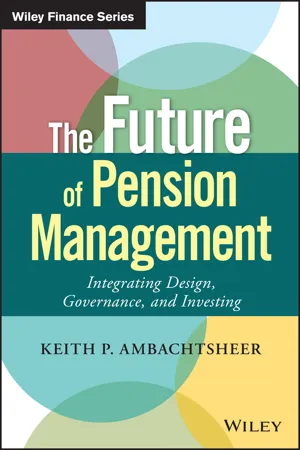
The Future of Pension Management
eBook - ePub

The Future of Pension Management

Integrating Design, Governance, and Investing

  1. English
  2. ePUB (mobile friendly)
  3. Available on iOS & Android
eBook - ePub

The Future of Pension Management

Integrating Design, Governance, and Investing

About this book

A real-world look at the pension revolution underway

The Future of Pension Management offers a progress report from the field, using actual case studies from around the world. In the mid-70s, Peter Drucker predicted that demographic dynamics would eventually turn pensions into a major societal issue; in 2007, author Keith Ambachsheer's book Pension Revolution laid out the ways in which Drucker's predictions had come to pass. This book provides a fresh look at the situation on the ground, and details the encouraging changes that have taken place in pension management concepts and practices. The challenges identified in 2007 are being addressed, and this report shows how design, management, and investment innovation have led to measurably better pension outcomes.

Pensions have become an everyday news item, and people are rightly concerned about the security of their retirement in light of recent pension scandals and the global financial crisis. This book provides a note of encouragement, detailing the ways in which today's pensions are becoming more and more secure, and the new ideas and practices that are chipping away at the challenges.

  • Learn how pension management practices are improving
  • Examine the uptick in positive outcomes over recent years
  • Discover why pension investing is turning toward the long-term
  • Consider the challenges that remain and their possible solutions

Drucker's vision of a needed pension revolution is unfolding in real time. Better pension designs, more effective pension governance, and more productive pension investing are mitigating many of the issues that threatened collapse. The Future of Pension Management provides a real-world update on the state of pensions today and a look forward to the changes we still need to make.

Trusted by 375,005 students

Access to over 1.5 million titles for a fair monthly price.

Study more efficiently using our study tools.

Information

Publisher
Wiley
Year
2016
Print ISBN
9781119191032
Edition
1
eBook ISBN
9781119191025
Subtopic
Finance

Part One

Touchstones

Literally: Stones used to test the quality of precious metals.
Metaphorically: Tests to assess the value or merits of a claim or idea.
—Adapted from the Oxford English Dictionary.

Chapter 1

Improved Pension Designs and Organizations

Gateways to a More Functional Capitalism

“…with the separation between ownership and management which prevails today…and with the development of organized investment markets…a new factor of great importance has entered in…which sometimes facilitates investment…but sometimes adds greatly to the instability of the system…”
“…it might have been supposed that competition between expert professionals…would correct the vagaries of ignorant individuals left to themselves…it happens however that their energies and skill are mainly occupied otherwise…largely concerned with foreseeing changes in conventional valuations a short time ahead…”
“…the measure of success attained by Wall Street…regarded as the institution of which the proper social purpose is to direct new investments into the most profitable channels in terms of future yield…cannot be claimed as one of the outstanding triumphs of laissez-faire capitalism…if I am right in thinking that its best brains have in fact been directed towards a different object…”
—Excerpts from John Maynard Keynes, The General Theory of Employment, Interest, and Money (1936), Chapter 12.

A “Gateways” Lecture in London

Some time ago, I was invited by the UK's ShareAction organization to give a lecture in the Houses of Parliament. It provided an opportunity to place Keynes' insights on faux vs. functional capitalism, Peter Drucker's on the special role of retirement savings in shaping capitalism, and Jan Tinbergen's on aligning pension goals and instruments in a 21st-century setting. These insights lead to the critical conclusion that the over-$30 trillion pension fund sector is by far the largest investor class with a fiduciary duty to invest across generations. Thus it is the leading institutional investor class with a clear motivation to, in Keynes' words, “direct new investments into the most profitable channels in terms of future yield.”
The lecture, which I called the “Gateways” lecture, acknowledged that capitalism faces strong headwinds today as reflected in issues such as aging populations, physical limits to growth, bubbles and financial crises, a growing rich–poor divide, and continuing alignment of interest challenges between corporate managers and owners. Also, the traditional defined-benefit (DB) and defined-contribution (DC) pension designs both mitigate against pension funds playing the wise intergenerational investor role we would like them to play. Their ability to play this role is further hampered by the generally weak governance and organizational structures of these funds.
The good news is that there is no need to invent either better pension designs or stronger organizational structures. Logic and research have already identified them. Further, here and there, they already exist in practice. Our collective challenge is to vastly accelerate the process of moving these better ways into widespread practice around the globe. In the end, it is a question of what Peter Drucker would call effective leadership.

Setting the Stage

The Gateways lecture had four parts:
  1. A quick sweep through 400 years of capitalism
  2. An equally quick assessment of the challenges facing capitalism in the 21st century
  3. The special role pension funds should and could play to address these challenges
  4. Getting pension funds to actually do this on a large scale
Capitalism is an economic system in which the means of production are privately owned and operated for profit, usually in competitive markets. Many consider the Dutch East Indies Company, founded in 1602, as the prototype of the first modern corporation, complete with key features such as limited liability for shareowners and the ability for them to buy or sell their shares on the stock exchange. However, it was the 19th-century industrial revolution that transformed capitalism into the dominant economic system it continues to be today.
At first, its major owners were not institutions, but powerful individuals with names such as Carnegie, Rockefeller, Getty, Vanderbilt, Ford, and JP Morgan. With their passing, and after the deeply traumatic experiences of WWI, the Great Depression, WWII, and the drawing of the Iron Curtain across Europe, we witnessed the birth of “institutional capitalism” with insurance companies, mutual funds, and pension funds becoming the dominant owners of the means of production.
Before we diagnose the ills of today's version of capitalism and discuss possible remedies, we should reflect for a moment on its central role in the remarkable transformation of the still-largely agrarian societies of the 18th century into the post-industrial societies of the developed world today. As just one indication of this remarkable transformation, global GDP per capita grew roughly 50 percent in the seven centuries from 1000 to 1800, compared to a 20-fold (2,000 percent!) increase in GDP per capita for the developed world in the 19th and 20th centuries, while at the same time significantly reducing the number of hours people worked, as well as eliminating forced labor for children and for the aged.1

Addressing Capitalism's 21st-Century Challenges

However, with our entry into the 21st century, most of us are painfully aware that capitalism is facing strong headwinds today. For example:
  • Physical limits to continued economic growth in such forms as carbon emissions, pollution, water usage, and food production
  • Aging populations and very modest economic growth prospects in the developed world
  • Preferences by collective electorates and individual family units to maintain or enhance public services and private living standards through borrowing rather than through current taxes and earnings
  • Increased frequency of bubbles and crises in financial markets
  • A growing societal have–have not divide in both perception and reality
  • Continued alignment-of-interests challenges between corporate managers and corporate owners2
The question before us is what the over-$30 trillion global pension fund sector can do to ameliorate some of these headwinds, while at the same time fulfilling its mission to provide retirement income security to hundreds of millions of beneficiaries.
I believe it is within our reach to move capitalism in a direction that is more wealth-creating, more sustainable, less crisis-prone, and more legitimate than the “headwinds” capitalism of today. And why specifically pension funds? Because they are the only global investor class which has a fiduciary duty to invest across generations. In determining their investment strategies, pension funds are duty-bound to be even-handed between the financial needs of today's pensioners and those of young workers, whose retirement years lie 30, 40, even 50 years ahead of them.
However, this transformation to pension fund capitalism will not be easy for two reasons:
  1. It requires the redesign of pension systems so these systems themselves become more sustainable and intergenerationally fair.
  2. It requires the redesign of pension fund organizations so that they themselves become more effective and hence more productive stewards of the retirement savings of young workers and pensioners alike.
These two pre-conditions are essential and will take hard work to bring about.

Sustainable Pension Designs

The designs of traditional DC and DB plans are both problematical:
  • Traditional DC plans force contribution rate and investment decisions on participants that they cannot and do not want to make. Also, little thought is given to the design of the post-work asset decumulation phase. As a result, DC plan investing has been unfocused, and post-work financial outcomes have been and continue to be highly uncertain. This raises fundamental questions about the effectiveness and sustainability of this individualistic pension model.
  • Traditional DB plans lump the young and the old on the same balance sheet, and unrealistically assume they have the same risk tolerance, and that p...

Table of contents

  1. Cover
  2. Series Page
  3. Title Page
  4. Copyright
  5. Table of Contents
  6. Dedication
  7. Preface
  8. Part One: Touchstones
  9. Part Two: Pension Design
  10. Part Three: Pension Governance
  11. Part Four: Pension Investing
  12. Conclusion
  13. About the Author
  14. Index
  15. End User License Agreement

Frequently asked questions

Yes, you can cancel anytime from the Subscription tab in your account settings on the Perlego website. Your subscription will stay active until the end of your current billing period. Learn how to cancel your subscription
No, books cannot be downloaded as external files, such as PDFs, for use outside of Perlego. However, you can download books within the Perlego app for offline reading on mobile or tablet. Learn how to download books offline
We are an online textbook subscription service, where you can get access to an entire online library for less than the price of a single book per month. With over 1.5 million books across 990+ topics, we’ve got you covered! Learn about our mission
Look out for the read-aloud symbol on your next book to see if you can listen to it. The read-aloud tool reads text aloud for you, highlighting the text as it is being read. You can pause it, speed it up and slow it down. Learn more about Read Aloud
Yes! You can use the Perlego app on both iOS and Android devices to read anytime, anywhere — even offline. Perfect for commutes or when you’re on the go.
Please note we cannot support devices running on iOS 13 and Android 7 or earlier. Learn more about using the app
Yes, you can access The Future of Pension Management by Keith P. Ambachtsheer in PDF and/or ePUB format, as well as other popular books in Business & Finance. We have over 1.5 million books available in our catalogue for you to explore.