Lasers have become an increasingly useful tool in conventional dental practice. Their precision and less invasive quality make them an attractive technology in esthetic and pediatric dentistry, oral medicine, and a range of other dental procedures. Lasers in Dentistry: Guide for Clinical Practice is a comprehensive, yet concise and easy-to-use guide to integrating lasers into conventional clinical practice.
The book begins by providing the reader a thorough understanding of how lasers work and their varied effects on oral tissues. Subsequent chapters are organized by procedure type, illustrating common clinical techniques with step-by-step illustrations and case examples. In addition, each chapter provides an overview of the latest research for use in clinical practice. More comprehensive than at atlas yet practical and clinically oriented in its approach, Lasers in Dentistry is an essential tool for practitioners and students looking to broader their skill set in laser dentistry.
Chapter 1 Physics of lasers and LEDs: Basic concepts
Clóvis Grecco, José Dirceu Vollet-Filho, Mariana Torres Carvalho, and Vanderlei Salvador Bagnato
São Carlos Institute of Physics, University of São Paulo (USP), São Carlos, SP, Brazil
Lasers
Laser light has very specific properties, thanks to the way that electromagnetic radiation is generated, and these properties are especially useful in science and technology. A special process produces laser light and this depends on some aspects of the interaction between the atoms that constitute matter and the electromagnetic radiation. To understand why laser light has unique properties, comprehension of the basic concepts of physics is required and these are explained in this chapter.
Key points to be understood include atomic structure, and how light originates and the path it takes through matter. The concept of the atom can be traced back to the ancient philosophers. They defined the “atom,” from the Greek for “not divisible,” as the smallest possible portion of a rock that could be formed by repeatedly splitting a rock until it could not be split further and without changing the basic properties of the original rock. They believed the atom was indestructible, a belief that has been disproved by scientific advances.
In 1808, the British scientist John Dalton scientifically defined the atom: “The atom is the smallest matter particle. It is indestructible. Its mass and size cannot be changed. Atoms may combine with each other, creating other species of matter.” The current definition of the atom diverges from that of Dalton. Unlike in current models, Dalton viewed the atom as a rigid sphere. Nevertheless, Dalton’s simplified model may still be used in describing situations such as chemical reactions and the law of definite proportions (Proust’s law), in which atoms may be considered as rigid spheres.
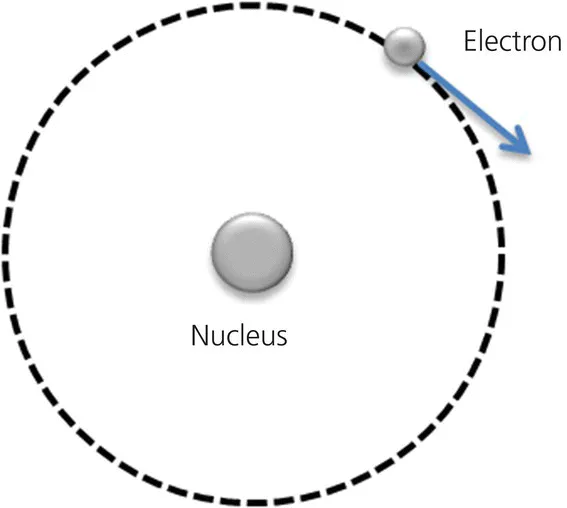
Later in the 18th century, Ernest Rutherford, a British scientist, introduced new concepts about atomic structure (the reader is referred to basic chemistry and physics texts for a detailed description of his model). His main concept was that “the atom would be constituted of a central part, called nucleus, and it has positive electric charge. The nucleus’s size would be smaller than the atom’s size (100 000–10 000 times smaller).” The question then was: if the atom has a nucleus with an expressive positive charge, how is it that matter is usually neutral? Rutherford answered the question by proposing that the positive charge of the nucleus is balanced by particles with a negative charge, called “electrons,” which revolve around the nucleus. He proposed a dynamic balance, as illustrated in Figure 1.1, because if electrons were not moving, they would be attracted to the nucleus.
Figure 1.1 Schematic of the atom according to Bohr.
However, there was a problem with Rutherford’s model of an electric charge revolving around the nucleus. Electromagnetic theory at that time had already determined that electrically charged particles (such as electrons) emit energy when they accelerate. Therefore, in Rutherford’s model, electrons should emit energy constantly (since a curved trajectory implies acceleration according to Newton’s laws) and as a result, the radius of their circular trajectory will reduce as kinetic energy, which sustains their movement, is lost. According to this theory, matter would quickly collapse as electrons fall inwards and onto the nucleus.
The Danish physician Niels Bohr (1885–1962) used the basic ideas of Max Planck (1858–1947) to solve the problem of why matter does not collapse. He made certain propositions, known as “Bohr’s postulates,” to explain the electron–nucleus dynamics:
The electrons revolving around the nucleus follow well-defined circular orbits, under the influence of the Coulomb attraction.
The radii of the orbits of the electrons around the nucleus can only assume certain values, proportional to h/2π (where h is Planck’s constant).
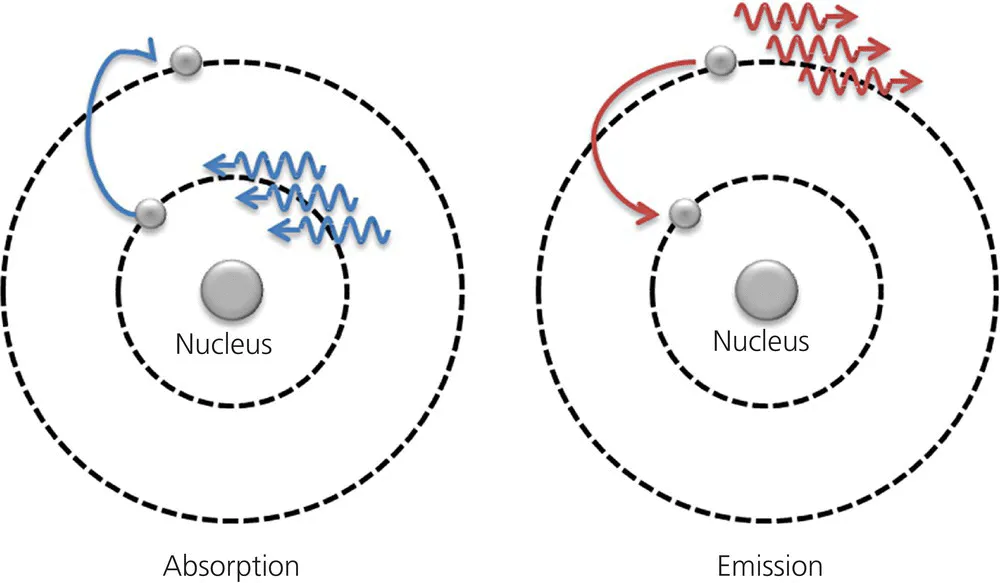
The energy of the atom has a definite value when the electrons are in a given stationary orbit. When an electron moves to a new orbit, energy is absorbed or emitted. The amount of absorbed/emitted energy can be obtained from the expression ΔE = hf, where ΔE is the energy absorbed or emitted, h is Planck’s constant, and f is the frequency of radiation (see later in this chapter). Note that ΔE is the energy difference between the two stationary orbits involved in the process.
The energy emitted or absorbed by an electron when it changes its orbit was named a “photon.” A photon can be viewed as a small energy “packet” or “quantum.” Therefore, when the electron moves to an orbit closer to the nucleus, it emits a photon; when it moves to an orbit that is farther from the nucleus, it absorbs a photon (Fig. 1.2). Bohr assumed that the angular momentum (
, where
is the radius vector, m is the scalar mass, and
is the velocity vector) of the electron revolving around the nucleus was an integral multiple of Planck’s constant h divided by 2π. This is called Bohr’s quantization rule.
Figure 1.2 Representation of absorption and emission of photons by an electron, with transition to an energy level farther from (absorption) or closer to the nucleus (emission).
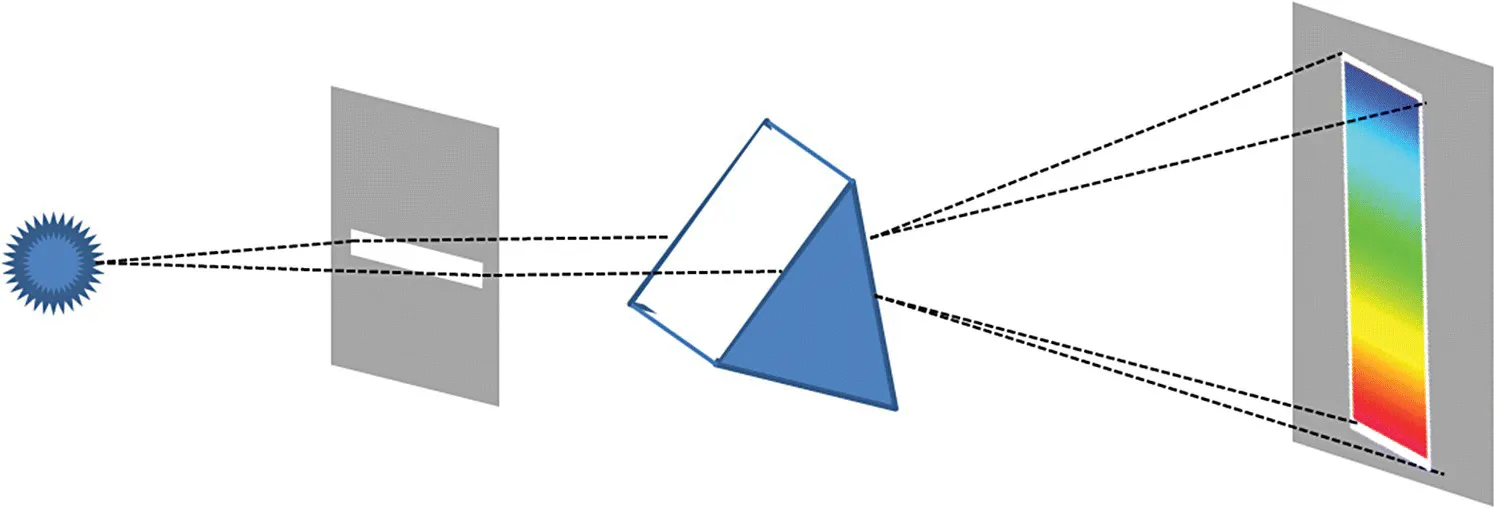
Bohr’s ideas were not pulled out of the hat, but based on experimental studies of the emission spectrum of hydrogen. To understand what is meant by “spectrum,” think about white light passing through a prism (Fig. 1.3). It is decomposed into all the colors that constitute the visible light spectrum. This same phenomenon creates rainbows, where water droplets act as spherical prisms and the sun is the light source. Bohr used this technique to decompose the light spectrum emitted by a hydrogen gas lamp.
Figure 1.3 A beam of white light may be diffracted into different colors when passed thr...
Table of contents
Cover
Title page
Copyright page
Dedication page
Table of Contents
List of contributors
Foreword
Preface
Section 1: Basic principles of lasers and LEDs
Section 2: Preventive, esthetic, and restorative dentistry
Section 3: Endodontics
Section 4: Periodontology
Section 5: Oral surgery
Section 6: Orthodontics and orofacial pain
Section 7: Treatment of oral and facial lesions
Section 8: Laser and antimicrobial photodynamic therapies in cancer patients
Index
End User License Agreement
Trusted by 375,005 students
Access to over 1.5 million titles for a fair monthly price.
Study more efficiently using our study tools.
Frequently asked questions
Yes, you can cancel anytime from the Subscription tab in your account settings on the Perlego website. Your subscription will stay active until the end of your current billing period. Learn how to cancel your subscription
No, books cannot be downloaded as external files, such as PDFs, for use outside of Perlego. However, you can download books within the Perlego app for offline reading on mobile or tablet. Learn how to download books offline
Perlego offers two plans: Essential and Complete
Essential is ideal for learners and professionals who enjoy exploring a wide range of subjects. Access the Essential Library with 800,000+ trusted titles and best-sellers across business, personal growth, and the humanities. Includes unlimited reading time and Standard Read Aloud voice.
Complete: Perfect for advanced learners and researchers needing full, unrestricted access. Unlock 1.5M+ books across hundreds of subjects, including academic and specialized titles. The Complete Plan also includes advanced features like Premium Read Aloud and Research Assistant.
Both plans are available with monthly, semester, or annual billing cycles.
We are an online textbook subscription service, where you can get access to an entire online library for less than the price of a single book per month. With over 1.5 million books across 990+ topics, we’ve got you covered! Learn about our mission
Look out for the read-aloud symbol on your next book to see if you can listen to it. The read-aloud tool reads text aloud for you, highlighting the text as it is being read. You can pause it, speed it up and slow it down. Learn more about Read Aloud
Yes! You can use the Perlego app on both iOS and Android devices to read anytime, anywhere — even offline. Perfect for commutes or when you’re on the go. Please note we cannot support devices running on iOS 13 and Android 7 or earlier. Learn more about using the app
Yes, you can access Lasers in Dentistry by Patricia M. Freitas, Alyne Simões, Patricia M. Freitas,Alyne Simões,Patricia M. Freitas in PDF and/or ePUB format, as well as other popular books in Medicine & Dentistry. We have over 1.5 million books available in our catalogue for you to explore.