A Choice Outstanding Academic Title for 2014!
Sponsored by the Association of College and Research Libraries (ACRL), this one-of-a-kind book demonstrates the best tools, resources, and techniques for discovering, selecting, and integrating interactive open educational resources (OERs) into the teaching and learning process. The author examines many of the best repositories and digital library websites for finding high quality materials, explaining in depth the best practices for effectively searching these repositories and the various methods for evaluating, selecting, and integrating the resources into the instructor's curriculum and course assignments, as well as the institution's learning management system.
eBook - ePub
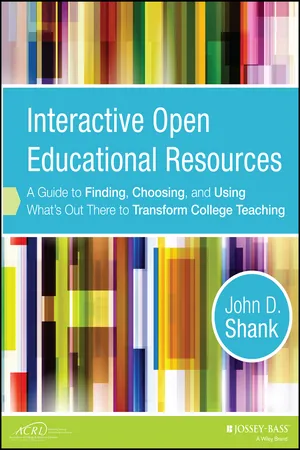
Interactive Open Educational Resources
A Guide to Finding, Choosing, and Using What's Out There to Transform College Teaching
- English
- ePUB (mobile friendly)
- Available on iOS & Android
eBook - ePub
Interactive Open Educational Resources
A Guide to Finding, Choosing, and Using What's Out There to Transform College Teaching
About this book
Information
Part One
Interactive Learning Materials: Setting the Stage
Today, computers are common in every classroom from kindergarten to college. Over the past three decades, children have been exposed to technology from a very early age and have grown up playing video games and using computers both at home and school. These digital natives, known formally as the Net Generation, have always lived in a world with computers. Combined with the arrival of the Internet, these technologies have profound implications for current and future students as well as for preceding generations.
These implications are broad ranging and will reshape our society and educational system in the Information Age. Entire industries (i.e., music, entertainment, and publishing) will be impacted by evolving technologies. Where these paradigm shifts intersect this book lies within the changing nature of the type of resources we have used to educate our students. For decades, textbooks, journals, and newspapers (more recently videos) have served as the primary resources for course curricula, but in the near future that paradigm will shift. Because of the Internet and mobile computing technologies, a whole host of newer and developing formats of information will be increasingly accessible to students. The following chapters set the stage for exploring these newer formats and the advantages they offer.
Chapter One
Interactive Learning Materials
Engaging Learners in the Emerging Digital World
We shape our tools and afterwards our tools shape us.
—Marshall McLuhan
Today's students are digital natives; they are a generation of students that like to be constantly connected with content that allows them to watch, listen, read, and (most critically) interact with their technology-rich environment (Prensky, 2001; Oblinger and Oblinger, 2005). Unlike the generation of many of today's instructors, they have never lived in a world that does not let them interact with their entertainment and communication environment. The idea of passively sitting back and gathering around the radio or television to simply watch and listen to a show is becoming increasingly foreign to today's students.
For centuries, instructors have been faced with the challenge of finding ways to motivate, engage, and help students learn critical course content. The difference today is that our students live in a world where they can interact and connect with the shows they watch. For example, American Idol allows them to vote by texting a message directly to the show using a cell phone or wireless Internet-enabled device. Likewise, they live in a digital multitasking world that allows them simultaneously to play games, chat over the Internet with friends anywhere, and listen to music. Educators today, most of whom are considered digital immigrants (I am certainly one), compete more fiercely now than ever before for their students' attention. One of their primary challenges is cultivating students' intellectual curiosity and interest.
The Rise of Interactive Learning Materials
Computer digital technologies have given rise to the development of all types of resources. This includes the digitization of more traditional resources such as books, magazines, and newspapers as well as the creation of new forms of digital information formats such as podcasts, videos, and animations. The tremendous proliferation of online learning materials has been concurrent with the growth of open educational resources (OERs), which include all types of learning materials that are licensed to be freely available for educational, nonprofit use (Johnstone, 2005; Atkins, Brown, and Hammond, 2007).
A smaller but rapidly expanding subset of educational resources attempts to integrate active learning components digitally into its material (Barkley, 2010) to engage learners with the goal of holding their attention. Called interactive learning materials (ILMs), they—and the various types of digital informational formats they represent (e.g., interactive, multimedia modules that contain tutorials with practice exercises, games, and simulations)—build on more traditionally passive learning materials like text, audio, and video content to create a new format of learning resources that moves beyond requiring students to simply listen or view the course material.
Why are these types of digital educational resources rapidly becoming vital resources for faculty and students to enhance both classroom and online learning? To begin to answer this question we must examine the components of well-designed ILMs. Broadly speaking, three major components need to be incorporated into ILMs to make them more effective than the traditional learning tools: (1) some type of interactivity that engages learners and requires them to actively participate in comprehending the content; (2) combination of several modalities in presenting the content (e.g., audio, visual, kinesthetic); and (3) assessment and feedback component that tests and informs learners about their level of understanding of the material.
It is helpful to examine in detail a well-designed module (i.e., containing a tutorial with practice exercises) that was created using the basic instructional design process ADDIE (Analyze, Design, Develop, Implement, and Evaluate). (Note to faculty: This is a collaboration opportunity with instructional design or technology staff at your institution because they are experts in instructional design models; also see Going Further: Recommended Reading at the end of this chapter to learn more about this topic.) ADDIE was employed to create an ILM that could gain students' attention and assist them in better understanding course content. The tutorials with practice exercises come from a group of introductory calculus modules created by the Center for Learning & Teaching (CLT) at the Berks College of the Pennsylvania State University (Penn State Berks, 2012). The tutorials use Robert Gagne's Nine Events of Instruction as a foundation to create instructional events to facilitate and improve students' learning of calculus (Briggs, Gustafson, and Tillman, 1991). The more aspects the learning modules contain, the more likely it is that the learning modules will enhance student learning:
1. Gaining the learners attention: This requires developing a learning environment for the ILM that students find relevant, appealing, and enjoyable to use. A goal of any ILM is to increase learner engagement with the content by having them interact with the content as it is presented and practiced, thereby increasing the “time on task” with the instructor's student learning objectives and course concepts. A benefit to learners is that as they spend more time engaged with the content of the course they will generally perform better in demonstrating course learning objectives (Chickering and Ehrmann, 1996).
2. Explicitly stating the ILMs' objectives: What outcomes will students be able to demonstrate if they have learned or mastered the material? The use of specific, measurable learning objectives allows for an accurate assessment of the knowledge and/or skills gained after completing the resource. The benefit to learners is that by having a clear statement presented of what they are expected to learn, they can better understand what they should focus on/pay attention to while using the ILM.
3. Reminding learners of relevant prior knowledge: This is necessary to guide learners to remediate any missed or forgotten knowledge so that it can be used as a building block for learning new material. The benefit to learners is that by including essential prior knowledge through instructional scaffolding they will be more likely to understand the new material and successfully move on to learning new content (August, Lopez, Yokomoto, and Buchanan, 2002).
4. Stimulating learners: A critical component of any well-designed ILM, this requires learners to respond to visual, auditory, and tactile stimuli necessitating that they take some action to proceed through the resource. The benefit to learners is that they will be able to identify with one or more of the various media and sensory modalities depending on their preferred learning style, which will enhance their engagement with the tutorial (Gagné, Wager, Golas, and Keller, 2005).
5. Providing learning guidance: This correlates to both the ILM design (i.e., it is easy and intuitive to use, like turning the next page in a book) and the process and structure by which learners navigate or are guided step by step, linearly or nonlinearly, using visuals, examples, or case studies to facilitate new knowledge and understanding of the material. The benefit to learners is reduced confusion and ambiguity in navigating the tutorial content, which enhances their ability to process the content (Churchill, 2007).
6. Eliciting learner performance: This relates directly to learner stimulation and guidance. ILMs should require learners to practice the skill or demonstrate an understanding of the new knowledge gained through repeated practice exercises that confirm or deny their mastery of the material and also helps them remember it. The benefit to learners is the ability to demonstrate and practice their newly acquired knowledge, which helps to reinforce the learning that has taken place.
7. Providing learner feedback: This lets learners know immediately if they correctly understand the resources objectives. Also, the specificity of the feedback can inform learners about existing gaps in their understanding of the material and what actions they may need to take to gain a better understanding. The benefit to learners is that the feedback aids them in knowing they have either correctly or incorrectly applied the concepts or skills to be learned and also reinforces the correct information. Additionally, the corrective feedback guides the learner so that they can have a better idea of why they answered incorrectly and know what step or action they should take to arrive at the correct solution.
8. Assessing learner performance: Activities, tests, or quizzes confirm learners' level of understanding as a result of completing the ILM and provide additional coaching, feedback, or hints that can help them be more successful in the future. The benefit to learners is that enhanced learner responses reveal to both the instructor and learner what learning has or has not occurred. The summative assessment can enable the learner to better understand the concepts they grasped and recognize those that they still struggle with understanding.
9. Enhancing learner retention and transfer to the real world: The context with which learners frame the ILM is vital to helping them see its relevance and authenticity to the real world. This component of Gagne's Nine Events of Instruction most closely aligns with cognitive constructivism (Schuh and Barab, 2008). A good example of this is demonstrated in the Accounting 211 module (Penn State Berks, 2011) in which students play the role of an accountant for a company called Veggie Deli to demonstrate their mastery of T-accounts and debits and credits. The benefit to learners is that they are better able to understand and apply how the concepts they are learning are relevant and can be applied to their future career goals and workplace expectations.
Synopsis
Current and future generations of students who are growing up in the networked computing and digital information age are oriented toward their surrounding environment in ways researchers still do not understand (Hargittai, 2010; Helsper and Eynon, 2010; Jones et al., 2010). These digital natives were raised with radically different technologies from that of previous generations' digital immigrants. This dynamic is not likely to abate because, as Moore's law suggests, technology evolves rapidly and exponentially, with every future successive generation growing up in a world ever more altered by technological innovations.
This has profound implications for our entire educational system, including higher education. Some of the changes brought about by these technological innovations will be disruptive. Consequently, educators will need to scrutinize their own teaching practices and seek to align them with best practices in student learning. ILMs are one such technological innovation. These resources have the potential to address significant modern-day learning challenges such as student preparedness, student engagement, and attentiveness.
Interactive learning materials such as modules, games, and simulations are part of a rapidly expanding array of resources that educators will be able to access and use in their courses. Modules composed of both tutorials and practice exercises do not have a uni...
Table of contents
- Cover
- Title Page
- Copyright
- Series Page
- Dedication
- Preface
- About the Author
- Part One: Interactive Learning Materials: Setting the Stage
- Part Two: Finding ILMs: A Digital Exploration
- Part Three: Choosing and Using ILMs
- Epilogue: How Faculty, Librarians, and Instructional Support Staff Transform Learning with ILMs in the Future
- References
- More from Wiley
- Index
Trusted by 375,005 students
Access to over 1.5 million titles for a fair monthly price.
Study more efficiently using our study tools.
Frequently asked questions
Yes, you can cancel anytime from the Subscription tab in your account settings on the Perlego website. Your subscription will stay active until the end of your current billing period. Learn how to cancel your subscription
No, books cannot be downloaded as external files, such as PDFs, for use outside of Perlego. However, you can download books within the Perlego app for offline reading on mobile or tablet. Learn how to download books offline
Perlego offers two plans: Essential and Complete
- Essential is ideal for learners and professionals who enjoy exploring a wide range of subjects. Access the Essential Library with 800,000+ trusted titles and best-sellers across business, personal growth, and the humanities. Includes unlimited reading time and Standard Read Aloud voice.
- Complete: Perfect for advanced learners and researchers needing full, unrestricted access. Unlock 1.5M+ books across hundreds of subjects, including academic and specialized titles. The Complete Plan also includes advanced features like Premium Read Aloud and Research Assistant.
We are an online textbook subscription service, where you can get access to an entire online library for less than the price of a single book per month. With over 1.5 million books across 990+ topics, we’ve got you covered! Learn about our mission
Look out for the read-aloud symbol on your next book to see if you can listen to it. The read-aloud tool reads text aloud for you, highlighting the text as it is being read. You can pause it, speed it up and slow it down. Learn more about Read Aloud
Yes! You can use the Perlego app on both iOS and Android devices to read anytime, anywhere — even offline. Perfect for commutes or when you’re on the go.
Please note we cannot support devices running on iOS 13 and Android 7 or earlier. Learn more about using the app
Please note we cannot support devices running on iOS 13 and Android 7 or earlier. Learn more about using the app
Yes, you can access Interactive Open Educational Resources by John D. Shank in PDF and/or ePUB format, as well as other popular books in Education & Higher Education. We have over 1.5 million books available in our catalogue for you to explore.