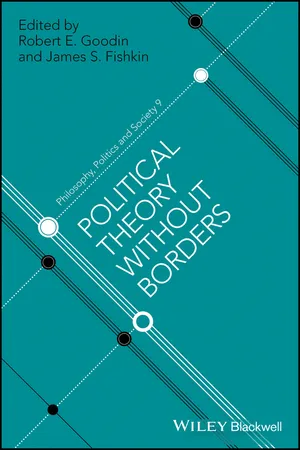
Political theory has traditionally focused on governance within the confines of a specific polity, but with the recent proliferation of environmental realities and national decisions that have global repercussions, political theory must now be re-imagined to confront globalization head-on. Political Theory Without Borders presents a collection scholarship that does just that. Each chapter focuses on answering specific questions that have arisen from issues of global spillover – like climate change and pollution – and the increasingly unrestricted flow of people, products, and financial capital across borders. With contributions from emerging scholars alongside key texts from some of the most well-known theorists of previous generations, this collection illustrates how the classic concerns of political theory – justice and equality, liberty and oppression – have re-emerged with a renewed significance at the global level.
- English
- ePUB (mobile friendly)
- Available on iOS & Android
eBook - ePub
Political Theory Without Borders
About this book
POLITICAL THEORY WITHOUT BORDERS
Information
1
Political Theory Without Borders
An Introduction
Robert E. Goodin and James S. Fishkin
Political theorists of old had much to say about war and peace, and issues arising from them. Those matters apart, however, political theory’s traditional focus was insistently internal – on relations among a people, and on relations between them and those ruling over them.
Those political theorists of universalist inclination have always insisted that the same principles should apply everywhere alike, of course. Virtually none of them, however, thought that literally one and the same set of institutions should rule over everyone everywhere alike.1 Political theory’s prescriptions were traditionally for the internal governance of principalities, taken one at a time.2
In political theory, as in political practice, proffered rules governing relations among and across principalities tended to be essentially Westphalian. They were designed to ensure that each self-contained community could get on with the business of perfecting its own institutions and practices in light of the theory’s prescriptions, with minimal interference from abroad.3 Of course there are always threats and opportunities arising from abroad – but that is the business of statesmen to manage well in the national interest. And of course there are always disasters and destitution abroad that tug at the heartstrings – but that is the business of charity and churches. Or so it had long been thought, within both political theory and political practice.
Yet the world has a way of intruding. And it did. First, with spillovers of a very literal sort – with industrial effluents threatening to poison the global biosphere upon which all life depends, including especially carbon emissions wrecking havoc with the global climate. Chapters in Part I by Kennan and Caney address those concerns, with Risse’s reminding us of what it really means to treat the earth as the common property of all of humankind.
With the latest wave of globalization,4 state borders also became increasingly porous – to the movement of people and products and financial capital. States have become sovereign over their domestic affairs largely in name only, in a great many respects. At the same time, and in consequence, the classical concerns of political theory – justice and equality, liberty and oppression – have reemerged powerfully at the global level. Global justice has grown into a veritable cottage industry, now displaying decreasing returns to scale.5 But over and above the question of whether the same principles of distributive justice are properly applied at the global as at the national level, there are a great many other more specific matters of principle raised by those global flows of people, products and financial capital. Those issues are here explored in chapters in Part II by Dietsch and Rixen, Barry, Buchanan, Cole and Keohane, Offe, and Shachar and Hirschl.
As a result of all of that, there has been a growing reluctance to regard what happens elsewhere as of concern to people in that jurisdiction alone, as shown in the chapters in Part III. Through colonialism, earlier waves of globalization had left an awful legacy, as Lu’s chapter reemphasizes; and suspending judgment for a time may have been an honorable stance in the backwash of it, as Geertz’s chapter nicely recalls. But in the wake of increasing numbers (or anyway awareness) of atrocities and disasters – many connected to the phenomena described above – there has been a growing sense of global responsibility for global problems. This expanding humanitarian sensibility has led to increasing intervention abroad, by both humanitarians with guns and those without.6 Those are the subjects of chapters by Evans and Rubenstein.
It would be wrong to claim that political theorists have fully theorized all these new developments. The critique contained in Marx’s Eleventh Thesis on Feuerbach remains valid: theorists mostly just interpret the world rather than change it. Still, political theorists have not been remiss in engaging with and responding critically and creatively to the new sociopolitical and intellectual landscape that is rapidly emerging as the old Westphalian borders are increasing drained of practical relevance – as we hope this set of chapters will show.
Notes
PART I
Global Spillovers
2
To Prevent a World Wasteland
A Proposal
George F. Kennan
NOT even the most casual reader of the public prints of recent months and years could be unaware of the growing chorus of warnings from qualified scientists as to what industrial man is now doing—by overpopulation, by plundering of the earth’s resources, and by a precipitate mechanization of many of life’s processes—to the intactness of the natural environment on which his survival depends. “For the first time in the history of mankind,” U.N. Secretary-General U Thant wrote, “there is arising a crisis of worldwide proportions involving developed and developing countries alike—the crisis of human environment…. It is becoming apparent that if current trends continue, the future of life on earth could be endangered.”
Study and debate of these problems, and sometimes even governmental action, have been developing with cumulative intensity. This response has naturally concentrated largely on environmental deterioration as a national problem. It is normally within national boundaries that the first painful effects of deterioration are felt. It is at the national level that the main burden of legislation and administrative effort will admittedly have to be borne, if certain kinds of pollution and destruction are to be halted.
But it is also clear that the national perspective is not the only one from which this problem needs to be approached. Polluted air does not hang forever over the country in which the pollution occurs. The contamination of coastal waters does not long remain solely the problem of the nation in whose waters it has its origin. Wildlife—fish, fowl and animal—is no respecter of ...
Table of contents
- Cover
- Title Page
- Table of Contents
- Acknowledgments
- About the Contributors
- 1 Political Theory Without Borders
- PART I: Global Spillovers
- PART II: Global Flows
- PART III: Global Interventions
- Index
- End User License Agreement
Trusted by 375,005 students
Access to over 1.5 million titles for a fair monthly price.
Study more efficiently using our study tools.
Frequently asked questions
Yes, you can cancel anytime from the Subscription tab in your account settings on the Perlego website. Your subscription will stay active until the end of your current billing period. Learn how to cancel your subscription
No, books cannot be downloaded as external files, such as PDFs, for use outside of Perlego. However, you can download books within the Perlego app for offline reading on mobile or tablet. Learn how to download books offline
Perlego offers two plans: Essential and Complete
- Essential is ideal for learners and professionals who enjoy exploring a wide range of subjects. Access the Essential Library with 800,000+ trusted titles and best-sellers across business, personal growth, and the humanities. Includes unlimited reading time and Standard Read Aloud voice.
- Complete: Perfect for advanced learners and researchers needing full, unrestricted access. Unlock 1.5M+ books across hundreds of subjects, including academic and specialized titles. The Complete Plan also includes advanced features like Premium Read Aloud and Research Assistant.
We are an online textbook subscription service, where you can get access to an entire online library for less than the price of a single book per month. With over 1.5 million books across 990+ topics, we’ve got you covered! Learn about our mission
Look out for the read-aloud symbol on your next book to see if you can listen to it. The read-aloud tool reads text aloud for you, highlighting the text as it is being read. You can pause it, speed it up and slow it down. Learn more about Read Aloud
Yes! You can use the Perlego app on both iOS and Android devices to read anytime, anywhere — even offline. Perfect for commutes or when you’re on the go.
Please note we cannot support devices running on iOS 13 and Android 7 or earlier. Learn more about using the app
Please note we cannot support devices running on iOS 13 and Android 7 or earlier. Learn more about using the app
Yes, you can access Political Theory Without Borders by Robert E. Goodin,James S. Fishkin in PDF and/or ePUB format, as well as other popular books in Philosophy & Philosophy History & Theory. We have over 1.5 million books available in our catalogue for you to explore.