The first part of this book looks at the consequence of chemical and topological defects existing on real surfaces, which explain the wettability of super hydrophilc and super hydrophobic surfaces. There follows an in-depth analysis of the acido-basicity of surfaces with, as an illustration, different wettability experiments on real materials. The next chapter deals with various techniques enabling the measurement of acido basicity of the surfaces including IR and XPS technics.
The last part of the book presents an electrochemical point of view which explains the surface charges of the oxide at contact with water or other electrolyte solutions in the frame of Bronsted acido-basicity concept. Various consequences are deduced from such analyses illustrated by original measurement of the point of zero charge or by understanding the basic principles of the electrowetting experiments.
Young’s relationship and definition of the work of adhesion.
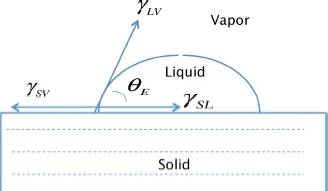
Figure 1.1.Equilibrium of a liquid droplet on an ideal solid substrate
When a liquid droplet is placed in a solid, it takes on a given configuration according to the interactions which take place between the solid and the liquid.
The system evolves toward a configuration of minimum free energy characterized by an angle of equilibrium θE.
If there is no chemical reaction at the solid–liquid interface, the geometry is simple, as shown in Figure 1.1.
Young’s relationship [YOU 05] provides the equilibrium of forces at the triple line. Interfacial tensions are described as forces per unit of triple line length [DEF 66, DE 03]
[1.1]
where θ E is the wetting angle and γ is the interfacial tension of solid–vapor, liquid–vapor and solid–liquid, respectively.
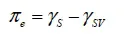
COMMENT 1.1.– γSV is the interfacial tension of the solid in equilibrium with the vapor phase. This value is generally different from the surface tension of the solid in equilibrium with vacuum or a neutral gas, denoted as γS. This difference is known as spreading pressure: πe
[1.2]
Young’s equation can therefore be written as follows:
[1.3]
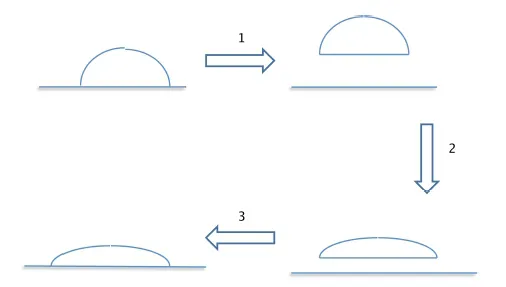
The same result as Young’s equation can be deduced from a virtual thermodynamic cycle (there are a number of different variations of this demonstration):
Figure 1.2.Virtual thermodynamic cycle for the equilibrium of a liquid droplet
Using a droplet with the interfacial area Ώ placed on the solid, it can be assumed first that the droplet can be separated from the substrate without changing its shape.
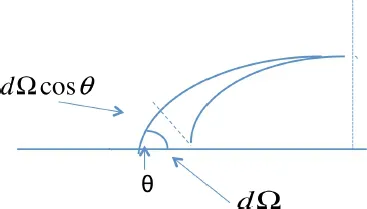
Subsequently, the raised droplet undergoes a variation in contact area dΩ corresponding to the equilibrium situation. As a result, there is a variation in the area of the droplet cap: dΩ cosθ (Figure 1.3).
Figure 1.3.Area variation of the liquid droplet when it reaches the state of equilibrium
Hence:
In the third stage, the droplet is placed back onto the solid:
The overall outcome is: ΔG = ΔG1+ΔG2+ΔG3.
Hence:
At equilibrium, this gives: dΔG /dΩ=O.
Hence:
This does indeed bring us back to Young’s equation.
1.2. Adhesion effect
Dupré definition, spreading coefficient.
The work of adhesion WSL is the variation of free energy per unit area involved in the following transformation sh...
Table of contents
Cover
Table of Contents
Title
Copyright
Introduction
Chapter 1: Wettability of an Ideal Surface: Overview
Chapter 2: Real Surfaces
Chapter 3: Components of the Surface Energy
Chapter 4: The Acid-Base Component in the Work of Adhesion
Chapter 5: Experimental Determination through Wettability Measurements
Chapter 6: Acid-Base Properties of Surfaces: Experimental Approaches
Access to over 1.5 million titles for a fair monthly price.
Study more efficiently using our study tools.
Frequently asked questions
Yes, you can cancel anytime from the Subscription tab in your account settings on the Perlego website. Your subscription will stay active until the end of your current billing period. Learn how to cancel your subscription
No, books cannot be downloaded as external files, such as PDFs, for use outside of Perlego. However, you can download books within the Perlego app for offline reading on mobile or tablet. Learn how to download books offline
Perlego offers two plans: Essential and Complete
Essential is ideal for learners and professionals who enjoy exploring a wide range of subjects. Access the Essential Library with 800,000+ trusted titles and best-sellers across business, personal growth, and the humanities. Includes unlimited reading time and Standard Read Aloud voice.
Complete: Perfect for advanced learners and researchers needing full, unrestricted access. Unlock 1.5M+ books across hundreds of subjects, including academic and specialized titles. The Complete Plan also includes advanced features like Premium Read Aloud and Research Assistant.
Both plans are available with monthly, semester, or annual billing cycles.
We are an online textbook subscription service, where you can get access to an entire online library for less than the price of a single book per month. With over 1.5 million books across 990+ topics, we’ve got you covered! Learn about our mission
Look out for the read-aloud symbol on your next book to see if you can listen to it. The read-aloud tool reads text aloud for you, highlighting the text as it is being read. You can pause it, speed it up and slow it down. Learn more about Read Aloud
Yes! You can use the Perlego app on both iOS and Android devices to read anytime, anywhere — even offline. Perfect for commutes or when you’re on the go. Please note we cannot support devices running on iOS 13 and Android 7 or earlier. Learn more about using the app
Yes, you can access Physical Chemistry and Acid-Base Properties of Surfaces by Jean-Charles Joud,Marie-Geneviève Barthés-Labrousse in PDF and/or ePUB format, as well as other popular books in Technology & Engineering & Materials Science. We have over 1.5 million books available in our catalogue for you to explore.