Physics of Magnetic Nanostructures
eBook - ePub

Physics of Magnetic Nanostructures

  1. English
  2. ePUB (mobile friendly)
  3. Available on iOS & Android
eBook - ePub

Physics of Magnetic Nanostructures

About this book

A comprehensive coverage of the physical properties and real-world applications of magnetic nanostructures

This book discusses how the important properties of materials such as the cohesive energy, and the electronic and vibrational structures are affected when materials have at least one length in the nanometer range. The author uses relatively simple models of the solid state to explain why these changes in the size and dimension in the nanometer regime occur. The text also reviews the physics of magnetism and experimental methods of measuring magnetic properties necessary to understanding how nanosizing affects magnetism. Various kinds of magnetic structures are presented by the author in order to explain how nanosizing influences their magnetic properties. The book also presents potential and actual applications of nanomaterials in the fields of medicine and computer data storage.

Physics of Magnetic Nanostructures:

  • Covers the magnetism in carbon and born nitride nanostructures, bulk nanostructured magnetic materials, nanostructured magnetic semiconductors, and the fabrication of magnetic nanostructures
  • Discusses emerging applications of nanomaterials such as targeted delivery of drugs, enhancement of images in MRI, ferrofluids, and magnetic computer data storage
  • Includes end-of-chapter exercises and five appendices

Physics of Magnetic Nanostructures is written for senior undergraduate and graduate students in physics and nanotechnology, material scientists, chemists, and physicists.
Frequently asked questions

Yes, you can cancel anytime from the Subscription tab in your account settings on the Perlego website. Your subscription will stay active until the end of your current billing period. Learn how to cancel your subscription.
No, books cannot be downloaded as external files, such as PDFs, for use outside of Perlego. However, you can download books within the Perlego app for offline reading on mobile or tablet. Learn more here.
Perlego offers two plans: Essential and Complete
  • Essential is ideal for learners and professionals who enjoy exploring a wide range of subjects. Access the Essential Library with 800,000+ trusted titles and best-sellers across business, personal growth, and the humanities. Includes unlimited reading time and Standard Read Aloud voice.
  • Complete: Perfect for advanced learners and researchers needing full, unrestricted access. Unlock 1.4M+ books across hundreds of subjects, including academic and specialized titles. The Complete Plan also includes advanced features like Premium Read Aloud and Research Assistant.
Both plans are available with monthly, semester, or annual billing cycles.
We are an online textbook subscription service, where you can get access to an entire online library for less than the price of a single book per month. With over 1 million books across 1000+ topics, we’ve got you covered! Learn more here.
Look out for the read-aloud symbol on your next book to see if you can listen to it. The read-aloud tool reads text aloud for you, highlighting the text as it is being read. You can pause it, speed it up and slow it down. Learn more here.
Yes! You can use the Perlego app on both iOS or Android devices to read anytime, anywhere — even offline. Perfect for commutes or when you’re on the go.
Please note we cannot support devices running on iOS 13 and Android 7 or earlier. Learn more about using the app.
Yes, you can access Physics of Magnetic Nanostructures by Frank J. Owens in PDF and/or ePUB format, as well as other popular books in Technology & Engineering & Nanotechnology & MEMS. We have over one million books available in our catalogue for you to explore.

1
PROPERTIES OF NANOSTRUCTURES

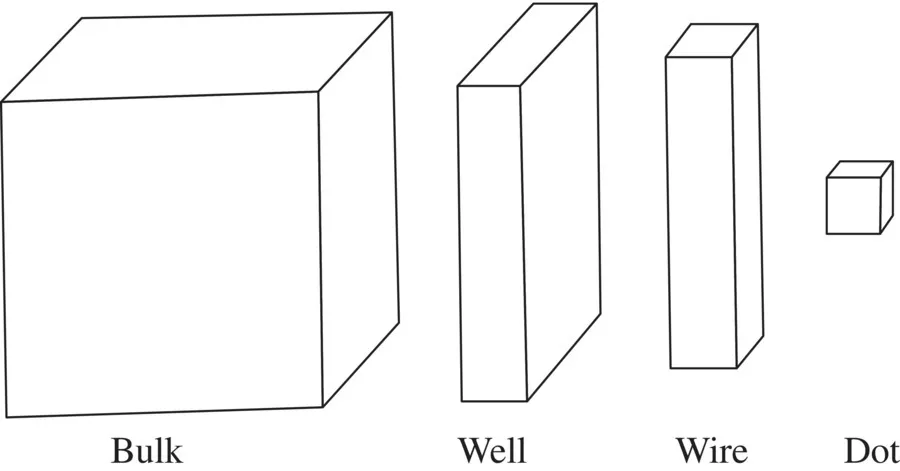
Nanostructures are generally considered to consist of a number of atoms or molecules bonded together in a cluster with at least one dimension less than 100 nm. A nanometer is 10−9 m or 10 Å. Spherical particles having a radius of about 1000 Å or less can be considered to be nanoparticles. If one dimension is reduced to the nano range, while the other two dimensions remain large, then we obtain a structure known as a well. If two dimensions are reduced, while one remains large, the resulting structure is referred to as a wire. The limiting case of this process of size reduction in which all three dimensions reach the low nanometer range is called a dot. Figure 1.1 illustrates the structures of rectangular wells, wires, and dots. This chapter will discuss how the important properties of materials such as the cohesive energy and the electronic and vibrational structure are affected when materials have at least one length in the nanometer range. Elementary models of the solid state will be used to explain why the changes occur on nanosizing.
c1-fig-0001
FIGURE 1.1 Structures corresponding to a rectangular well, wire, and dot having one, two, and three dimensions of nanometer length, respectively.

1.1 COHESIVE ENERGY

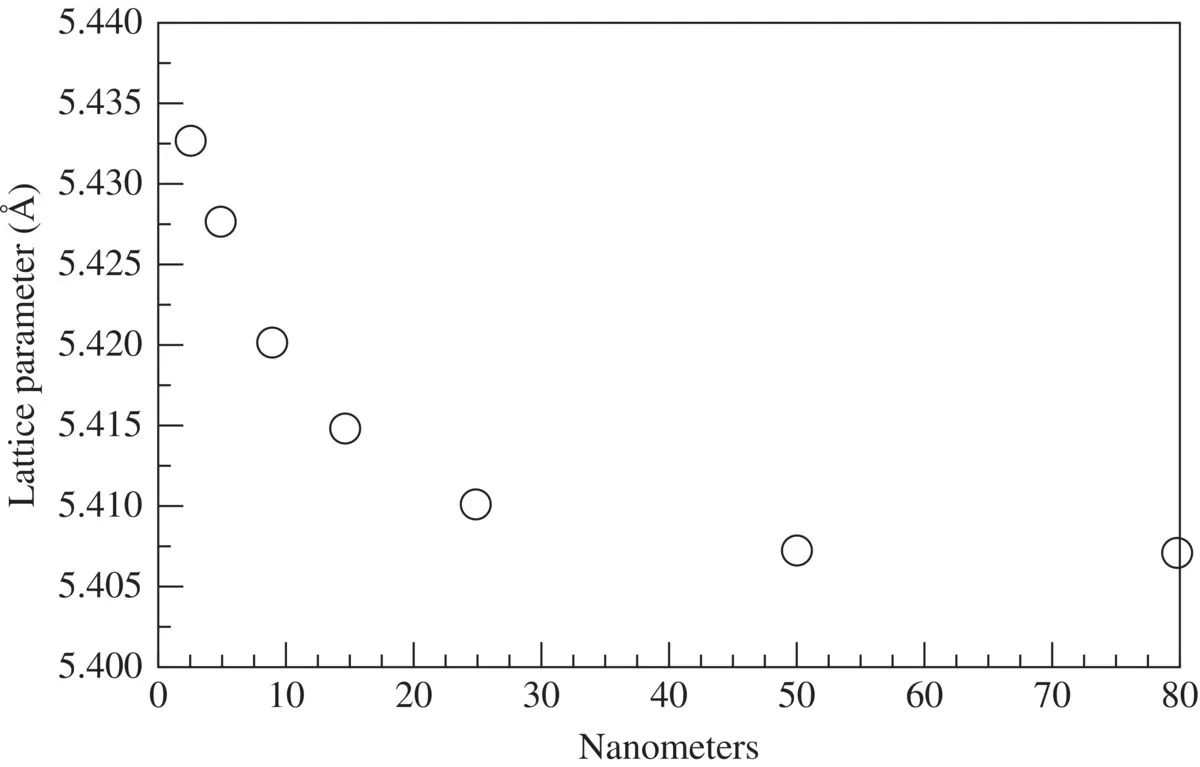
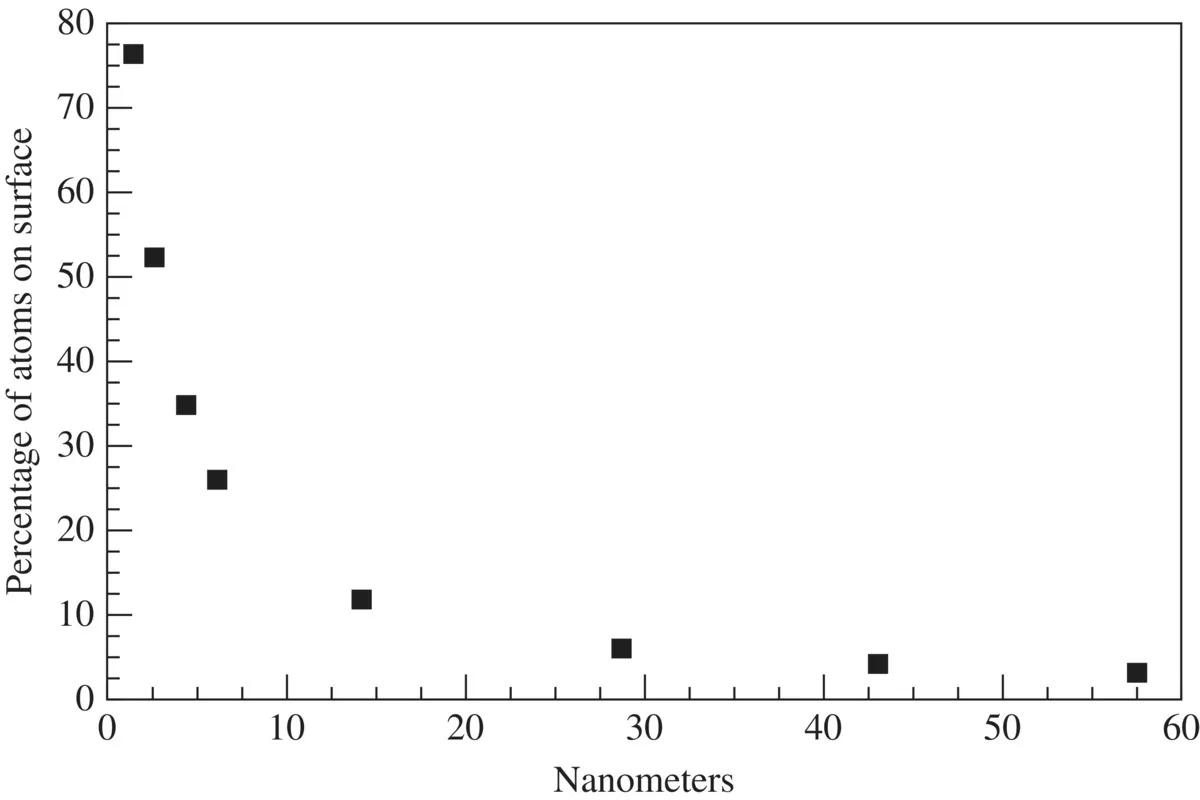
The atoms or ions of a solid are held together by interactions between them, which can be electrostatic and/or covalent. The electrostatic interaction is described by the Coulomb potential between charged particles. Covalent bonding involves overlap of wave functions of outer electrons of nearest neighbor atoms in the lattice. A crystal is stable if the total energy of the lattice is less than the sum of the energies of the atoms or molecules that make up the crystal when they are isolated from each other. The energy difference is the cohesive energy of the solid. As materials approach nanometer dimensions, the percentage of atoms on the surface increases. Figure 1.2 demonstrates a plot of the percentage of atoms on the surface of a hypothetical face-centered cubic (fcc) structure having a lattice parameter of 4 Å. Appendix A provides a table relating the diameter of spherical nanoparticles to the number of atoms in the particle and the percentage on the surface. Below about 14 nm, more than 10% of the atoms are on the surface. This holds true for metallic particles as well as ionically and covalently bonded materials. Since the atoms on the surface have less nearest neighbor atoms, this means that the cohesive energy of an ionic solid decreases as the size is reduced in the nanometer range. One of the results of this decrease in cohesive energy is an increase in the separation of the constituents of the lattice. Figure 1.3 shows an X-ray diffraction measurement of the lattice parameter of the ionic solid CeO2 as a function of particle size showing the increase in the lattice parameter as the particle size is reduced. This results in a reduction of the strength of the interaction between the ions of the solid and thus a reduction in the cohesive energy.
c1-fig-0002
FIGURE 1.2 Percentage of atoms on surface of a face-centered cubic lattice versus particle size. The lattice parameter is 4 Å.
c1-fig-0003
FIGURE 1.3 Experimental measurement of the ...

Table of contents

  1. COVER
  2. TITLE PAGE
  3. TABLE OF CONTENTS
  4. PREFACE
  5. ACKNOWLEDGMENT
  6. 1 PROPERTIES OF NANOSTRUCTURES
  7. 2 THE PHYSICS OF MAGNETISM
  8. 3 PROPERTIES OF MAGNETIC NANOPARTICLES
  9. 4 BULK NANOSTRUCTURED MAGNETIC MATERIALS
  10. 5 MAGNETISM IN CARBON AND BORON NITRIDE NANOSTRUCTURES
  11. 6 NANOSTRUCTURED MAGNETIC SEMICONDUCTORS
  12. 7 APPLICATIONS OF MAGNETIC NANOSTRUCTURES
  13. 8 MEDICAL APPLICATIONS OF MAGNETIC NANOSTRUCTURES
  14. 9 FABRICATION OF MAGNETIC NANOSTRUCTURES
  15. APPENDIX A A TABLE OF NUMBER OF ATOMS VERSUS SIZE IN FACE CENTERED CUBIC NANOPARTICLES
  16. APPENDIX B DEFINITION OF A MAGNETIC FIELD
  17. APPENDIX C DENSITY FUNCTIONAL THEORY
  18. APPENDIX D TIGHT BINDING MODEL OF ELECTRONIC STRUCTURE OF METALS
  19. APPENDIX E PERIODIC BOUNDARY CONDITIONS
  20. INDEX
  21. End User License Agreement