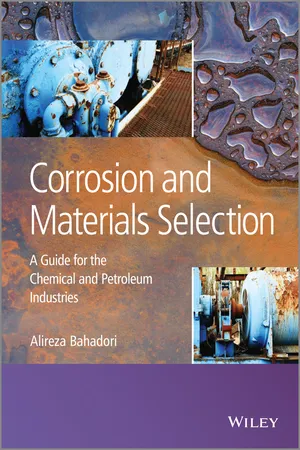
Corrosion and Materials Selection
eBook - ePub

Corrosion and Materials Selection

A Guide for the Chemical and Petroleum Industries

  1. English
  2. ePUB (mobile friendly)
  3. Available on iOS & Android
eBook - ePub

Corrosion and Materials Selection

A Guide for the Chemical and Petroleum Industries

About this book

The petroleum and chemical industries contain a wide variety of corrosive environments, many of which
are unique to these industries. Oil and gas production operations consume a tremendous amount of iron
and steel pipe, tubing, pumps, valves, and sucker rods. Metallic corrosion is costly. However, the cost of
corrosion is not just financial. Beyond the huge direct outlay of funds to repair or replace corroded structures are the indirect costs – natural resources, potential hazards, and lost opportunity. Wasting natural resources is a direct contradiction to the growing need for sustainable development.

By selecting the correct material and applying proper corrosion protection methods, these costs can be
reduced, or even eliminated. This book provides a minimum design requirement for consideration when
designing systems in order to prevent or control corrosion damage safely and economically, and addresses:

• Corrosion problems in petroleum and chemical industries
• Requirements for corrosion control
• Chemical control of corrosive environments
• Corrosion inhibitors in refineries and petrochemical plants
• Materials selection and service life of materials
• Surface preparation, protection and maintainability
• Corrosion monitoring - plant inspection techniques and laboratory corrosion testing techniques

Intended for engineers and industry personnel working in the petroleum and chemical industries, this book is also a valuable resource for research and development teams, safety engineers, corrosion specialists and researchers in chemical engineering, engineering and materials science.


Frequently asked questions

Yes, you can cancel anytime from the Subscription tab in your account settings on the Perlego website. Your subscription will stay active until the end of your current billing period. Learn how to cancel your subscription.
No, books cannot be downloaded as external files, such as PDFs, for use outside of Perlego. However, you can download books within the Perlego app for offline reading on mobile or tablet. Learn more here.
Perlego offers two plans: Essential and Complete
  • Essential is ideal for learners and professionals who enjoy exploring a wide range of subjects. Access the Essential Library with 800,000+ trusted titles and best-sellers across business, personal growth, and the humanities. Includes unlimited reading time and Standard Read Aloud voice.
  • Complete: Perfect for advanced learners and researchers needing full, unrestricted access. Unlock 1.4M+ books across hundreds of subjects, including academic and specialized titles. The Complete Plan also includes advanced features like Premium Read Aloud and Research Assistant.
Both plans are available with monthly, semester, or annual billing cycles.
We are an online textbook subscription service, where you can get access to an entire online library for less than the price of a single book per month. With over 1 million books across 1000+ topics, we’ve got you covered! Learn more here.
Look out for the read-aloud symbol on your next book to see if you can listen to it. The read-aloud tool reads text aloud for you, highlighting the text as it is being read. You can pause it, speed it up and slow it down. Learn more here.
Yes! You can use the Perlego app on both iOS or Android devices to read anytime, anywhere — even offline. Perfect for commutes or when you’re on the go.
Please note we cannot support devices running on iOS 13 and Android 7 or earlier. Learn more about using the app.
Yes, you can access Corrosion and Materials Selection by Alireza Bahadori in PDF and/or ePUB format, as well as other popular books in Technology & Engineering & Materials Science. We have over one million books available in our catalogue for you to explore.

Information

Chapter 1
Fundamentals of Corrosion in the Oil, Gas, and Chemical Industries

The petroleum and chemical industries contain a wide variety of corrosive environments; many are unique to these industries. Thus it is convenient to group all these environments together. Corrosion problems occur in at least three general areas: (1) production, (2) transportation and storage, and (3) operations.
Oil and gas production operations consume a tremendous amount of iron and steel pipe, tubing, pumps, valves, and sucker rods. Leaks cause loss of oil and gas, and also permit infiltration of water and silt, thus increasing corrosion damage. Saline water and sulfides are often present in oil and gas wells and corrosion occurs both inside and outside the casing. Surface equipment is subject to atmospheric corrosion.
What follows is a simple explanation of how corrosion occurs, the different types, and how problems can be solved.
We have all seen corrosion and know that the process produces a new and less desirable material from the original metal and can result in a loss of function of the component or system. The corrosion product we see most commonly is the rust which forms on the surface of steel.
1.1
equation
For this to happen the major component of steel, iron (Fe) at the surface of a component undergoes a number of simple changes. Firstly, the iron atom can lose some electrons and become a positively charged ion.
1.2
equation
This allows it to bond to other groups of atoms that are negatively charged. We know that wet steel rusts to give a variant of iron oxide, so the other half of the reaction must involve water
c01-math-0003
and oxygen
c01-math-0004
, something like this:
1.3
equation
This makes sense as we have a negatively charged material that can combine with the iron and electrons produced in the first reaction. We can, for clarity, ignore the electrons and write
1.4
equation
Oxygen dissolves quite readily in water and because there is usually an excess of it, reacts with the iron hydroxide.
1.5
equation
This series of steps tells us a lot about the corrosion process:
  1. Ions are involved and need a medium to move in (usually water).
  2. Oxygen is involved and needs to be supplied.
  3. The metal has to be willing to give up electrons to start the process.
  4. A new material is formed and this may react again or could protect the original metal.
  5. A series of simple steps are involved and a driving force is needed to achieve them.
  6. The most important fact is that interfering with the steps allows the corrosion reaction to be stopped or slowed to a manageable rate.

1.1 Uniform Corrosion

Uniform corrosion, as the name suggests, occurs over the majority of the surface of a metal at a steady and often predictable rate. Although it is unsightly, its predictability facilitates easy control, the most basic method being to make the material thick enough to function for the lifetime of the component. Uniform corrosion can be slowed or stopped in five basic ways:
  1. Slow down or stop the movement of electrons:
    1. Coat the surface with a non-conducting medium such as paint, lacquer or oil
    2. Reduce the conductivity of the solution in contact with the metal, an extreme case being to keep it dry
    3. Wash away conductive pollutants regularly
    4. Apply a current to the material (see cathodic protection).
  2. Slow down or stop oxygen from reaching the surface. This is difficult to do completely, but coatings can help.
  3. Prevent the metal from giving up electrons:
    1. Use a more corrosion-resistant metal higher in the electrochemical series,
    2. Use a sacrificial coating that gives up its electrons more easily than the metal being protected
    3. Apply cathodic protection
    4. Use inhibitors.
  4. Select a metal that forms an oxide that is protective and stops the reaction.
  5. Control and consideration of environmental and thermal factors is also essential.

1.2 Localized Corrosion

The consequences of localized corrosion can be a great deal more severe than uniform corrosion, generally because the failure occurs without warning and after a surprisingly short period of use or exposure. Application of the five basic principles needs greater thought and insight.

1.2.1 Galvanic Corrosion

This can occur when two different metals are placed in contact with each other and is caused by the greater willingness of one to give up electrons than the other. Three special features of this mechanism need to operate for corrosion to occur:
  • The metals need to be in contact electrically.
  • One metal needs to be significantly better at giving up electrons than the other
  • An additional path for ion and electron movement is necessary.
Prevention of this problem is based on ensuring that one or more of the three features do not exist:
  • Break the electrical contact using plastic insulators or coatings between the metals.
  • Select metals close together in the galvanic series.
  • Prevent ion movement by coating the junction with an impermeable material, or ensure the environment is dry and that liquids cannot be trapped.

1.2.2 Pitting Corrosion

Pitting corrosion occurs in materials that have a protective film, such as a corrosion product or a coating. When this breaks down, the exposed metal gives up electrons easily and the reaction initiates tiny pits with localized chemistry supporting rapid attack. Control can be ensured by:
  • selecting a resistant material,
  • ensuring a high enough flow velocity of fluids in contact with the material or
  • frequent washing,
  • control of th...

Table of contents

  1. Cover
  2. Title Page
  3. Copyright
  4. Dedication
  5. About the Author
  6. Preface
  7. Acknowledgements
  8. Chapter 1: Fundamentals of Corrosion in the Oil, Gas, and Chemical Industries
  9. Chapter 2: Corrosion Problems in the Petroleum and Chemical Industries
  10. Chapter 3: Corrosion Considerations in Material Selection
  11. Chapter 4: Engineering Materials
  12. Chapter 5: Chemical Control of Corrosive Environments
  13. Chapter 6: Requirements for Corrosion Control in the Petroleum and Petrochemical Industries
  14. Chapter 7: Corrosion Inhibitors in Refineries and Petrochemical Plants
  15. Chapter 8: Corrosion Inhibitor Evaluations
  16. Chapter 9: Compatibility in Material Selection
  17. Chapter 10: Surface Preparation, Protection and Maintenance
  18. Chapter 11: Fabrication and Choice of Material to Minimize Corrosion Damage
  19. Chapter 12: Heat Treatment
  20. Glossary of Terms
  21. Bibliography
  22. Index
  23. End User License Agreement


