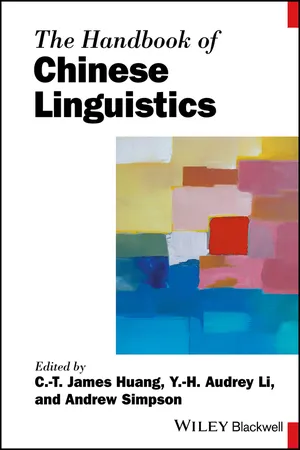
The Handbook of Chinese Linguistics is the first comprehensive introduction to Chinese linguistics from the perspective of modern theoretical and formal linguistics. Containing twenty-five chapters, the book offers a balanced, accessible and thoughtfully organized introduction to some of the most important results of research into Chinese linguistics carried out by theoretical linguists during the last thirty years. Presenting critical overviews of a wide range of major topics, it is the first to meet the great demand for an overview volume on core areas of Chinese linguistics.
Authoritative contributions describe and assess the major achievements and controversies of research undertaken in each area, and provide bibliographies for further reading. The contributors refer both to their own work in relevant fields, and objectively present a range of competitor theories and analyses, resulting in a volume that is fully comprehensive in its coverage of theoretical research into Chinese linguistics in recent years.
This unique Handbook is suitable both as a primary reader for structured, taught courses on Chinese linguistics at university level, and for individual study by graduates and other professional linguists.
eBook - ePub
The Handbook of Chinese Linguistics
- English
- ePUB (mobile friendly)
- Available on iOS & Android
eBook - ePub
The Handbook of Chinese Linguistics
About this book
Information
Part I
Syntax, Semantics, and Morphology
1
Morphology
1 Introduction
This chapter provides an overview of morphological phenomena in Mandarin Chinese. Although Chinese is in the main an isolating language, with significantly less morphology than agglutinating and polysynthetic languages, a range of both inflectional and derivational affixes do occur and are productive, and will be discussed in Section 2. Like many other heavily isolating languages, Chinese exhibits great richness in the area of compounding, and much of the chapter focuses on this aspect of morphology in Chinese. Section 3 discusses general patterns found in nominal compounds and the controversial issue of the headedness of Chinese compounds. Section 4 takes the study of compounds further into the verbal domain and examines the status of a particularly challenging type of compound in Chinese, verb–object/VO compounds, which seem to behave both as morphological compounds and syntactic phrases, posing potential problems for their categorization as objects formed by morphological or syntactic rules. Before we proceed to consider these issues, certain standard morphological terminology made use of in the chapter will be noted. First, in terms of structural role, a morpheme (the smallest meaningful or grammatical unit participating in word formation operations) may be a stem (the base of which is called a root) or an affix (AFF). If a morpheme is able to stand alone as an independent word, it is termed a free morpheme; it is otherwise referred to as a bound morpheme. By such a definition, all affixes are necessarily bound, while roots may be either free or bound (simple examples of bound roots in Chinese would be ge- in ge-dan “pigeon-egg, pigeon egg” and er- in er-zi “son-Affix, son”). Affixes are further divided into two types, according to their morphological functions. Derivational affixes generally change the categories of the stems they attach to, while inflectional affixes contribute grammatical information and functions to the stems but do not affect the category of the stem (e.g., plural marking on nouns, tense affixation to verbs).
2 Affixes in Chinese
In its inventory of affixal elements, Chinese has been noted to exhibit both inflectional and derivational affixes, as broadly defined above (Dai 1992; Packard 2000).1 In what follows in Sections 2.1–2.2, a sampling of representative affixes given in Chao (1968), Dai (1992), Li and Thompson (1981), and Packard (2000), is given, categorized here according to their categorial statuses (i.e., whether the inflectional affixes are attached to verbal or nominal stems, and whether the derivational affixes yield verbal or nominal stems). In Section 2.3, a controversial issue is discussed regarding the correct distinction of bound roots and derivational affixes in Chinese.
2.1 Inflectional affixes
2.1.1 Nominal inflectional affixes
Chinese nouns are in general rather “bare” because they are not inflected for grammatical gender, number, or person. The plural (PL) suffix -men, which is used with human nouns and pronouns in standard Mandarin, marks the only exception, as illustrated in (1):2
| (1) | N[+human]-men “noun-Plural” |
| ren-men “person-PL: people,” laoshi-men “teacher-PL: teachers,” nan-hai-men “male-child-PL: boys,” gong-ren-men “work-man-PL: workers,” wo/ni/ta-men “I/you/he-PL: we/you/they” (but not *niu-men “cow-PL” or *che-men “car-PL”). |
Chao (1968) notes that certain classifiers can also be used as inflectional suffixes marking plurality and collectivity:
| (2) | N+CL “noun-Collective” |
| zhi-zhang “paper-CL: papers,” niu-zhi “cow-CL: a herd of cows,” ma-pi “horse-CL: a herd of horses,” hua-duo “flower-CL: flowers” (but not *ren-ge “person-CL” or *shou-zhi “hand-CL”). |
2.1.2 Verbal inflectional affixes
Verbal inflections in Chinese are also relatively few. Verbs are only inflected with aspectual suffixes (Asp). In Mandarin, these aspectual suffixes include the Perfective -le, Experiential -guo, and Progressive/Durative -zhe, which combine with verbs in an extremely regular fashion (see Chapter 7 for further discussion). One less-mentioned aspectual suffix, which Chao (1968: 205) refers to as Tentative aspect (while Li and Thompson 1981 and Dai 1992 use the term Delimitative aspect), is in the form of reduplication (RED):
| (3) | V-RED “V for a short while/a little” |
| zou-zou “walk-walk: walk for a while,” xue-xue “learn-learn: learn a little/for a while,” kan-kan “see-see: watch for a while” |
As Dai (1992) notes, when this rule is applied to disyllabic words, the whole stem must be reduplicated, as shown in (4b), which contrasts with unacceptable reduplication forms in (4c):
| (4) | Verb reduplication rule for disyllabic stems |
| a. [XY]V-RED → XY-XY, when the verbal stem is of the form XY | |
| b. [bang-zhu]-bang-zhu “help-help-RED: help a little,” [an-wei]-an-wei “peace-console-RED: console a little”ss | |
| c. *bang-bang-zhu, *bang-zhu-zhu, *bang-bang-zhu-zhu |
We shall come back to reduplication in Section 3.2, where the reduplication rule will be shown to be useful for determining the “compound-hood” of Verb–Object compounds.
It can also be noted that adjectives in Chinese may undergo reduplication, and while verbal reduplications take the form XYXY, adjectival reduplications have the different form XXYY (Chao 1968; Li and Thompson 1981). For example, the word qingsong “relax/relaxed” can be used as a verb or as an adjective. The distinction is reflected through different reduplication patterns. Observe the following examples:
| (5) | a. [qing-song]V-RED → qing-song-qing-song “to relax a little” | [XYXY] |
| b. [qing-song]Adj-RED → qing-qing-song-song “quite relaxed” | [XXYY] |
2.2 Derivational affixes
Derivational affixes generally display a range of character...
Table of contents
- Cover
- Blackwell Handbooks in Linguistics
- Title page
- Copyright page
- List of Figures
- List of Tables
- Notes on Contributors
- Foreword
- Part I: Syntax, Semantics, and Morphology
- Part II: Phonetics, Phonology, and Prosody
- Part III: Language Acquisition and Psycholinguistics
- Part IV: Historical Linguistics
- Part V: Morpho-Syntax of Other Non-Mandarin Varieties of Chinese
- Index
Trusted by 375,005 students
Access to over 1.5 million titles for a fair monthly price.
Study more efficiently using our study tools.
Frequently asked questions
Yes, you can cancel anytime from the Subscription tab in your account settings on the Perlego website. Your subscription will stay active until the end of your current billing period. Learn how to cancel your subscription
No, books cannot be downloaded as external files, such as PDFs, for use outside of Perlego. However, you can download books within the Perlego app for offline reading on mobile or tablet. Learn how to download books offline
Perlego offers two plans: Essential and Complete
- Essential is ideal for learners and professionals who enjoy exploring a wide range of subjects. Access the Essential Library with 800,000+ trusted titles and best-sellers across business, personal growth, and the humanities. Includes unlimited reading time and Standard Read Aloud voice.
- Complete: Perfect for advanced learners and researchers needing full, unrestricted access. Unlock 1.5M+ books across hundreds of subjects, including academic and specialized titles. The Complete Plan also includes advanced features like Premium Read Aloud and Research Assistant.
We are an online textbook subscription service, where you can get access to an entire online library for less than the price of a single book per month. With over 1.5 million books across 990+ topics, we’ve got you covered! Learn about our mission
Look out for the read-aloud symbol on your next book to see if you can listen to it. The read-aloud tool reads text aloud for you, highlighting the text as it is being read. You can pause it, speed it up and slow it down. Learn more about Read Aloud
Yes! You can use the Perlego app on both iOS and Android devices to read anytime, anywhere — even offline. Perfect for commutes or when you’re on the go.
Please note we cannot support devices running on iOS 13 and Android 7 or earlier. Learn more about using the app
Please note we cannot support devices running on iOS 13 and Android 7 or earlier. Learn more about using the app
Yes, you can access The Handbook of Chinese Linguistics by C. T. James Huang, Y. H. Audrey Li, Andrew Simpson, C. T. James Huang,Y. H. Audrey Li,Andrew Simpson in PDF and/or ePUB format, as well as other popular books in Languages & Linguistics & Languages. We have over 1.5 million books available in our catalogue for you to explore.