This new edition of Industrial Power Distribution addresses key areas of electric power distribution from an end-user perspective, which will serve industry professionals and students develop the necessary skills for the power engineering field.
Expanded treatment of one-line diagrams, the per-unit system, complex power, transformer connections, and motor applications
New topics in this edition include lighting systems and arc flash hazard
Concept of AC Power is developed step by step from the basic definition of power
Fourier analysis is described in a graphical sense
End-of-chapter exercises
If you are an instructor and adopted this book for your course, please email [email protected] to get access to the instructor files for this book.
Be aware of the need to always exercise safety while working around electricity
Understand the significance of the voltage level at the point of delivery to the industrial customer
Be proficient in the use of one-line diagrams to represent a three-phase electrical system
Understand the concept of protection zones
Recognize various source configurations and know the advantages and disadvantages of each
Calculate per-unit quantities, convert between actual and per-unit quantities, and be able to apply the per-unit system to do electrical calculations
Understand the components of power in an AC system
Be able to calculate voltage drop in a balanced three-phase system
Understand the significance of short circuit availability, both from a fault interrupting standpoint and from a motor starting standpoint
Comprehend the importance of properly sizing conductors and supply transformers
1.1 ELECTRICAL SAFETY
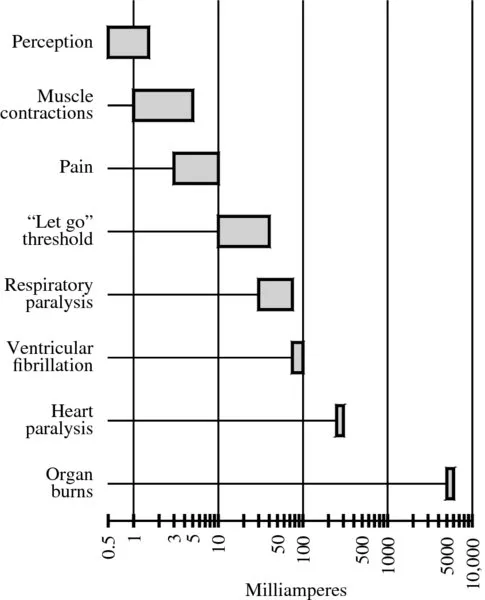
A 6-W night light bulb draws 50 mA of current. Even this small magnitude of current can kill a person. Humans can perceive an electric current as small as 0.5 mA. As the current magnitude rises to the 1–5 mA range, muscles will contract. Currents in the 3–10 mA range cause pain. Currents in the 10–40 mA range fall in the “let go” threshold, meaning they will cause muscles to contract so tightly that “letting go” of a grasped wire becomes impossible. Respiratory paralysis can occur in the 30–75 mA range. The heart will be affected with ventricular fibrillation occurring in the 75–100 mA range and heart paralysis occurring in the 250–300 mA range. Note that we have not yet reached one-third of an ampere! In the range of 5–6 A, organ burns will occur. These typical values are summarized in Figure 1.1.
Figure 1.1 Effects of Electrical Current on the Human Body
Although electrocution is a major concern when working around electricity, most electrical injuries are the result of burns occurring when large amounts of thermal energy are released during arcing faults. Electric arc flash presents a hazard that is distinct from electric shock. The heat and blast released during a short circuit fault can injure or kill a person located many feet from the fault location and who never come in contact with an energized conductor. The arc flash hazard will be discussed in Section 7.5.
Because of the shock and burn hazards posed by electricity, safety must always be exercised and considered as the highest priority when working around electrical equipment. Nothing supersedes safety. Carelessness for even a moment could result in a serious injury—or worse.
Much of what is considered safe working practices falls soundly into the category of common sense. For example, do not assume a circuit is de-energized—test it and ground it to make sure. Follow all grounding and bonding requirements when performing maintenance of electrical equipment. Stringently adhere to all switching and tagging practices required by the owner of the facility in which you are working. Be aware of working clearances and approach boundaries (these topics will be discussed in Section 7.5). Be sure that all tools and equipment including personal protective equipment (PPE) are in good condition, are being used properly, and have current testing or certification credentials, if applicable. Adhere to all safety procedures, even if the procedure does not seem important to you. It probably is important, but even if it is not, better safe than sorry. And be sure to complete all required training, including refresher courses, required for your job.
Electricity need not be feared, but certainly does command respect. Safe working practices need to be standard operating procedure and never be compromised. Safety must also be considered when designing electrical systems. Engineering additional safety features beyond what is minimally required for a system is a hallmark of excellent design. If an unsafe condition is discovered, it needs to be reported and made safe as quickly as possible. Take safety seriously—your life depends on it!
1.2 DELIVERY VOLTAGE
Electric...
Table of contents
COVER
IEEE PRESS
TITLE PAGE
COPYRIGHT
PREFACE
PREFACE TO THE FIRST EDITION
ACKNOWLEDGMENTS
ABOUT THE AUTHOR
CHAPTER 1 UTILITY SOURCE
CHAPTER 2 INSTRUMENT TRANSFORMERS AND METERING
CHAPTER 3 TRANSFORMER CONNECTIONS
CHAPTER 4 FAULT CALCULATIONS
CHAPTER 5 PROTECTIVE DEVICE SELECTION AND COORDINATION
CHAPTER 6 RACEWAY DESIGN
CHAPTER 7 SWITCHGEAR AND MOTOR CONTROL CENTERS
CHAPTER 8 LADDER LOGIC
CHAPTER 9 MOTOR APPLICATION
CHAPTER 10 LIGHTING SYSTEMS
CHAPTER 11 POWER FACTOR CORRECTION
CHAPTER 12 POWER QUALITY
APPENDIX A UNITS OF MEASUREMENT
APPENDIX B CIRCUIT ANALYSIS TECHNIQUES
APPENDIX C PHASORS AND COMPLEX NUMBER MATHEMATICS
APPENDIX D IMPEDANCE DATA
APPENDIX E AMPACITY DATA
APPENDIX F CONDUIT DATA
INDEX
IEEE PRESS SERIES ON POWER ENGINEERING
EULA
Trusted by 375,005 students
Access to over 1.5 million titles for a fair monthly price.
Study more efficiently using our study tools.
Frequently asked questions
Yes, you can cancel anytime from the Subscription tab in your account settings on the Perlego website. Your subscription will stay active until the end of your current billing period. Learn how to cancel your subscription
No, books cannot be downloaded as external files, such as PDFs, for use outside of Perlego. However, you can download books within the Perlego app for offline reading on mobile or tablet. Learn how to download books offline
Perlego offers two plans: Essential and Complete
Essential is ideal for learners and professionals who enjoy exploring a wide range of subjects. Access the Essential Library with 800,000+ trusted titles and best-sellers across business, personal growth, and the humanities. Includes unlimited reading time and Standard Read Aloud voice.
Complete: Perfect for advanced learners and researchers needing full, unrestricted access. Unlock 1.5M+ books across hundreds of subjects, including academic and specialized titles. The Complete Plan also includes advanced features like Premium Read Aloud and Research Assistant.
Both plans are available with monthly, semester, or annual billing cycles.
We are an online textbook subscription service, where you can get access to an entire online library for less than the price of a single book per month. With over 1.5 million books across 990+ topics, we’ve got you covered! Learn about our mission
Look out for the read-aloud symbol on your next book to see if you can listen to it. The read-aloud tool reads text aloud for you, highlighting the text as it is being read. You can pause it, speed it up and slow it down. Learn more about Read Aloud
Yes! You can use the Perlego app on both iOS and Android devices to read anytime, anywhere — even offline. Perfect for commutes or when you’re on the go. Please note we cannot support devices running on iOS 13 and Android 7 or earlier. Learn more about using the app
Yes, you can access Industrial Power Distribution by Ralph Fehr in PDF and/or ePUB format, as well as other popular books in Technology & Engineering & Power Resources. We have over 1.5 million books available in our catalogue for you to explore.