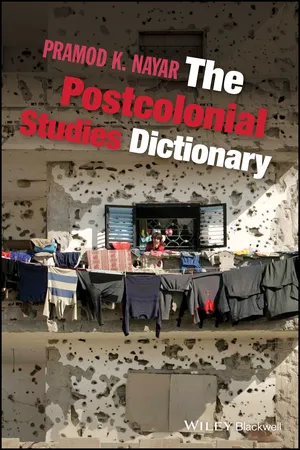
The Postcolonial Studies Dictionary
eBook - ePub

The Postcolonial Studies Dictionary

  1. English
  2. ePUB (mobile friendly)
  3. Available on iOS & Android
eBook - ePub

The Postcolonial Studies Dictionary

About this book

This new Dictionary features a thoughtfully collated collection of over 150 jargon-free definitions of key terms and concepts in postcolonial theory.

  • Features a brief introduction to postcolonial theory and a list of suggested further reading that includes the texts in which many of these terms originated
  • Each entry includes the origins of the term, where traceable; a detailed explanation of its perceived meaning; and examples of the term's use in literary-cultural texts
  • Incorporates terms and concepts from multiple disciplines, including anthropology, literary studies, science, economics, globalization studies, politics, and philosophy
  • Provides an ideal companion text to the forthcoming Postcolonial Studies: An Anthology, which is also edited by Pramod K. Nayar, a highly-respected authority in the field

Trusted by 375,005 students

Access to over 1 million titles for a fair monthly price.

Study more efficiently using our study tools.

Information

Publisher
Wiley
Year
2015
Print ISBN
9781118781043
9781118781050
Edition
1
eBook ISBN
9781118781036

References

  1. Abu-Lughod, J. Before European Hegemony: The World System, AD 1250–1350. New York: Oxford University Press, 1989.
  2. Achebe, C. Arrow of God. New York: John Day, 1967.
  3. Adas, M. Machines and the Measure of Man: Science, Technology and Ideologies of Western Dominance. Delhi: Oxford University Press, 1990.
  4. Adesokan, A. Postcolonial Artists and Global Aesthetics. Indiana University Press, 2011.
  5. Agarwal, B. ‘The Gender and Environment Debate: Lessons from India’, Feminist Studies 18.1 (1992).
  6. Ahmad, A. ‘Jameson’s Rhetoric of Otherness and the “National Allegory”’, Social Text 17 (1987): 3–25.
  7. Ahmad, A. In Theory: Classes, Nations, Literature. New York: Verso, 1992.
  8. Ahmad, A. ‘The Politics of Literary Postcoloniality’. In P. Mongia (ed.), Contemporary Postcolonial Theory: A Reader. Delhi: Oxford University Press, 1997, pp. 276–293.
  9. Ali, A.S. ‘Postcard from Kashmir’. In J. Thieme (ed.), The Arnold Anthology of Post-colonial Literatures in English. London: Arnold, 1996, pp. 752.
  10. Ali, M. Brick Lane. 2001. London: Doubleday, 2003.
  11. Allender, T. ‘Surrendering a Colonial Domain: Educating North India, 1854–1890’, History of Education 36.1 (2007): 45–63.
  12. Amin, S. ‘Gandhi as Mahatma: Gorakhpur District, Eastern University Press, 1921–2’, Subaltern Studies III. Delhi: Oxford University Press, 1984.
  13. Anderson, A. The Powers of Distance: Cosmopolitanism and the Cultivation of Detachment. Princeton, NJ: Princeton University Press, 2001.
  14. Anderson, B. Imagined Communities: Reflections on the Origins and Spread of Nationalism. London and New York: Verso, 1991. Rev. ed.
  15. Andrews, M. ‘The Metropolitan Picturesque’. In Stephen Copley and Peter Garside (eds), The Politics of the Picturesque: Literature, Landscape and Aesthetics since 1770. Cambridge: Cambridge University Press, 1994, pp. 282–298.
  16. Anzaldúa, G. Borderlands/La Frontera: The New Mestiza. 1987. San Francisco: Spinsters/Aunt Lute, 1994.
  17. Appadurai, A. Modernity at Large: Cultural Dimensions of Globalization. Minneapolis and London: University of Minnesota Press, 1996.
  18. Appiah, K.A. In My Father’s House: Africa in the Philosophy of Culture. London: Methuen, 1992.
  19. Appiah, K.A. Cosmopolitanism: Ethics in a World of Strangers. London: Penguin, 2006.
  20. Arata, S.D. ‘The Occidental Tourist: Dracula and the Anxiety of Reverse Colonization’, Victorian Studies 33.4 (1990): 621–645.
  21. Aravamudan, S. ‘Fiction/Translation/Transnation: The Secret History of the Eighteenth-century Novel’. In P.R. Backscheider and C. Ingrassia (eds), A Companion to the Eighteenth-Century English Novel and Culture. Malden: Blackwell, 2005, pp. 48–74.
  22. Arnold, D. Colonizing the Body: State Medicine and Epidemic Disease in Nineteenth-century India. Berkeley and London: University of California Press, 1993.
  23. Arnold, D. The Tropics and the Travelling Gaze: India, Landscape, and Science 1800–1856. New Delhi: Permanent Black, 2005.
  24. Asad, T. (ed.), Anthropology and the Colonial Encounter. London and Ithaca, NY: Cornell University Press, 1973.
  25. Ashcroft, B., Griffiths, G. and Tiffin, H. The Empire Writes Back: Theory and Practice in Post-colonial Literatures. London and New York: Routledge, 1989.
  26. Atwood, M. and Pachter, C. The Journals of Susanna Moodie. 1970. Boston and New York: Houghton Mifflin, 1990.
  27. Bacon, F. The New Atlantis. In The Works of Francis Bacon. Ed. J Spedding, R.L. Ellis, D.D. Heath. Vol. V. Boston. Brown and Taggard, 1862, pp. 347–414.
  28. Ballhatchet, K. Race, Sex and Class under the Raj Imperial Attitudes and Policies and their Critics 1703–1905. London: Weidenfeld and Nicolson, 1980.
  29. Banerjee, S. Becoming Imperial Citizens: Indians in the Late-Victorian Empire. Durham and London: Duke University Press, 2010.
  30. Bank, A. ‘Of “Native Skulls” and “Noble Caucasians”: Phrenology in Colonial South Africa’, Journal of Southern African Studies 22.3 (1996): 387–403.
  31. Barad, K. Meeting the Universe Halfway: Quantum Physics and the Entanglements of Matter and Meaning. Durham and London: Duke University Press, 2007.
  32. Barbour, R. Before Orientalism: London’s Theatre of the East 1576–1626. Cambridge: Cambridge University Press, 2003.
  33. Barker, F, Hulme, P. and Iverson, M. (eds). Cannibalism and the Colonial World. New York: Cambridge University Press, 1998.
  34. Barringer, T.J. (ed.), Colonialism and the Object: Empire, Material Culture and the Museum. London and New York: Routledge, 1998.
  35. Bayly, C.A. Empire and Information: Intelligence Gathering and Social Communication in India, 1780–1870. Cambridge: Cambridge University Press, 1999.
  36. Behdad, A. ‘Nation and Immigration’, Portal Journal of Multidisciplinary International Studies 2.2 (2005): 1–16.
  37. Behdad, A. ‘On Globalization, Again!’ In A. Loomba et al. (eds), Postcolonial Studies and Beyond. Ranikhet: Permanent Black, 2008, pp. 62–79.
  38. Beverley, J. ‘“Through All Things Modern”: Second Thoughts on Testimonio’, boundary 2 18.2 (1991): 1–21.
  39. Beverley, J. ‘The Margin at the Center: On Testimonio (Testimonial Narrative)’. In S. Smith and J. Watson (eds), De/Colonizing the Subject: The Politics of Gender in Women’s Autobiography, Minneapolis: University of Minnesota Press, 1992, pp. 91–114.
  40. Bewell, A. Romanticism and Colonial Disease. Baltimore, Maryland: Johns H...

Table of contents

  1. Cover
  2. Title page
  3. Table of Contents
  4. Terms
  5. Acknowledgements
  6. Preface
  7. A
  8. B
  9. C
  10. D
  11. E
  12. F
  13. G
  14. H
  15. I
  16. K
  17. L
  18. M
  19. N
  20. O
  21. P
  22. R
  23. S
  24. T
  25. U
  26. V
  27. W
  28. References
  29. End User License Agreement

Frequently asked questions

Yes, you can cancel anytime from the Subscription tab in your account settings on the Perlego website. Your subscription will stay active until the end of your current billing period. Learn how to cancel your subscription
No, books cannot be downloaded as external files, such as PDFs, for use outside of Perlego. However, you can download books within the Perlego app for offline reading on mobile or tablet. Learn how to download books offline
Perlego offers two plans: Essential and Complete
  • Essential is ideal for learners and professionals who enjoy exploring a wide range of subjects. Access the Essential Library with 800,000+ trusted titles and best-sellers across business, personal growth, and the humanities. Includes unlimited reading time and Standard Read Aloud voice.
  • Complete: Perfect for advanced learners and researchers needing full, unrestricted access. Unlock 1.4M+ books across hundreds of subjects, including academic and specialized titles. The Complete Plan also includes advanced features like Premium Read Aloud and Research Assistant.
Both plans are available with monthly, semester, or annual billing cycles.
We are an online textbook subscription service, where you can get access to an entire online library for less than the price of a single book per month. With over 1 million books across 990+ topics, we’ve got you covered! Learn about our mission
Look out for the read-aloud symbol on your next book to see if you can listen to it. The read-aloud tool reads text aloud for you, highlighting the text as it is being read. You can pause it, speed it up and slow it down. Learn more about Read Aloud
Yes! You can use the Perlego app on both iOS and Android devices to read anytime, anywhere — even offline. Perfect for commutes or when you’re on the go.
Please note we cannot support devices running on iOS 13 and Android 7 or earlier. Learn more about using the app
Yes, you can access The Postcolonial Studies Dictionary by Pramod K. Nayar in PDF and/or ePUB format, as well as other popular books in Literature & Literary Criticism Theory. We have over one million books available in our catalogue for you to explore.