This book focuses on the emergence of the "science of sustainability" and the key concepts in making sustainability operational in an organization.
The authors discuss the methods, techniques and tools needed to manage the impact of sustainability and how these can be reformulated into business models and solutions for new growth and applications. They then move onto the reformulation of future thinking processes before ending by looking towards an approach for the measurement of sustainability and competitiveness.
PART 1 Sustainability: Toward the Unification of Some Underlying Principles and Mechanisms
Self-organization and unification of the principles Unification is crystallization: bi-terminated Herkimer diamond (Mineralogy – ParisTech)
1 Toward a Sustainability Science
The concepts of sustainability have experienced much success for several decades and they are quoted in many projects and programs conducted by public institutions, corporations and academies worldwide.
1.1. Introduction
Now, we can discuss the emergence of a “science of sustainability”. A science of sustainability requires the involvement of many people geographically spread all around the world in many collaboration fields to bridge the existing gap between theory, practice and policy. For the same reasons, this science needs for skills coming from various disciplines such as social, biological, life, physical, theoretical and applied sciences to answer a lot of fundamental questions.
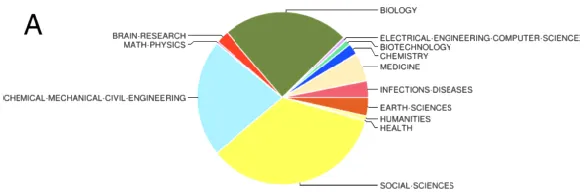
Here, it is interesting to show the graph issued by E. Bettencourt et al. [BET 11], which gives a highlight of the sources of proceedings related to sustainability science.
Figure 1.1.Developments and literature in sustainability sciences [BET 11]
In Figure 1.1, we can see that the largest contributions come from the social sciences, from biology and chemical, mechanical and civil engineering, and then medicine, etc.
This pattern conveys the universality of the concerns related to sustainability in so many activity sectors. But, what is most important is knowing whether they are subject to the same underlying mechanisms: this is a key question. Indeed, since many transdisciplinary people and skills are involved in sustainability, this is because the same theories and basic principles could apply everywhere for the same and global goal. This is also because traditional susceptibilities, in each field of application, are unable to fully describe the causes and sources, that is to say the foundations themselves of the sustainability.
What we try to show, in this book, are the basic principles and rules existing behind sustainability, listing some of their properties, in order to better understand their entanglement and to propose a cohesive and consistent view.
It is this kind of conceptual and technical unification that we have tried to develop.
1.2. What does unification mean?
Sustainability is the result of an emergence: it is suitable for any system or ecosystem resulting from the combination of many factors and fundamental concepts. It is a representation of the world, according to Aristotle. It applies to all the mechanisms and ultimate constituents of nature, whatever the level of complexification (microlevel subject to quantum physics, up to meso- and macrolevel of assembly).
In terms of processes, the system is characterized by the implementation of organized agents into an interconnected structure, which individually perform functions on, or interactions with, other agents, according to a given mode, in order to accomplish a given objective. The intrinsic activities of such multi-agents system and their external activities, as well, enable the transformation, production or manufacturing of some resources and raw materials: they form what we call a process and are governed by a set of rules, forces and procedures, etc.
Regarding forces, in nature, we refer to the four fundamental forces to explain all the well-known types of interactions:
– the first (discovered by Newton in the 17th Century) is the force of gravity, which is the cause of gravity;
– the second, because it ensures the cohesion of atoms making up the molecules of our bodies, and everything around us, is the electromagnetic force (achieved by Maxwell in the 19th Century, the unification of electricity and magnetism);
– finally, the two nuclear forces: the weak force (responsible for radioactivity and cohesion of an atom) and strong (which binds together the elementary particles: protons and neutrons in the nucleus of atoms, associated with the considerable energy that is released during nuclear reactions).
The “theory of everything” means a physical theory capable of describing, in a coherent and unified way, all the fundamental interactions we may have in the physical system. The unification of the theories is both a synthesis, an aggregation and a simplification of many concepts which require a lot of inductive and abductive reasoning. Again, why engage many factors, mechanisms and theories, apparently independent from each other and heterogeneous, as being from different fields and theories?
Since the first moments of the universe, these factors were not perhaps precisely so diverse and of different nature as understood. We have to keep in mind that the very structure of the universe comprises small agents subject to quantum physics. Also, the upper assembly of these agents is based on fractal growths, thus quite consistent and harmonious properties will emerge. It is the same with all the concepts and designs that have emerged from the mind and conscience of human beings.
As mentioned before, everything emerges from basic and common information. Then, at some specific scale levels and at a particular time, the flow of material, energy, data, resources and products, as well as the nature and intensity of interactions, become indistinguishable as they behave in similar ways. Moreover, despite some cyclic phenomena (knowing that many scientists assure that the climate is now changing and that warming over past century is primarily due to human-induced emissions of heat-trapping gases), we are faced with a global expansion and cooling of the universe, that is to say, its slowing-down process. Which leads to a progressive stabilization and to the decoupling of some elements, by distinguishing cosmological from individual forces, and makes the elements appear with different and specific properties. Similarly, the Earth’s mass and volume is evolving. Therefore, some gravitational, local, or geophysical constants that appear will vary overtime. Under these conditions, even global sustainability is a dynamic concept subject to relativity.
In practical terms, to summarize a piece of the unification path, we may address part of the story in physics. It is a step-by-step process. Within this context, the electromagnetic force and weak nuclear force were consolidated into the so-called electroweak force (the 1979 Nobel Prize in Physics was awarded jointly to Sheldon Lee Glashow, Abdus Salam and Steven Weinberg for “their contributions to the theory of the unified weak and electromagnetic interaction between elementary particles, including, inter alia, the prediction of the weak neutral current”). The integration of the weak and strong nuclear forces went later, but was not, at that time, confirmed by strong evidence. Similarly, sustainability can be associated with “anticipation”.
In this book, the purpose of unification is to get a consistent and simplified view of reality. It is, therefore, intended to replace several complementary representation models, with one more global model. This helps us to identify properties that would be impossible to emerge and describe from a single model, with a partial view of the system. This is what we do in economics or industry when replacing the representation of a production system, usually performed with discrete event modeling, with a more comprehensive model incorporating the nonlinear dynamics specific to the system considered.
We know that the grand unification objective is to embrace both the framework for nuclear and electromagnetic forces (special relativity with quantum physics) and the gravity (general relativity). It is still very speculative, but it makes sense to try having a single representation of the reality rather than constantly referring to several theories.
1.3. Coming back to sustainability: how many “sustainabilities”?
Since we are discussing unification, is it the same approach we have to implement for sustainability? Undoubtedly, the fact of unifying theories and integrating sets of agents, or things involved in a system, improves its consistency, so its sustainability. This systemic approach, however, is not always naturally embraced by the proponents of sustainability: thus, it follows some deviances. This is why, when some responsible people are talking about sustainability, it is advisable to determine if we are considering a kind of either “wrong sustainability”, “convenient sustainability” or “good sustainability”.
To illustrate this, we will describe how the problem of sustainability is addressed by many officials. In the following, we can see a general graph showing the three spheres of “sustainability”. This pedagogical graph is agreed on by most: it focuses on activity sectors on which we have to act. Now, what can we observe?
1) The “wrong sustainability”. For ideological or ecological reasons, it is common to address sustainability in terms of the environment, as a priority. Progresses, in this area, should be implemented, according to them, to the detriment of economic imperatives and financial constraints. Likewise, they ignore some major societal needs: of course, we take into account safety and resources security needs or those related to the health. But, we forget to think about what is happening on other continents: a billion people are starving. How do we provide food and jobs to 9 billion people and give them access to a little comfort as in developed countries?
2) The “convenient sustainability”. Here, in this context, we broaden the concerns of the teno...
Table of contents
Cover
Table of Contents
Title
Copyright
Note to all Contributors
Note to the Reader
List of Acronyms
Introduction
PART 1: Sustainability: Toward the Unification of Some Underlying Principles and Mechanisms
PART 2: Operationalization: Methods, Techniques and Tools – the Need to Manage the Impact
PART 3: Reformulating the Above Into Business Models and Solutions for New Growth and Applications
PART 4: Reformulating Future Thinking: Processes and Applications
PART 5: Towards an Approach to the Measurement of Sustainability and Competitivity
General Conclusion – Where Are We Now?
Bibliography
Index
End User License Agreement
Trusted by 375,005 students
Access to over 1.5 million titles for a fair monthly price.
Study more efficiently using our study tools.
Frequently asked questions
Yes, you can cancel anytime from the Subscription tab in your account settings on the Perlego website. Your subscription will stay active until the end of your current billing period. Learn how to cancel your subscription
No, books cannot be downloaded as external files, such as PDFs, for use outside of Perlego. However, you can download books within the Perlego app for offline reading on mobile or tablet. Learn how to download books offline
Perlego offers two plans: Essential and Complete
Essential is ideal for learners and professionals who enjoy exploring a wide range of subjects. Access the Essential Library with 800,000+ trusted titles and best-sellers across business, personal growth, and the humanities. Includes unlimited reading time and Standard Read Aloud voice.
Complete: Perfect for advanced learners and researchers needing full, unrestricted access. Unlock 1.5M+ books across hundreds of subjects, including academic and specialized titles. The Complete Plan also includes advanced features like Premium Read Aloud and Research Assistant.
Both plans are available with monthly, semester, or annual billing cycles.
We are an online textbook subscription service, where you can get access to an entire online library for less than the price of a single book per month. With over 1.5 million books across 990+ topics, we’ve got you covered! Learn about our mission
Look out for the read-aloud symbol on your next book to see if you can listen to it. The read-aloud tool reads text aloud for you, highlighting the text as it is being read. You can pause it, speed it up and slow it down. Learn more about Read Aloud
Yes! You can use the Perlego app on both iOS and Android devices to read anytime, anywhere — even offline. Perfect for commutes or when you’re on the go. Please note we cannot support devices running on iOS 13 and Android 7 or earlier. Learn more about using the app
Yes, you can access Operationalizing Sustainability by Pierre Massotte,Patrick Corsi in PDF and/or ePUB format, as well as other popular books in Business & Business General. We have over 1.5 million books available in our catalogue for you to explore.